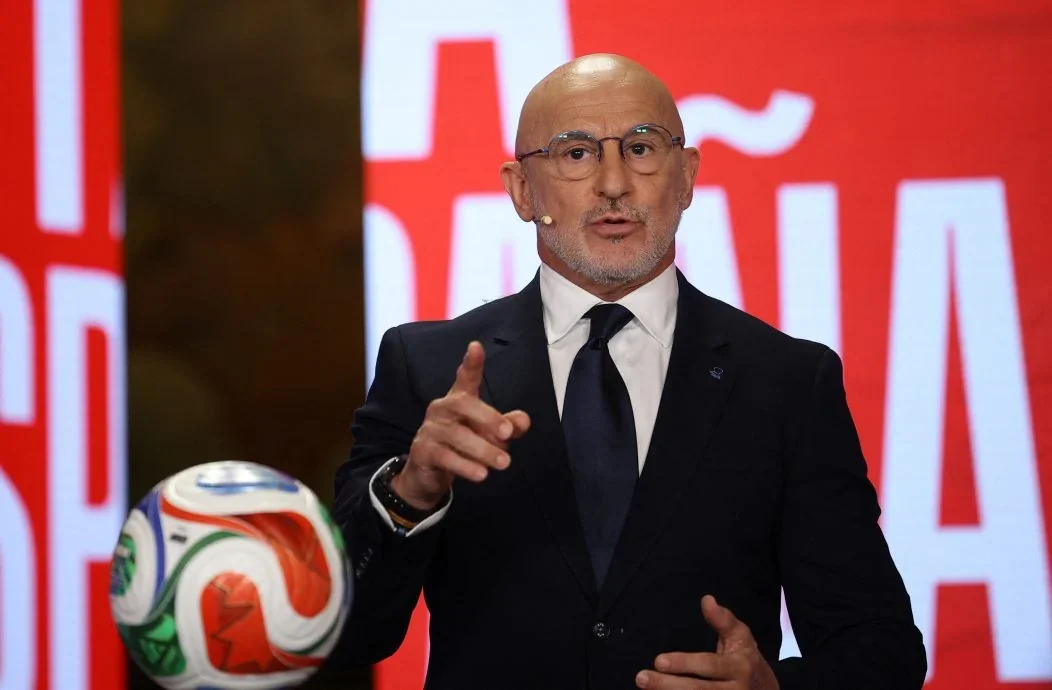
Spain World Cup Squad 2026: Roster, Fixtures, Stars
·
Who is in Spain World Cup Squad 2026?
Quick answer: Spain World Cup Squad 2026 is Luis de la Fuente's roster hub, covering the full squad, Group H fixtures, key players and likely roles. Spain face Cape Verde, Saudi Arabia and Uruguay, with Lamine Yamal, Rodri, Pedri and Gavi shaping the tournament plan.
Spain arrive at the 2026 FIFA World Cup carrying weight that very few teams are asked to carry. Luis de la Fuente's side are defending their UEFA Euro 2024 title — a 2-1 win over England in Berlin — and doing so with one of the youngest and most technically coherent squads in the tournament. The spain world cup squad announced on 25 May 2026 contains eight Barcelona players, and none from Real Madrid. That last detail writes its own chapter of Spanish football history. In announcing this group, De la Fuente has confirmed that his Spain is built on a particular footballing philosophy — one rooted in positional play, collective pressing and the belief that system coherence wins tournaments more reliably than individual star power. What follows is a close analysis of every key dimension of this squad: the positional groups, the tactical core, the notable absences, the group draw and the historical context that makes this Spain world cup squad one of the most discussed selections at the 2026 tournament.
What does the Spain world cup squad 2026 look like?
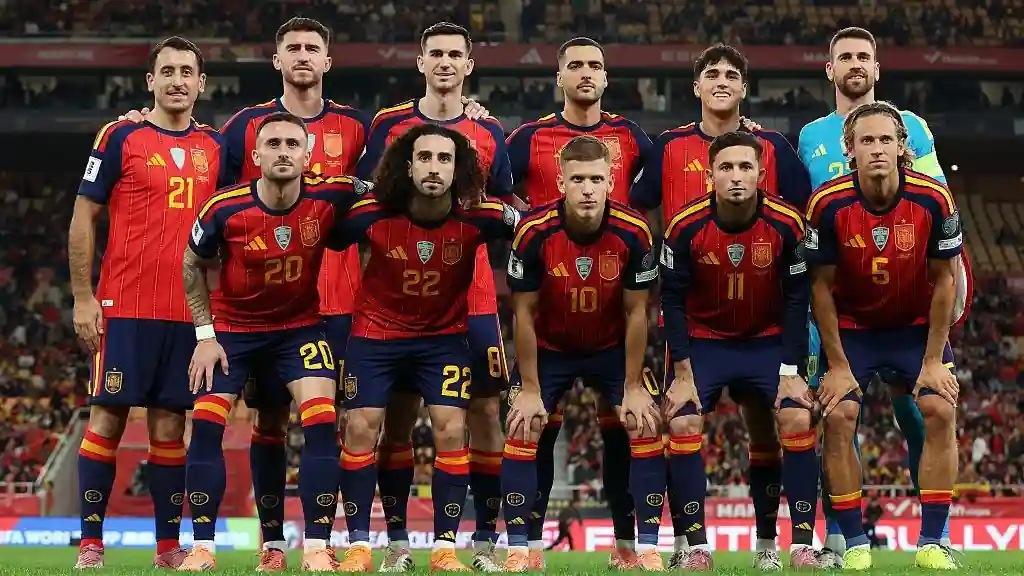
De la Fuente's confirmed 26-man Spain world cup squad breaks down into three goalkeepers, eight defenders, seven midfielders and eight forwards.
| # | Player | Club |
|---|---|---|
| Goalkeepers | ||
| GK | Unai Simón | Athletic Club |
| GK | David Raya | Arsenal |
| GK | Joan García | FC Barcelona |
| Defenders | ||
| CB | Pau Cubarsí | FC Barcelona |
| CB | Aymeric Laporte | Al-Nassr |
| CB | Eric García | FC Barcelona |
| RB | Pedro Porro | Tottenham Hotspur |
| RB | Marc Pubill | UD Almería |
| RB | Marcos Llorente | Atlético de Madrid |
| LB | Marc Cucurella | Chelsea |
| LB | Alejandro Grimaldo | Bayer 04 Leverkusen |
| Midfielders | ||
| DM | Rodri | Manchester City |
| DM | Martín Zubimendi | Arsenal |
| CM | Pedri | FC Barcelona |
| CM | Gavi | FC Barcelona |
| CM | Fabián Ruiz | PSG |
| CM | Mikel Merino | Arsenal |
| AM | Álex Baena | Atlético de Madrid |
| Forwards | ||
| RW | Lamine Yamal | FC Barcelona |
| RW | Yéremy Pino | Villarreal CF |
| LW | Nico Williams | Athletic Club |
| LW | Ferran Torres | FC Barcelona |
| CF | Mikel Oyarzabal | Real Sociedad |
| CF | Dani Olmo | FC Barcelona |
| CF | Borja Iglesias | Real Betis |
| CF | Víctor Muñoz | Girona FC |
Which Spain national football team players form De la Fuente's core?
The spine of this Spain squad is not difficult to identify. Unai Simón remains the first-choice goalkeeper, valued for his composure, his communication and his experience of high-pressure moments. In central defence, Pau Cubarsí and Aymeric Laporte represent the most credible pairing: Laporte brings positional experience and aerial dominance, while Cubarsí's reading of the game — extraordinary given he is still a teenager — provides a platform that the team builds from rather than merely protects. In midfield, Rodri is the foundation on which everything else is constructed. The Manchester City midfielder won the Ballon d'Or in 2024 and remains the most influential defensive midfielder in world football when fit.
Why is Rodri's return the most significant selection in the Spain squad?
Rodri missed much of Manchester City's 2024-25 season recovering from a serious knee injury. His return to the Spain national football team for the World Cup matters more than almost any other selection decision in this squad because of what he does that no one else in the group can replicate in the same way. He provides structural security, allowing Pedri and Gavi to function in their best positions with less defensive responsibility. He wins the ball, distributes with precision under pressure and gives Spain a controlling tempo that can suffocate opponents before the attack even engages. Without him, Spain must work harder to maintain their shape when possession is lost. With him, their press has a safety net that transforms tactical risk into controlled aggression. De la Fuente has confirmed publicly that Rodri is fit and available from the first group match.
What makes Lamine Yamal the face of the Spain squad for world cup 2026?
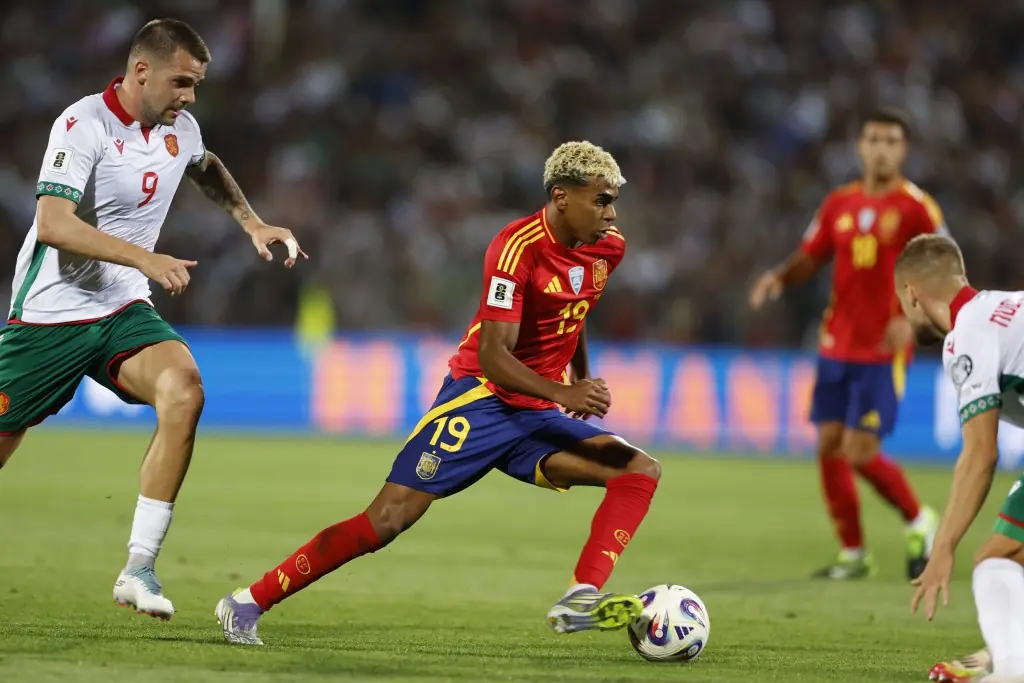
Lamine Yamal turned 18 on the day of the UEFA Euro 2024 final and scored one of the tournament's defining goals against France in the semi-final — a curling left-foot strike from outside the area that levelled the match and set up Spain's passage to the final. He arrives at World Cup 2026 as Barcelona's first-choice wide forward, having already played more than 100 first-team matches for the club. His ability to receive under pressure, carry at pace over short and long distances, and produce in decisive moments has been tested at the highest level across multiple tournaments. De la Fuente has acknowledged a hamstring concern but stated that Yamal is expected to be available from the opening group match against Cape Verde. When Yamal is at his best, Spain's attack becomes significantly harder to organise against — not just because of his direct output, but because the defensive attention he demands opens space for Pedri, Nico Williams and Dani Olmo around him.
Why are there no Real Madrid players in the Spain squad for world cup 2026?
The absence of Real Madrid players from this Spain squad is the most-discussed selection story of the announcement. It is the first time since 1950 that Spain have gone to a World Cup without a single player from the club. The immediate causes are injury and form. Dean Huijsen, the central defender who had been widely expected to make the group, was excluded after failing to overcome a physical problem. Dani Carvajal, a senior figure in multiple Spain squads and a Champions League winner with Real Madrid, was also left out after an injury-affected domestic season that limited his appearances and his form.
The deeper context is a shift in where Spanish talent is being developed and where it is performing. Barcelona's academy has produced Cubarsí, García and Pedri. Arsenal's recruitment — Zubimendi, Merino, Raya — has concentrated Spanish midfield and goalkeeping depth at the Emirates. Athletic Club's commitment to the Basque-only policy has delivered Simón and Nico Williams. Real Madrid, by contrast, have built their current squad around non-Spanish talent: Vinícius Júnior, Rodrygo, Endrick, Kylian Mbappé and Jude Bellingham are the marquee names. The Spanish players at the club — including those at the fringes — have simply not performed at the level required to displace the alternatives De la Fuente has available. This is not a crisis for Spanish football. It is a sign that the talent base has genuinely spread and deepened across clubs and leagues.
What are Spain's Group H fixtures and where do they play?
Spain's three group-stage matches are scheduled at two venues across the United States and Mexico.
Spain are the clear favourites to top Group H. The knockout-round seeding implications of that result will matter in later rounds.
How does the Barcelona-heavy selection define Spain's playing style?
Eight Barcelona players is the highest club representation from any single team in this Spain squad, and the number is not a coincidence. De la Fuente's system is built around the same principles that Barcelona have refined for decades: positional occupation, short combinations under pressure, structured press triggers and ball recovery through organised shape rather than individual sprint. When Pedri, Gavi, Dani Olmo, Ferran Torres, Lamine Yamal and Pau Cubarsí form the core of the team, the tactical identity does not need to be laboriously installed during training sessions. It is already resident in these players from thousands of competitive minutes together at club level.
The practical tournament impact is faster coherence. Spain do not require extended pre-tournament blocks to learn how their most influential players should interact under pressure. Pedri and Gavi have played in the same system since youth level. Yamal and Olmo have connected in decisive Barcelona moments. That familiarity reduces the coordination cost that most international squads face when they compress months of tactical preparation into two weeks of pre-tournament training. Whether it creates predictability — a vulnerability that organised opponents running compact low blocks could exploit — is the more interesting strategic question. In Euro 2024, Spain answered that challenge through individual brilliance at key moments: Yamal's semi-final equaliser, Oyarzabal's winning touch in the final. The system created the opportunities. Individual quality converted them. That balance remains the clearest description of how Spain play and what makes them difficult to prepare for.
Can Spain win the 2026 World Cup as reigning European champions?
The case for Spain winning this tournament is specific and credible. They arrive with a clear tactical identity that has already won a major tournament, a fully fit Rodri — the best defensive midfielder in the world — a generational talent in Yamal, one of the deepest midfields of any squad at the 2026 World Cup, and a head coach who has managed this group through a full competitive cycle. The squad has been built with positional depth across every line: three goalkeepers with distinct profiles, eight defenders covering multiple formations, seven midfielders who can each anchor or progress depending on the game state, and eight forwards offering variety across width, movement and finishing profiles.
The risks are also real. Yamal and Nico Williams both arrive nursing hamstring concerns, and a serious injury to either — particularly Yamal — would affect Spain's attacking identity significantly. Rodri's recent injury history means his fitness will be monitored throughout the tournament. Winning a World Cup requires seven matches of sustained excellence, which places demands on squad depth that a group-stage run does not fully test. The question of whether Borja Iglesias, Víctor Muñoz or Yéremy Pino can influence a tight knockout match is still open.
What the spain squad for world cup 2026 analysis ultimately shows is a team in a specific kind of golden moment. Yamal is young enough to be at his physical peak while already being experienced at the highest level. Rodri and Pedri are at the height of their technical maturity. Gavi has returned from a long injury absence with renewed form. The window for this group to achieve something historically significant — winning consecutive Euro and World Cup titles — is now, not in four years. That compressed opportunity is the most compelling reason to take Spain's World Cup chances seriously. The spain national football team arrives in North America not as a sentimental favourite but as one of the three or four squads that a neutral analyst would place at the top of any objective ranking.
What questions does De la Fuente still need to answer before the tournament?
Three questions remain genuinely open. First, how quickly can Yamal and Williams reach full fitness after their respective hamstring issues? The pace of that recovery affects not just the opening match against Cape Verde but the physical condition Spain carry into the knockout rounds. Second, what is the right balance between Gavi and a deeper alternative in the midfield when Spain face a high-pressing opponent? Gavi's technical quality is clear, but his positional discipline in transition has sometimes created exposure. Third, who fills the right-back role with Pedro Porro and Marc Pubill competing for the same position? That decision shapes Spain's width on the right side and, by extension, how Yamal receives ball in advanced areas. None of these are crises. But they are the details that tournaments turn on.
For the complete fixture list, group tables and live scores throughout the tournament, see the full 2026 World Cup schedule, all 12 group stage draws and the World Cup 2026 results. For why this squad became champion, continue with the Spain vs Argentina final report and the World Cup 2026 awards list.
FAQ
Who is in the Spain world cup squad 2026?
Luis de la Fuente's 26-man Spain squad included Unai Simón, David Raya, Pau Cubarsí, Aymeric Laporte, Pedri, Gavi, Rodri, Mikel Merino, Dani Olmo, Nico Williams, Ferran Torres and Lamine Yamal.
Did Spain's World Cup 2026 squad win the tournament?
Yes. Spain won World Cup 2026 by beating Argentina 1-0 in the final. The title run confirmed that De la Fuente's group was not just talented; it was built to control knockout football.
Which Spain squad players won FIFA awards?
Rodri won the Golden Ball, Unai Simón won the Golden Glove and Pau Cubarsí won Best Young Player. That awards sweep tells the story of Spain's tournament spine: control, clean defending and calm goalkeeping.
How important was the Barcelona core to Spain's title?
The Barcelona-heavy core gave Spain shared habits under pressure. Cubarsí, Pedri, Gavi, Dani Olmo, Ferran Torres and Lamine Yamal helped the national team look more connected than a normal short-camp tournament squad.
Why were there no Real Madrid players in Spain's squad?
Spain went without a Real Madrid player because De la Fuente found stronger available fits elsewhere, while injury and form weakened the cases for Madrid-linked Spanish candidates. It became a talking point, not a tournament weakness.
How many knockout goals did Spain concede?
Spain conceded only one goal across four knockout matches: Portugal 0, Belgium 1, France 0 and Argentina 0. That defensive record explains why Unai Simón and Pau Cubarsí were central to the awards conversation.