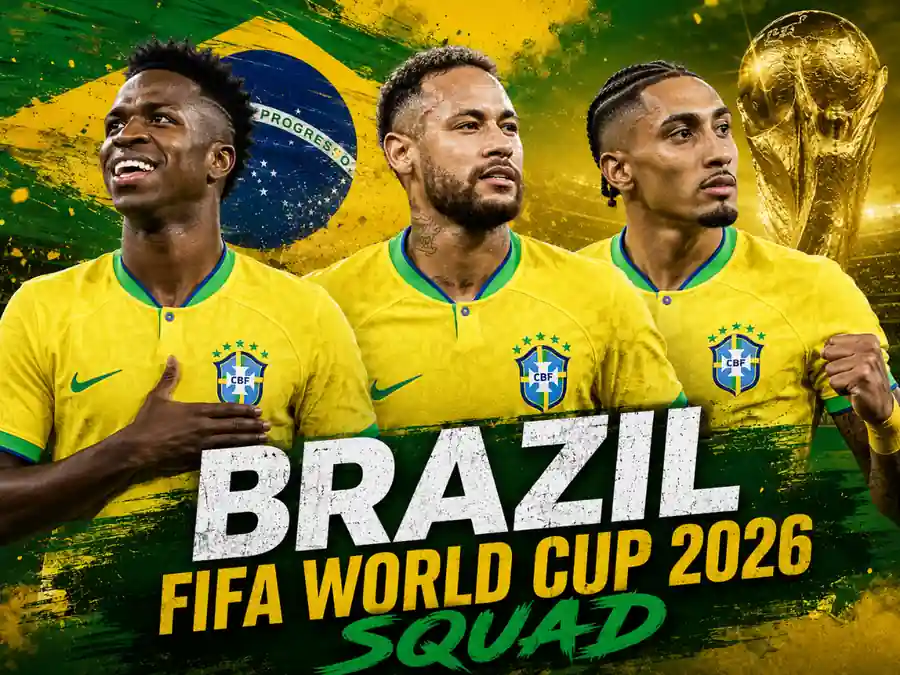
Brazil World Cup Squad 2026
·
Brazil World Cup 2026 squad: Carlo Ancelotti named a 26-man squad on May 18, 2026. Brazil are in Group C facing Morocco (June 13), Haiti (June 19) and Scotland (June 24). Key players include Vinícius Júnior, Raphinha, Neymar, Endrick and Igor Thiago.
Carlo Ancelotti names Brazil's final 26 for the USA, Canada and Mexico tournament — with Neymar's surprise inclusion headlining the announcement
Brazil confirmed their official 26-man squad for the 2026 FIFA World Cup on May 18, with head coach Carlo Ancelotti making the announcement at the Museum of Tomorrow in Rio de Janeiro. The five-time world champions enter the tournament as one of the tournament favourites, drawing on a generation of attacking talent built around Vinícius Júnior and Raphinha, reinforced by the surprise but headline-grabbing return of Neymar. Brazil are placed in Group C alongside Morocco, Haiti and Scotland, with their opening fixture at MetLife Stadium on June 13 already generating significant global attention. This is the full roster breakdown, key players to watch and everything you need to know about the Brazil national football team's World Cup 2026 campaign.
Brazil's Full 26-Man World Cup Roster
Ancelotti submitted a 55-man preliminary list to FIFA on May 11 before cutting down to the final 26. The squad balances experience and emerging talent across all positions, with goalkeeper Alisson Becker providing the foundation behind a defensive unit led by Marquinhos and Gabriel. Here is the complete Brazil 2026 World Cup squad by position.
| # | Player | Club |
|---|---|---|
| Goalkeepers | ||
| GK | Alisson Becker | Liverpool |
| GK | Ederson | Fenerbahçe |
| GK | Weverton | Grêmio |
| Defenders | ||
| CB | Marquinhos | Paris Saint-Germain |
| CB | Gabriel Magalhães | Arsenal |
| CB | Bremer | Juventus |
| CB | Ibañez | Al-Ahli |
| CB | Léo Pereira | Flamengo |
| RB | Wesley | AS Roma |
| LB | Danilo | Flamengo |
| LB | Alex Sandro | Flamengo |
| LB | Douglas Santos | Zenit |
| Midfielders | ||
| DM | Casemiro | Manchester United |
| DM | Fabinho | Al-Ittihad |
| CM | Bruno Guimarães | Newcastle United |
| CM | Danilo (Botafogo) | Botafogo |
| AM | Lucas Paquetá | Flamengo |
| Forwards | ||
| LW | Vinícius Júnior | Real Madrid |
| RW | Raphinha | FC Barcelona |
| RW | Martinelli | Arsenal |
| RW | Luiz Henrique | Zenit |
| ST | Matheus Cunha | Manchester United |
| ST | Igor Thiago | Brentford |
| ST | Endrick | Real Madrid (loan: Lyon) |
| ST | Rayan | AFC Bournemouth |
| AM/LW | Neymar Jr. | Santos |
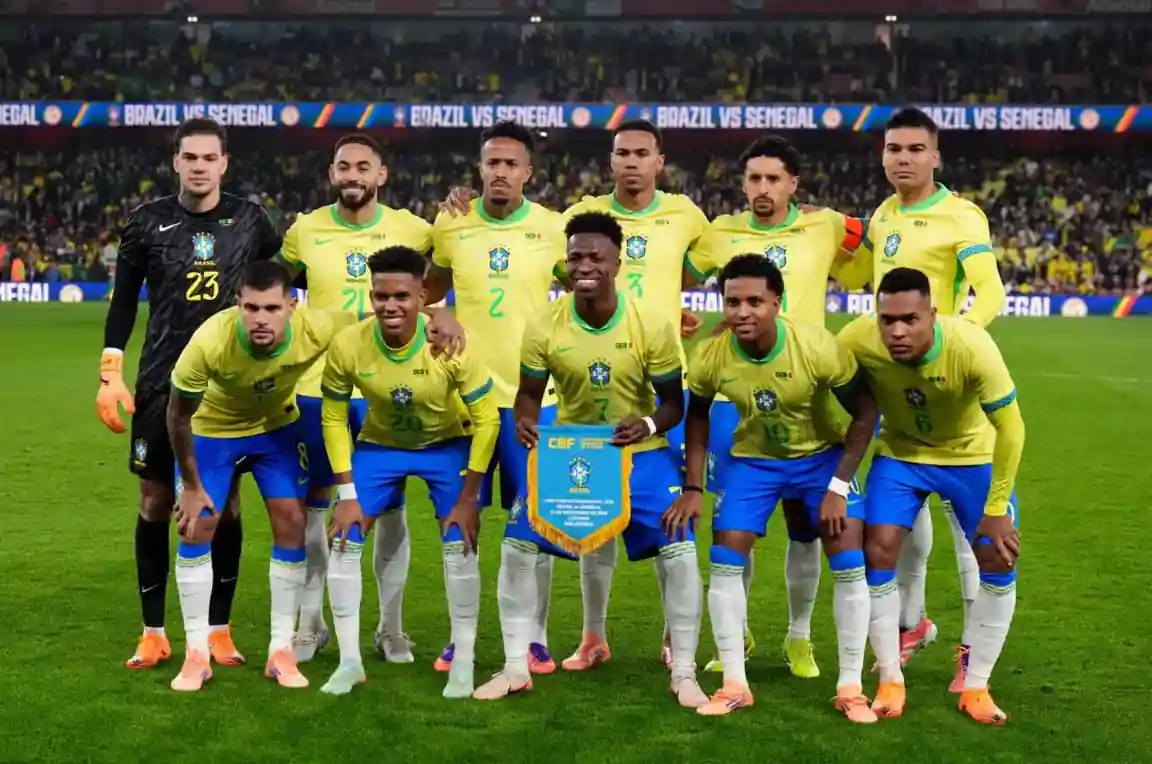
Brazil National Football Team Players to Watch
Brazil's attacking depth is arguably the strongest of any squad at this World Cup. Ancelotti has constructed a side that can hurt teams in multiple ways — from wide areas through Vinícius Júnior's direct pace and Raphinha's technical invention, through the middle via Lucas Paquetá's creativity, and in behind with the movement of Endrick and Igor Thiago. These are the players who will define Brazil's campaign.
Vinícius Júnior — The Tournament's Defining Attacker
Vinícius Júnior enters the 2026 World Cup as one of the best players on the planet. The Real Madrid forward has been at the peak of his powers for two consecutive seasons, combining direct dribbling, goals from wide positions and an improved link-up play that makes him as effective inside the box as he is on the flanks. At international level with Brazil, Vinícius is the player around whom Ancelotti's entire attacking structure is built. His ability to draw defenders and create space for arriving midfielders and secondary forwards is central to how Brazil intend to break down organised defences in North America. The expectation of a major tournament on him is significant, but at 25 years old and at the peak of his physical condition, there is every reason to believe this World Cup could produce a Vinícius performance that defines the whole competition.
Raphinha — Barcelona's Captain Leading Brazil's Right Side
Raphinha has developed into one of the world's most effective wide forwards over the past two seasons at Barcelona. His direct running, clinical finishing and capacity to play the full width of the pitch make him a constant offensive threat from the right, and his combination play with Vinícius on the opposite flank gives Brazil's attack a balance that few other nations can match. Raphinha arrived at this tournament off the back of one of the most productive domestic seasons of his career and enters Group C as Brazil's second most dangerous attacking weapon.
Bruno Guimarães — The Engine of Brazil's Midfield
Bruno Guimarães has emerged as one of the most complete central midfielders in European football at Newcastle United, combining defensive intensity with carrying ability and a range of passing that allows Brazil to control games from the middle. His partnership with Casemiro provides the defensive structure that allows Vinícius and Raphinha to operate freely, while his own driving runs from deep give Brazil an additional threat that opponents must account for. Guimarães is not the name that generates the most headlines in this squad, but he is arguably the player whose influence on the result is felt most when Brazil are at their best.
Endrick — The 19-Year-Old Wild Card
Endrick's inclusion in the final 26 was confirmed after a loan spell at Lyon produced six goals and four assists across 12 appearances — form that made Ancelotti's decision straightforward despite the teenager's limited minutes at Real Madrid. At 19, Endrick brings a quality that is difficult to plan against: the capacity to produce a moment of individual brilliance from limited involvement. His movement inside the box, his composure under pressure and his hunger to score at this level are precisely the profile of a player who thrives in knockout football.
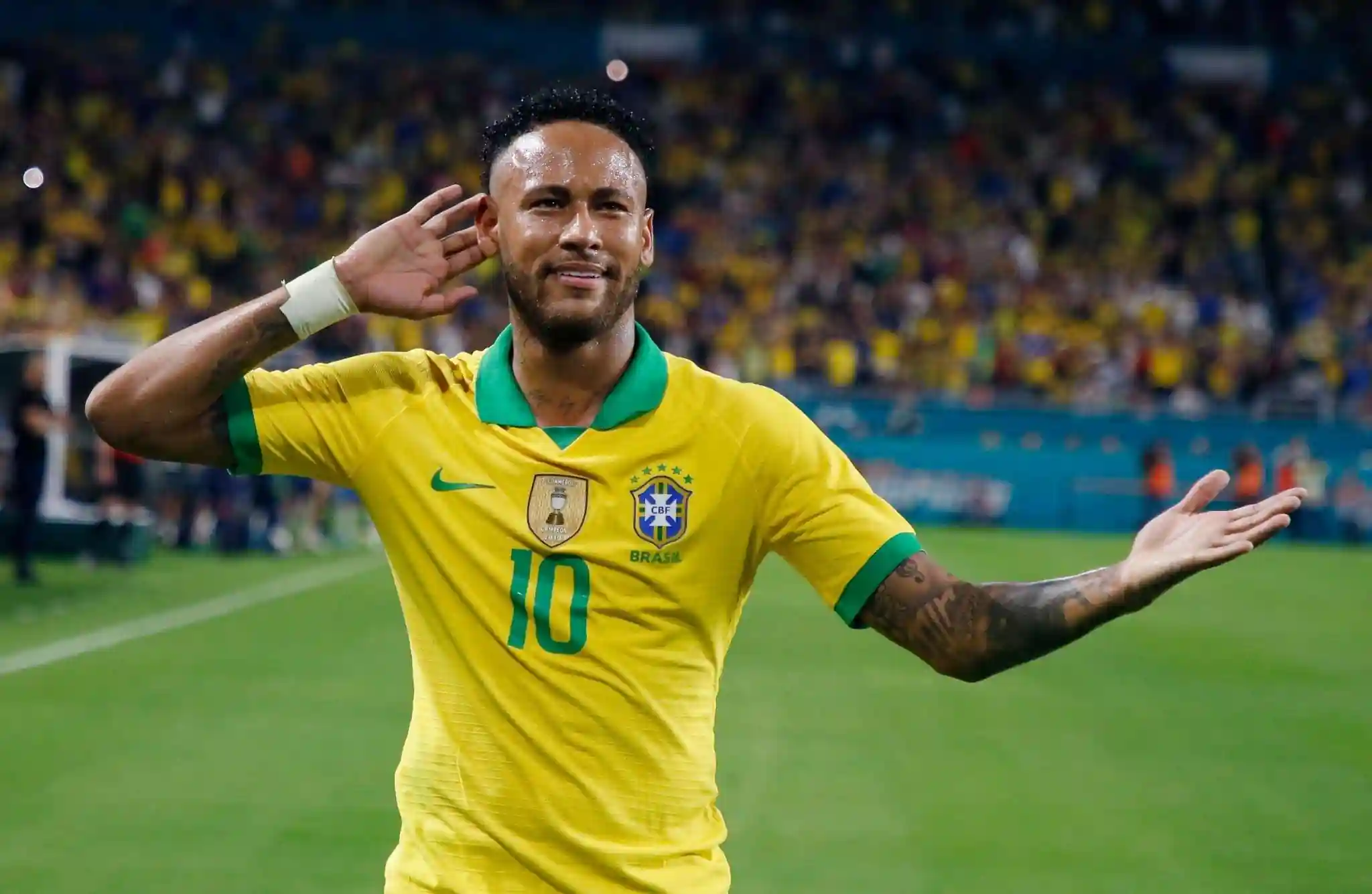
Neymar 2026 World Cup – Selected for Brazil's Final Squad
The biggest story from Brazil's squad announcement was the inclusion of Neymar Jr. Few had expected his name to appear on the final list. Neymar suffered a complete tear of his anterior cruciate ligament and lateral meniscus in October 2023 while representing Saudi Arabia's Al-Hilal — an injury so severe that his career appeared to be over at the highest level. He remained sidelined for the entirety of the 2024-25 club season and returned to Brazil, signing for Santos in a move that was widely seen as the final chapter of his career rather than a springboard back to the world stage.
What changed was his form at Santos. Playing in the Brasileirão under familiar conditions, with the physical pressure of the Saudi Pro League removed, Neymar began to rediscover the qualities that had made him one of the best players of his generation — the close control, the free-kick delivery, the ability to turn a match with a single action. Ancelotti, who has always valued Neymar's technical capacity highly, included him in Brazil's preliminary 55-man list submitted to FIFA on May 11. When the final 26 were confirmed on May 18, Neymar's name was among them.
His role in Ancelotti's squad will not be that of a starter. The Brazil coach has Vinícius Júnior, Raphinha and Martinelli ahead of him in the wide attacking positions, and the primary creative responsibility will fall on players who have been central to the system throughout the qualification campaign. Neymar's value is as an impact player — someone who can change a match in the final third during the 20 or 30 minutes he is involved, bringing a different dimension of creativity that Brazil's other forwards do not provide in quite the same way. At 34, this will almost certainly be his final World Cup. He scored six goals and four assists across 14 appearances at the 2014 and 2018 tournaments combined. If Brazil reach the later rounds, his availability from the bench becomes a significant tactical asset.
The significance of Neymar's presence also extends beyond what he produces on the pitch. He remains Brazil's most recognised player globally, the figure around whom casual World Cup attention in non-traditional football markets tends to focus. His selection adds a media and commercial dimension to Brazil's tournament profile that no other squad member replicates. Whether he plays 10 minutes or 90, Neymar at the 2026 World Cup is a story that will generate attention from the opening day of Group C through to whatever Brazil's final match turns out to be.
Who Is Brazil's Coach?
Carlo Ancelotti was appointed head coach of the Brazil national team in June 2024 following the conclusion of his hugely successful second spell at Real Madrid, where he won a second UEFA Champions League and a second La Liga title. The appointment was regarded as a significant coup for the Brazilian Football Confederation — Ancelotti is one of only two coaches to have won the UEFA Champions League four times, and his man-management skills and tactical adaptability gave Brazil access to a level of coaching experience that few other national teams could claim.
Ancelotti's Brazil have favoured a 4-3-3 system that provides freedom to Vinícius Júnior and Raphinha in wide positions while maintaining a compact, pressure-resistant midfield built around Casemiro's defensive positioning and Bruno Guimarães' carrying ability. The tactical approach is designed to exploit Brazil's attacking talent in transition while controlling games through possession and structure in the defensive phase. Brazil's qualification campaign in CONMEBOL demonstrated that the system is capable of producing results against defensively strong opponents, winning the South American qualifying group with consistent performances across the final eight fixtures.
The notable absentees from Ancelotti's final squad reflect some of the difficult decisions the qualification campaign required. Rodrygo — who had been central to Brazil's attacking plans throughout Ancelotti's tenure — suffered a torn ACL and was ruled out of the tournament entirely, a significant loss in terms of the tactical variety he provided. Estevão, the young Chelsea forward who had been generating enormous excitement as a future centrepiece of the Brazil attack, suffered a serious hamstring injury that removed him from consideration at an early stage. Those losses shifted the squad's balance toward experience and reliability rather than raw emerging talent — a calculation that explains both Neymar's inclusion and the trust placed in established Premier League and European performers.
Brazil's 2026 World Cup Schedule & Match Dates
Brazil are drawn in Group C of the 2026 FIFA World Cup alongside Morocco, Haiti and Scotland. All three group stage matches take place in the United States, with Brazil's journey beginning in New Jersey and ending in Miami. Here are Brazil's confirmed fixtures.
Brazil's group stage draw is widely viewed as one of the more favourable in the tournament. Morocco are the most credible threat — they demonstrated their defensive resilience and knockout football quality at the 2022 World Cup in Qatar, reaching the semi-finals and establishing themselves as Africa's leading national team. The Atlas Lions will provide Brazil's most serious test in the group and a useful early measure of how Ancelotti's side handles a team that defends in a low and compact block.
Haiti represent Brazil's most straightforward fixture on paper, though the conditions of a World Cup group stage — where every team is motivated and every result carries major implications for progression — mean that no match can be treated as certain. Brazil's superior squad depth and technical quality should tell across the 90 minutes at Lincoln Financial Field, but Ancelotti's team selection and rotation choices for that fixture will be significant given the demands of the schedule.
Scotland qualified for their first World Cup since 1998 and arrive in North America with a squad that has shown genuine competitive quality in European football. Their organisation under a compact defensive shape and the directness of their forward play present a physical challenge that Brazil will need to manage. The Hard Rock Stadium fixture on June 24 could determine the Group C table positions heading into the knockout round of 16, making the final group game a more meaningful occasion than Brazil's status as heavy favourites might suggest.
If Brazil progress from Group C as expected, they will enter the round of 16 in the bracket that runs through the western and southern United States venues, with potential knockout stage venues including AT&T Stadium in Dallas and SoFi Stadium in Los Angeles. The route to the final at MetLife Stadium in New York/New Jersey on July 19 is clearly mapped — the question is whether the players Ancelotti has selected can execute at the required level when the matches begin to matter most. With the squad he has assembled, Brazil arrive in North America as genuine contenders for the title that has eluded them since 2002.
For full fixture times, group tables and live score updates throughout the tournament, see our complete 2026 World Cup schedule and all 48 qualified teams.
Frequently Asked Questions
Who is Brazil's coach at the 2026 World Cup?
Carlo Ancelotti is Brazil's head coach at the 2026 World Cup. The Italian manager, widely regarded as one of the most decorated coaches in club football history, took charge of the Seleção after leading Real Madrid.
Who are Brazil's group stage opponents at the 2026 World Cup?
Brazil are in Group C at the 2026 World Cup, facing Morocco, Haiti and Scotland.
How many times has Brazil won the World Cup?
Brazil have won the FIFA World Cup five times — in 1958, 1962, 1970, 1994 and 2002 — more than any other nation in history.
Will Neymar play at the 2026 World Cup?
Neymar was not included in Carlo Ancelotti's first squad announcement on May 9 2026, with the coach citing fitness concerns. Brazil's all-time leading scorer holds 79 goals in 128 international appearances, but his inclusion remained uncertain as the tournament approached.
Who are Brazil's key attacking players at the 2026 World Cup?
Brazil's attacking options include Vinícius Júnior (Real Madrid), Raphinha (Barcelona, captain), Rodrygo (Real Madrid) and Endrick (Real Madrid, on loan at Olympique Lyonnais), with Bruno Guimarães (Newcastle United) anchoring the midfield.