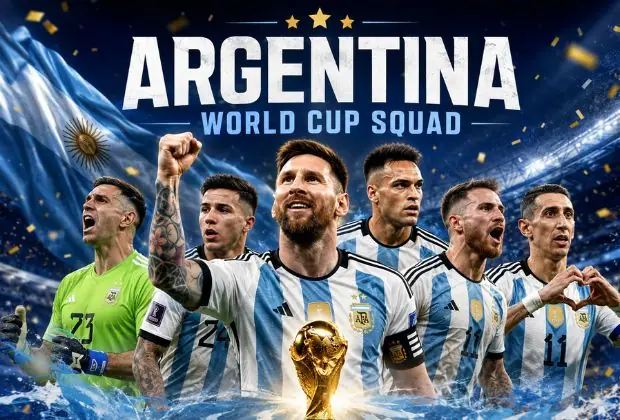
Argentina World Cup Squad 2026: Scaloni's 26 for Group J
·
Who Is in the Argentina World Cup Squad? Scaloni's 26 for Group J
This page covers the confirmed argentina world cup squad for the 2026 FIFA World Cup. Lionel Scaloni announced his final 26-man Argentina squad on . Lionel Messi captains the defending champions for what is widely expected to be his final World Cup appearance, Lautaro Martínez and Julián Álvarez lead the attack, and Alexis Mac Allister anchors the midfield from his base at Liverpool. The argentina world cup 2026 draw placed the Albiceleste in Group J alongside Algeria, Austria and Jordan — a manageable but not trivial group that demands tactical discipline and consistent starting performances from a squad that has not lost a competitive match in over three years.
For the Argentina national team, arriving at a World Cup as defending champions brings a pressure that differs in quality from the anticipation of any challenger. Scaloni's side enters North America 2026 carrying the weight of expectation that comes with the blue-and-white shirt, the memory of Qatar 2022's extraordinary final, and the knowledge that Messi — the player around whom this entire cycle has been constructed — is 38 years old and playing the last chapters of the most decorated international career in the history of the sport. The argentina squad for world cup 2026 is not simply a collection of talented players: it is a group with a shared identity, a settled tactical shape, and the lived experience of winning football's ultimate prize together. Whether that experience becomes a source of strength or complacency over the next four weeks is the central question of Argentina's tournament.
What does the Argentina world cup squad 2026 look like?
Scaloni's confirmed 26-man argentina world cup squad breaks down into three goalkeepers, eight defenders, eight midfielders and seven forwards — a selection weighted toward attacking depth and the midfield quality that has defined Argentina's unbeaten run since the 2019 Copa América.
| Pos | Player | Club |
|---|---|---|
| Goalkeepers | ||
| GK | Emiliano Martínez | Aston Villa |
| GK | Franco Armani | River Plate |
| GK | Gerónimo Rulli | Ajax |
| Defenders | ||
| RB | Nahuel Molina | Atlético Madrid |
| CB | Cristian Romero | Tottenham Hotspur |
| CB | Lisandro Martínez | Manchester United |
| CB | Nicolás Otamendi | Benfica |
| CB | Lucas Martínez Quarta | Fiorentina |
| LB | Marcos Acuña | Sevilla |
| LB | Nicolás Tagliafico | Olympique Lyon |
| RB | Gonzalo Montiel | Nottingham Forest |
| Midfielders | ||
| DM | Rodrigo De Paul | Atlético Madrid |
| DM | Leandro Paredes | Roma |
| DM | Guido Rodríguez | Real Betis |
| CM | Alexis Mac Allister | Liverpool |
| CM | Enzo Fernández | Chelsea |
| CM | Exequiel Palacios | Bayer Leverkusen |
| AM | Giovani Lo Celso | Tottenham Hotspur |
| AM | Thiago Almada | Botafogo |
| Forwards | ||
| RW | Lionel Messi © | Inter Miami |
| CF | Lautaro Martínez | Inter Milan |
| CF | Julián Álvarez | Atlético Madrid |
| RW | Paulo Dybala | Roma |
| LW | Nicolás González | Juventus |
| AM | Nico Paz | Como 1907 |
| CF | Valentín Carboni | Inter Milan |
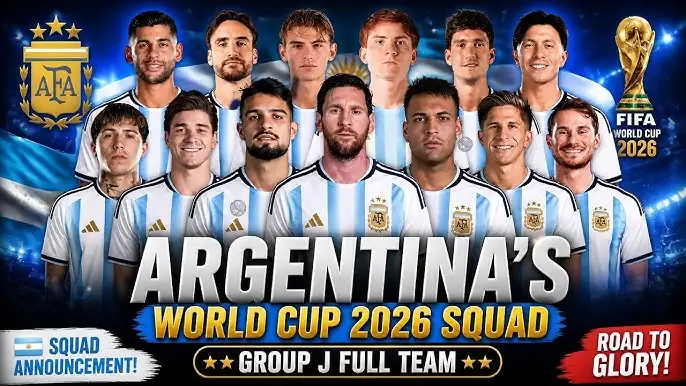
Why does Messi's presence define this entire Argentina squad?
No assessment of the argentina world cup squad 2026 can be separated from the figure of Lionel Messi. At 38 years old, playing his club football at Inter Miami in MLS, Messi brings to this tournament something that his earlier World Cups could not offer: the experience of having already won it. The psychological transformation that Qatar 2022 produced within this group of players — the release of the tension that had accumulated across four previous failed attempts — is now the foundation on which Scaloni's side stands. Messi himself has spoken about the difference between arriving at a World Cup carrying the burden of expectation and arriving as the holder of that expectation having been fulfilled. His physical condition is carefully managed at club level, and Scaloni has built the squad's attacking structure around a player who does not need ninety minutes to decide a match.
What Messi offers at this stage of his career is not the explosive dribbling athleticism of 2014 or the raw determination of 2022's quarter-final against the Netherlands. It is something more refined: the reading of space before it opens, the pass that breaks the defensive line before the press has time to form, the set-piece delivery that turns a balanced match in thirty seconds, and the weight of history that opponents feel when they stand across from the greatest footballer of the generation. The argentina squad for world cup that Scaloni has built is not dependent on Messi performing at his peak every minute — the depth in the forward line, the midfield quality of Mac Allister and Enzo Fernández, and the goalscoring output of Lautaro Martínez and Julián Álvarez all ensure that Argentina function without Messi at his best. But they are a different, more dangerous side when he is.
Who is Emiliano Martínez and why is he Argentina's most important goalkeeper?
Emiliano Martínez's inclusion as Argentina's first-choice goalkeeper is uncontroversial in a way that few selection decisions for a major tournament squad can be. His performance across the 2022 World Cup — culminating in the penalty shootout save from Kingsley Coman in the final and the subsequent stop from Randal Kolo Muani that secured Argentina's third world title — established him as the defining goalkeeper of that tournament generation. Martínez plays for Aston Villa in the Premier League, where he has continued to produce saves that combine technical excellence with psychological command of the penalty area. His aerial dominance, his distribution under pressure, and his ability to perform in the highest-stakes moments of the game make him one of the three or four best goalkeepers in the world at this tournament. Franco Armani, at 38 and with his base at River Plate, provides the experienced domestic alternative, while Gerónimo Rulli at Ajax offers a technically sophisticated third-choice option for a squad that rarely needs to use him.
Can Lautaro Martínez and Julián Álvarez lead Argentina's attack at the 2026 World Cup?
The question of who carries the attacking burden when Messi is conserved or unavailable has a clear answer in Scaloni's squad construction: Lautaro Martínez and Julián Álvarez, two forwards who have been among the most consistent performers at their clubs across the last two seasons and who offer Argentina genuinely different attacking profiles within the same starting eleven. Lautaro Martínez, the Inter Milan striker and Argentina's top scorer since Qatar 2022, brings physical presence, movement in the penalty area, and a finishing efficiency that makes him one of the most dangerous centre-forwards at this tournament. His link-up play with Messi in the attacking half has been one of the defining features of Argentina's recent form — the combination of Messi's creativity and Lautaro's movement producing goals in quantities that few international partnerships can match. Julián Álvarez, now at Atlético Madrid after his time at Manchester City, provides a very different threat: high pressing, diagonal runs from deep, and the capacity to score goals from positions that a conventional centre-forward would never occupy. Álvarez's two goals in the 2022 World Cup semi-final against Croatia — one a pressured ball-win from an improbable angle, the other a composed finish under the weight of a stadium — illustrated precisely what he brings to this side. Together, Lautaro and Álvarez give Scaloni the option to play both simultaneously in a front three with Messi, creating a forward line that defends from the front and attacks with a combination of pace, technical quality and clinical finishing that few Group J opponents will have encountered in recent months.
What does Mac Allister bring to Argentina's midfield at the 2026 World Cup?
Alexis Mac Allister has emerged as the structural organiser of Argentina's midfield in the years since Qatar 2022, and his inclusion in this squad represents the most important single selection decision outside the forward line. Playing as a deep-lying midfielder at Liverpool under Arne Slot, Mac Allister has developed the tactical intelligence to control tempo, the physical resilience to operate in the most contested zones of the Premier League, and the technical reliability under pressure that distinguishes elite international midfield play from merely good domestic performances. His partnership with Enzo Fernández gives Argentina a central midfield axis that combines work rate with creativity — Mac Allister providing the positional discipline and the short passing that allows Argentina to keep possession under pressure, Enzo Fernández offering the longer range passing and the carrying ability that opens space in transition. Rodrigo De Paul, Leandro Paredes, and Exequiel Palacios provide depth and tactical flexibility that allows Scaloni to adjust his midfield shape according to the specific demands of each group stage opponent.
What is Argentina's Group J schedule at the 2026 World Cup?
Argentina's three Group J matches span eleven days and require consistent performance against opponents who represent three distinct tactical challenges.
The opener against Algeria is the most technically demanding of the three group stage matches for Argentina's midfield. Algeria's qualification from the African play-offs was built on a collective pressing game and a high defensive line that has caused problems for opposition sides that attempt to build through the middle. For Argentina, the danger in this opening match is not individual quality — Algeria lack the star power to match Scaloni's squad across the pitch — but the collective energy of a team with nothing to lose against the world champions. How Argentina manage the first sixty minutes of the tournament, in terms of avoiding yellow cards, managing Messi's physical minutes, and establishing the tactical dominance that their squad quality demands, will set the tone for the entire group stage. Austria, coached by a technical staff that has developed one of the most coherent pressing systems in European football since Ralf Rangnick took charge, present a more familiar European challenge: organised, physically direct, and capable of winning matches through set-piece situations even when outclassed in open play. Jordan are the group's least experienced side at this level, but their qualification from the AFC play-off path demonstrated a disciplined defensive organisation that can frustrate opponents who are not fully concentrated. Argentina, as the defending champions, carry the expectation of winning all three group games — and Scaloni's squad, at full strength, has the quality to meet that expectation across three matches in eleven days.
Which young players could define Argentina's 2026 World Cup campaign?
Beyond the experienced core that won Qatar 2022, Scaloni has included several younger players whose performances across the group stage and knockout rounds could reshape the trajectory of Argentine football into the next cycle. Nico Paz, the Como 1907 midfielder who qualifies for both Argentina and Spain and chose the Albiceleste, is the selection that has attracted the most international attention. At 20 years old, Paz has produced performances in Serie A that suggest a technical ceiling well above what any Argentine midfielder of his generation has demonstrated since Enzo Fernández's emergence. His inclusion alongside the established midfield core gives Scaloni an option to introduce energy, creativity and unpredictability from the bench in matches where the starter-driven tactical approach is being adequately managed by the opposition. Valentín Carboni, the Inter Milan forward who has spent recent seasons developing through loans in Serie A, provides a technically gifted attacking alternative with the directness and pace to exploit spaces that open when opponents commit bodies forward in search of a goal. Thiago Almada at Botafogo rounds out the youthful attacking additions — a player whose MLS and Brazilian league experience has produced the consistent decision-making and pressing quality that Scaloni demands from any player who operates in Argentina's forward press.
How does Argentina's world cup history shape expectations for 2026?
Argentina's relationship with the FIFA World Cup is defined by three titles — 1978, 1986 and 2022 — and by a series of near-misses that include the 2014 final defeat to Germany and the heartbreaking 2018 round-of-sixteen exit to France. The 2022 triumph in Qatar broke a 36-year cycle of disappointment and placed Argentina alongside Brazil and Germany as the most decorated nations in World Cup history. Defending a world title, at any sport, is one of football's most difficult tasks: the combination of increased opposition preparation, the physical and mental demands of a full additional year of fixtures, and the psychological shift from challenger to champion all create conditions that have eliminated more defending champions at the group stage than any neutral observer would predict. Italy and France, both two-time World Cup winners, each failed to advance from the group stage in the tournament after their triumph. Brazil and Spain both lost in the knockout rounds at their first defence. Germany, the 2014 champions, crashed out of the group stage in 2018. Scaloni's awareness of this pattern is evident in the way he has maintained the squad's tactical discipline and collective identity across the intervening years — resisting the temptation to over-rotate, introducing new talent gradually, and keeping the squad's focus on the process rather than the status of being world champions. Whether that approach translates into a second consecutive title is the question that 2026 will answer.
For live scores, group standings and the full match schedule throughout the tournament, see the full 2026 World Cup schedule and all 12 group stage draws.
FAQ
Who is in the Argentina world cup squad 2026?
Lionel Scaloni confirmed Argentina's 26-man squad on . Goalkeepers: Emiliano Martínez, Franco Armani, Gerónimo Rulli. Defenders: Nahuel Molina, Cristian Romero, Lisandro Martínez, Nicolás Otamendi, Marcos Acuña, Nicolás Tagliafico, Gonzalo Montiel, Lucas Martínez Quarta. Midfielders: Rodrigo De Paul, Leandro Paredes, Enzo Fernández, Alexis Mac Allister, Giovani Lo Celso, Guido Rodríguez, Exequiel Palacios, Thiago Almada. Forwards: Lionel Messi (captain), Lautaro Martínez, Julián Álvarez, Paulo Dybala, Nicolás González, Nico Paz, Valentín Carboni.
Who are Argentina's group stage opponents at the 2026 World Cup?
Argentina are in Group J at the FIFA World Cup alongside Algeria, Austria and Jordan. The defending champions open on against Algeria, face Austria on , and close the group stage against Jordan on .
Who coaches Argentina at the 2026 World Cup?
Lionel Scaloni is the head coach of Argentina at the World Cup. Scaloni has been in charge since and led Argentina to the Copa América, the Finalissima and the FIFA World Cup title in Qatar — their third world championship and first since .
Is Messi in the Argentina squad for 2026?
Yes. Lionel Messi is included in Scaloni's 26-man Argentina world cup squad for and will captain the side. At 38, this is expected to be Messi's final FIFA World Cup. He won his first world title at Qatar and leads the Argentina attack alongside Lautaro Martínez and Julián Álvarez.
How many World Cups has Argentina won?
Argentina have won three FIFA World Cups: (hosted in Argentina), (Mexico) and (Qatar). Their 2022 triumph ended a 36-year wait for world football's biggest prize, with Lionel Messi lifting the trophy in his first and only World Cup final appearance as champion.