
Spain world cup 2026: why the Spain national football team still look ready to go deep
By Jack Brown · ·
What does the Spain world cup route tell us about the Spain national football team?
Spain at the 2026 World Cup — quick facts: Group H · Opponents: Cape Verde, Saudi Arabia, Uruguay · Coach: Luis de la Fuente · FIFA ranking: 1st · World Cup appearances: 17th · Best result: Champions (2010). Group-stage venues: Mercedes-Benz Stadium, Atlanta (15 & 21 June) and Estadio Akron, Guadalajara (26 June). Spain drew 0–0 with Cape Verde in their Group H opener on 15 June.
This page is about the Spain national football team at the 2026 FIFA World Cup. The spain world cup picture is unusually strong: La Roja arrive as reigning European champions, sit first in the FIFA/Coca-Cola Men's World Ranking and enter Group H with a squad built around Rodri, Lamine Yamal, Pedri, Nico Williams and a deep technical core shaped by Luis de la Fuente. For readers comparing spain national football team players, fixtures and knockout upside, the central point is simple: Spain are one of the few teams in this tournament with both a clear tactical identity and a realistic title pathway.
That combination matters because World Cups are rarely won by talent alone. Spain have the talent, but more importantly they have continuity. De la Fuente took over after Qatar 2022, won UEFA EURO 2024, reached the 2024-25 UEFA Nations League final and guided an almost perfect qualifying campaign to the finals in North America. FIFA's own preview frames them as one of the favourites, not because of reputation from the 2010 title alone, but because this team can control games in different ways: through possession, through fast transitions and through the sheer quality of their final-third combinations. The result is a Spain side that look less fragile and more complete than many of their recent predecessors.
What are Spain's world cup fixtures in Group H?
Spain's group stage opens with two matches in Atlanta before a final trip to Guadalajara. The sequence is favourable in one obvious sense: Spain can build rhythm without crossing the full continent between every early fixture. It is difficult in another: Uruguay in the third game may be one of the strongest group-stage opponents any favourite will face. That means the first two matches matter for both points and game-state management. Spain have enough quality to expect six points before the Uruguay meeting, but their route through Group H will still be judged by how cleanly they control those first two nights.
Cape Verde are the match in which Spain should dictate almost every structural variable. The African side are improved, energetic and well organised, but Spain's midfield control should force long defensive phases on them if Rodri, Pedri and the interior pair receive cleanly between lines. Saudi Arabia are more tactically interesting because they are capable of compressing space and forcing possession sides to remain patient. Spain should still expect to control territory, yet the value of that second game lies in whether they create high-quality chances rather than just high pass counts. Uruguay, by contrast, is the match that can decide first place and therefore the knockout route. That final group night should tell us whether Spain are merely one of the favourites or one of the two or three sides most capable of surviving a semi-final-level test in June rather than in July.
How did Spain qualify and why does that matter?
Spain's qualifying campaign matters because it reinforces the idea that the current Spain national football team are not living off one summer of brilliance. FIFA's team profile notes that they reached the last matchday knowing they only needed to avoid a heavy defeat against Türkiye to qualify, which tells you how strong their campaign was over the full group cycle. Spain did not limp to North America on reputation. They qualified with control, scoring depth and tactical continuity. That matters because qualification campaigns often expose the soft points that finals tournaments later punish. Spain's campaign did the opposite: it strengthened the case that the team already know how to solve different kinds of matches.
The most important takeaway from qualification was the way Spain balanced old strengths with newer ones. They still dominate phases through possession, but they are no longer dependent on sterile circulation to prove superiority. De la Fuente's side can attack early after regains, use the wings more directly and turn small midfield recoveries into immediate final-third pressure. That evolution matters in World Cup football because knockout matches are often decided by the transition after one loose pass or one disrupted build-up phase. Spain's qualification campaign suggested they are much better prepared for that reality than the 2018 or 2022 versions of the team were.
There is also a psychological layer. Teams that qualify strongly tend to arrive at the finals with their internal hierarchy settled. Spain know who their coach is, who their midfield anchor is, which wide players can break open a game and what their preferred structures look like. That level of certainty lowers noise during the tournament. It allows training sessions to refine details rather than solve identity problems. In a 48-team World Cup with more travel and one extra knockout round, that kind of clarity is not cosmetic. It is an advantage.
Why does this Spain national football team feel different from older Spain sides?
The easy answer is youth, but the better answer is tension between control and speed. Spain's best older teams, especially the 2008 to 2012 cycle, overwhelmed opponents through patient possession, rhythm and technical superiority. The current side still values those things, yet it also attacks with more vertical ambition. Lamine Yamal, Nico Williams and Ferran Torres change the geometry of matches because they can force a defensive line backward in seconds. That means Spain no longer need to choose between control and incision. They can use control to create the conditions for incision.
Rodri is the player who makes this dual identity possible. When fit, he is still the most secure controlling midfielder in the game. He can slow a match when the team need rest, speed it up with one line-breaking pass when a weak-side runner is free, and protect the middle after a turnover. Around him, Pedri offers subtle movement and progression, while the wider attackers stretch the pitch and create one-versus-one pressure points. The Spain national football team therefore play with less rigidity than the team many casual observers still imagine when they hear the word Spain. It is not tiki-taka nostalgia. It is a more modern possession side with clear transition weapons.
De la Fuente deserves credit here. He has not ripped up the country's footballing inheritance, but he has updated it. Spain still want the ball. They still want midfield superiority. They still want to dictate where the game is played. But they also accept that major tournaments are won by teams that can survive chaos as well as avoid it. That is why this side look more viable in a seven-match World Cup than some of their aesthetically cleaner but less flexible predecessors.
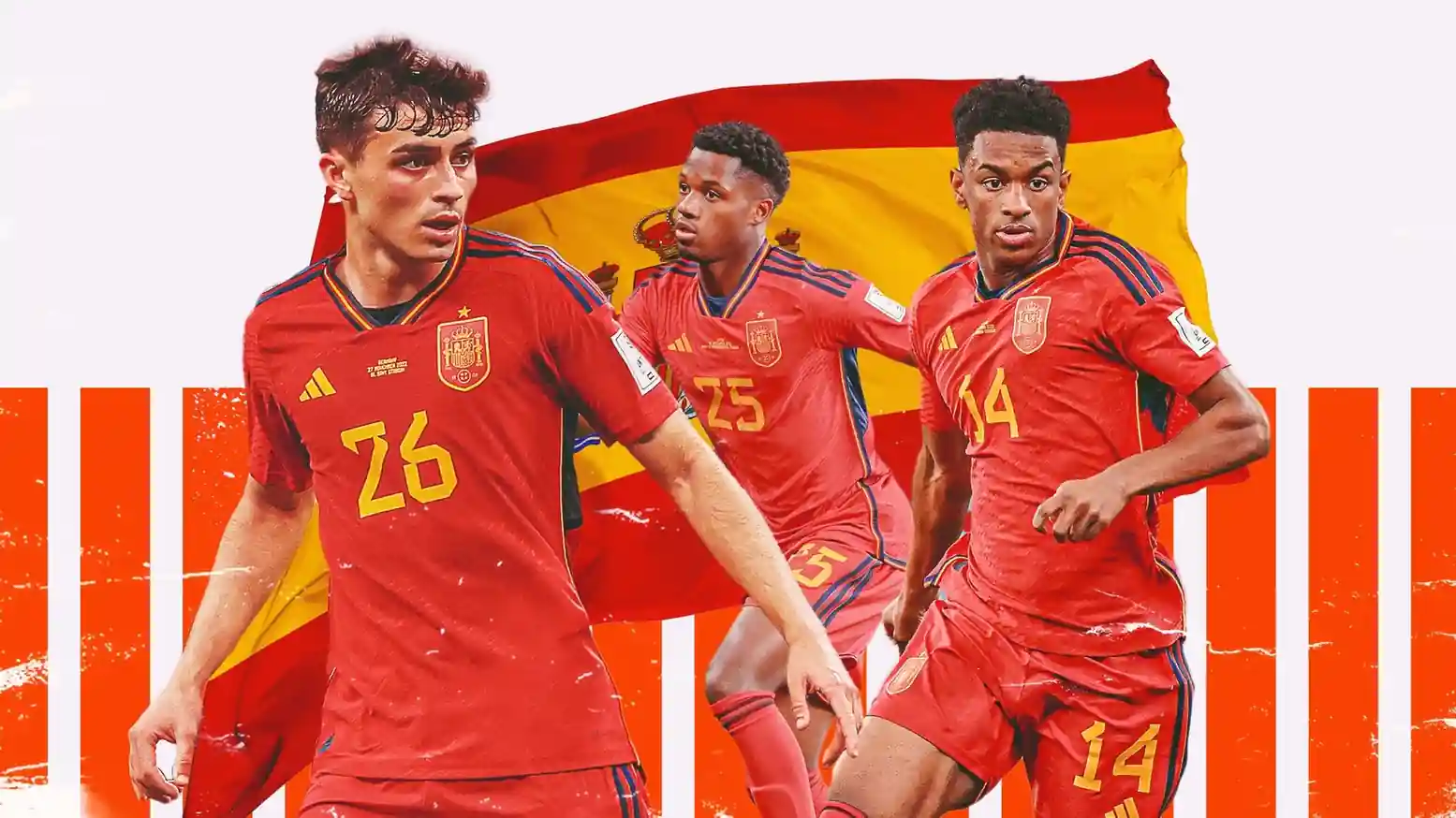
Which Spain national football team players could define the tournament?
Rodri remains the most important player to any serious Spain world cup projection because he determines how sustainable Spain's control really is. He is the reference point in and out of possession, the player who makes the rest of the structure believable against elite opposition. If Rodri plays at his normal level, Spain can dominate midfield territory against almost anyone. If he is limited or unavailable, the rest of the tournament model changes immediately. That is not a criticism of the depth chart. It is simply the truth about what a world-class holding midfielder does for every phase around him.
Lamine Yamal is the headline talent because he changes what defenders think they can survive. His ability to receive wide, drive inside, delay a decision and still make the right final action gives Spain an elite chaos creator without forcing them to become a chaotic team. Nico Williams provides a different form of threat: direct acceleration over long distances, immediate pressure in transition and the sort of touchline gravity that opens the half-space for interior runners. Ferran Torres matters because he gives Spain finishing clarity across multiple front-line roles. He can start wide, arrive centrally or serve as the cleaner final action after Yamal or Nico have destabilised the back line.
Pedri, meanwhile, is the player who makes Spain's attack look coherent rather than improvised. He reads the next pass early, carries the ball through soft pressure and rarely needs extra touches to access the dangerous zone between midfield and defence. Spain's best attacking stretches often come when Pedri becomes the connector between Rodri's control and the forwards' final-third aggression. If the tournament turns into one of those World Cups where compact mid-blocks dominate, Pedri may be the most important attacking player in the squad despite Yamal's star billing.
The broader point is that Spain national football team players now cover different match states. Some control, some destabilise, some finish, some restore order after the ball is lost. That portfolio effect is exactly what separates strong squads from title-capable ones. Spain are not reliant on one kind of game to look good. They have enough variety to solve several.
What does Spain's World Cup history really tell us in 2026?
History should not be used as a lazy shortcut, but it still helps define expectations. Spain are preparing for their 17th World Cup appearance, and FIFA's profile records their overall tournament line at 67 matches played, 31 won, 17 drawn and 19 lost. The headline fact remains their sole title in 2010, when Andrés Iniesta's extra-time goal against the Netherlands delivered Spain's first men's world championship. That title still shapes the country's self-image, but it is not the whole story. Spain have also suffered several recent exits that exposed structural weaknesses under pressure, including the round-of-16 departure in Qatar 2022.
What makes 2026 interesting is that Spain's modern tournament identity is no longer built on memory alone. They are not asking observers to believe in a faded brand. They are asking them to evaluate a present-tense team that won UEFA EURO 2024, reached another final in the 2024-25 Nations League and now sit at the top of the world ranking. That means history works in two directions. It provides the credibility of a former champion, but it also raises the baseline of expectation. A quarter-final may be respectable for some nations. For Spain in this cycle, it would probably feel incomplete.
There is also a more practical historical lesson. Spain's only title-winning side was not just technically gifted. It was positionally certain. The current team are strongest when they show that same certainty. The names have changed, the rhythm has changed and the wing play is more explosive, but the foundational truth has not: Spain are most dangerous when every player understands which spaces matter most in the exact moment the ball moves there. The teams that beat them in recent World Cups often disrupted that clarity. The teams they beat in EURO 2024 rarely could.
What is Spain's path if they win Group H?
If Spain win Group H, the first reward is not glamour but control. They would avoid the immediate complication that comes with a more difficult round-of-32 draw and should face one of the best third-placed teams rather than another group winner. In a 48-team World Cup, that matters. The extra knockout round adds physical load, and every slight advantage in the bracket becomes more valuable than it would have been in the 32-team format.
The second reward is emotional rhythm. A team that wins its group cleanly usually arrives at the knockouts with less noise around selection, less panic about execution and more freedom to manage minutes in the final group match. Spain, in particular, benefit from that kind of stability because their model improves when their midfield spacing and tempo remain predictable. If they top Group H before the Uruguay game or by beating Uruguay directly, they should enter the round of 32 looking like a side in control of its own narrative.
The real challenge comes later, of course. Spain's ceiling will be tested against another elite side capable of contesting central spaces rather than merely defending them. But the point of winning the group is to delay that meeting and arrive at it with the most stable possible internal state. Spain do not need an easy road to win the tournament. They do, however, benefit from a road that allows their younger attackers to grow into the event before the bracket turns brutal. Group H gives them that chance.
Can Spain actually win the 2026 World Cup?
Yes, Spain can win the 2026 World Cup, and the case is stronger than it would have been at the start of the last cycle. They have the best blend of coaching continuity, midfield quality and wide attacking upside of any European side outside perhaps France. They are first in the world ranking, defending continental champions and one of the few teams in the field whose best version already exists in competitive matches rather than only in theory. Spain do not need everything to break perfectly to look like contenders. They already do.
That does not make them bulletproof. World Cups punish small flaws. Spain can still be forced into sterile possession if opponents deny interior access and ask their full-backs to solve attacks from poor angles. They can also be made physically uncomfortable if transition protection collapses around Rodri. And like every contender, they still need fortune with injuries across seven matches. But those are relative concerns, not fatal ones. The underlying structure is real, and the player pool is deep enough to absorb at least some turbulence.
The strongest argument for Spain is that they can win in more than one script. They can dominate the ball and suffocate a weaker side. They can survive a high-tempo game and then punish the next loose touch. They can rely on Yamal or Nico for raw attacking separation, or on Pedri and Rodri for control. Title teams rarely rely on one button. Spain have several. That is why they belong in the conversation with the very strongest teams in the tournament.
For the complete fixture list, group tables and live scores throughout the tournament, see the full 2026 World Cup schedule and all 12 group stage draws. For the confirmed roster and position-by-position selection details, see the Spain World Cup Squad 2026.
FAQ
What are Spain's 2026 World Cup fixtures and venues?
Spain's group-stage fixtures are vs Cape Verde and vs Saudi Arabia at Mercedes-Benz Stadium in Atlanta, followed by vs Uruguay at Estadio Akron in Guadalajara.
Did Spain win World Cup 2026?
Yes. Spain won World Cup 2026 by beating Argentina 1-0 in the final at New York New Jersey Stadium, finishing the tournament as champions and moving clear of the pre-tournament “contender” label.
What was Spain's route through the World Cup 2026 knockouts?
Spain beat Portugal 1-0 in the Round of 16, Belgium 2-1 in the quarter-finals, France 2-0 in the semi-finals and Argentina 1-0 in the final. That route gave Spain wins over four heavyweight opponents after the group stage.
Which Spain players won World Cup 2026 awards?
Rodri won the Golden Ball, Unai Simón won the Golden Glove and Pau Cubarsí won Best Young Player. Spain's awards haul matched the shape of their tournament: control in midfield, security in goal and a young defender who looked ready for the biggest stage.
How many goals did Spain concede in the knockout rounds?
Spain conceded one goal across four knockout matches. The only knockout goal against them came in the 2-1 quarter-final win over Belgium; Spain then kept clean sheets against Portugal, France and Argentina.
What is Spain's best World Cup finish?
Spain's best World Cup finish is winning the tournament. They first did it in 2010 through Andrés Iniesta's extra-time goal against the Netherlands, then added a second men's world title in 2026.