
Brazil World Cup 2026: Schedule, Fixtures & Preview
By Jack Brown · ·
Can the Brazil national football team end a 24-year wait for a sixth World Cup title?
Brazil at the 2026 World Cup — quick facts: Group C · Opponents: Morocco, Haiti, Scotland · Coach: Carlo Ancelotti · Captain: Raphinha · FIFA ranking: 4th · World Cup appearances: 22nd · Best result: Champions × 5 (1958, 1962, 1970, 1994, 2002). Group stage venues: MetLife Stadium, New Jersey (13 June) · Lincoln Financial Field, Philadelphia (19 June) · Hard Rock Stadium, Miami (24 June). Brazil drew 1–1 with Morocco in their Group C opener on 13 June.
The Brazil national football team enters the 2026 FIFA Brazil World Cup campaign as the most decorated nation in the tournament's history and one of the clearest favourites to win it. Group C — featuring Morocco, Haiti and Scotland — gives Carlo Ancelotti's side a realistic path to the knockout stage, where a squad built around Vinícius Júnior, Raphinha and a generation of European-based elite talent is capable of beating any opponent in the world on a given night. The five-time world champions arrive in North America carrying the weight of a 24-year title drought, the largest in their World Cup history, and a collective purpose that goes beyond individual ambition: this is a squad that wants to end the long wait and restore Brazil to the top of the world game.
Carlo Ancelotti's appointment as Brazil head coach in June 2024 — immediately after completing his second spell at Real Madrid — represented a significant shift in how Brazilian football approached the coaching role. Where previous national team managers had come from the Brazilian domestic game or from within a familiar network of former players and federation insiders, the decision to appoint one of the most decorated coaches in the history of club football brought a different kind of tactical intelligence to the Seleção's preparation. Ancelotti's track record — four UEFA Champions League titles, two La Liga championships, domestic titles across four countries — gave Brazil access to a level of tournament experience that few other national teams could claim. The squad he has assembled for 2026 is built on that experience and on the individual quality of players who have spent multiple seasons at the top of European club football.
What are Brazil's Group C fixtures at the 2026 World Cup?
Brazil's group stage campaign opens on at MetLife Stadium in East Rutherford, New Jersey, where they face Morocco in the most consequential Group C fixture. Morocco reached the semi-finals of the 2022 World Cup in Qatar, becoming the first African nation in history to achieve that milestone, and arrive at this tournament with a defensive structure and collective organisation that is genuinely difficult to break down. The 6:00 PM ET kickoff at MetLife Stadium — the venue that will also host the World Cup final on 19 July — gives Brazil's opening match a particular significance: a strong performance against Morocco would send an early signal about how ready Ancelotti's team is for the tournament's demanding knockout phase. Morocco, under a coach who values defensive solidarity and compact shape over attacking ambition, will present Brazil's most serious test in the group and a useful early measure of how the Seleção handles a team that defends in a disciplined low block and strikes on the counter.
The second group fixture takes Brazil to Lincoln Financial Field in Philadelphia on at 9:00 PM ET against Haiti in what looks on paper to be the most accessible match of the three. Haiti qualified for their first World Cup in history, bringing an underdog narrative and the collective spirit of a nation for whom this participation represents an enormous achievement. Brazil's superior technical and physical quality should determine the outcome over ninety minutes, but Ancelotti's approach to squad rotation — how much he preserves key players for the final group match — will be one of the tournament's first significant management decisions. A straightforward win without unnecessary injury or fatigue to the first-choice XI is the target. Anything less would create unnecessary pressure heading into the Scotland fixture.
The group concludes on at Hard Rock Stadium in Miami, where Scotland provide Brazil's final Group C obstacle. Scotland's first World Cup appearance since France 1998 was earned through a competitive European qualifying campaign, and they arrive in North America organised, physically robust and capable of making Brazil work for their result. The Miami fixture at 6:00 PM ET is a simultaneous final-day group match — both Group C games kick off at the same time — meaning all four teams' table positions remain in play until the final whistle. Brazil are heavy favourites to win the group outright, but Scotland's directness in transition and their defensive discipline create a specific physical challenge that cannot be dismissed.
Brazil's Group C draw is broadly regarded as one of the most favourable in the tournament for a side of their stature. The 2022 World Cup saw Brazil eliminated at the quarter-final stage by Croatia on penalties — a result that ended the Fernando Tite era and set in motion the coaching transition that ultimately led to Ancelotti. Under the Italian manager, the emphasis has shifted toward collective organisation and a structured approach to each fixture rather than the individual improvisation that characterised some previous tournament campaigns. The group stage is the starting point, not the objective.
How does Carlo Ancelotti want the Brazil national football team to play?
Ancelotti has built a Brazil side around a 4-3-3 system that provides freedom to his wide forwards while maintaining defensive solidity through a well-organised central midfield. The tactical identity of this Brazil team differs from what many supporters associate with the historical jogo bonito tradition — the flowing, improvisational style associated with the 1970 squad. Instead, Ancelotti prioritises tactical discipline and structural coherence, trusting the individual quality of Vinícius Júnior, Raphinha and those around them to produce the creative moments within a framework that limits Brazil's defensive exposure and allows them to control the tempo of matches at a high level.
The central midfield axis is built on Casemiro and Bruno Guimarães. Casemiro — approaching the end of his international career but still a formidable defensive presence — provides the positional discipline that allows Brazil's full-backs to push forward and the wide forwards to make runs in behind. Bruno Guimarães contributes the energy and ball-carrying ability that Casemiro no longer provides at the same rate: the Newcastle United midfielder is one of the most dynamic central players in European football and his capacity to advance from deep, commit defenders and then deliver or shoot gives Brazil's attack an additional dimension that sets this squad apart from the 2022 version. Lucas Paquetá operates in the advanced central role, combining technical quality and vision with the capacity to link play between midfield and the forwards in tight spaces.
Defensively, Marquinhos leads a back line built on experience and collective organisation. The Paris Saint-Germain captain brings years of Champions League and international tournament football to a defence that also includes Gabriel Magalhães of Arsenal and Bremer of Juventus — two of the most effective centre-backs in European club football. Alisson Becker in goal remains universally regarded as one of the three best goalkeepers in the world and provides the defensive foundation the system requires. Brazil's CONMEBOL qualification campaign produced the best defensive record of any South American side across the final qualifying series, conceding fewer goals than Argentina, Colombia or Uruguay. That collective defensive solidity, combined with the attacking quality available in wide positions, gives Ancelotti the platform to construct a tournament run built on both results and performance quality.
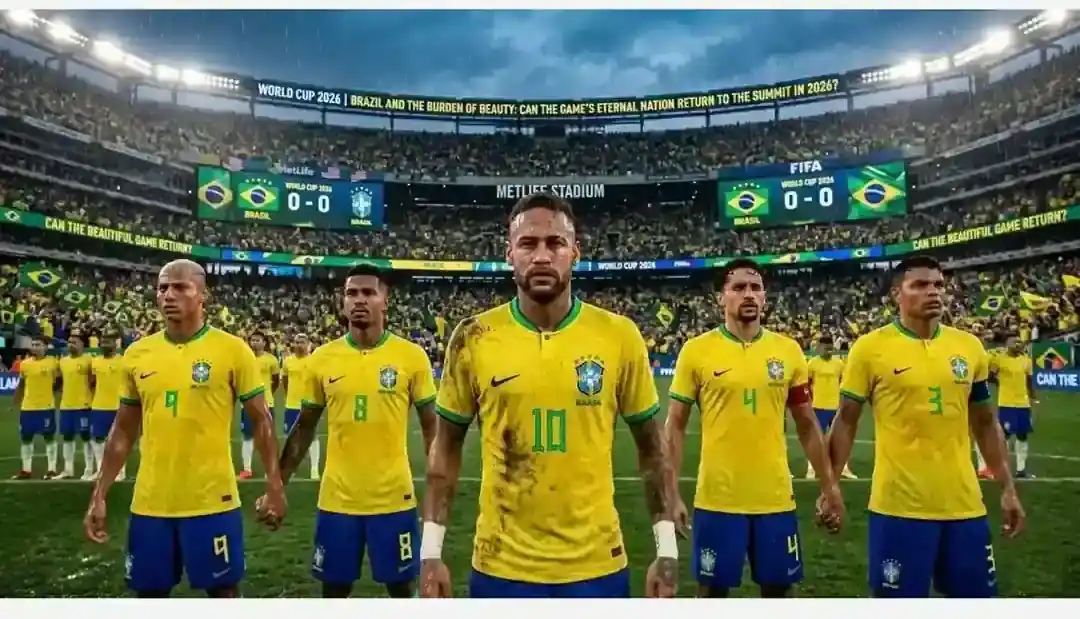
Which Brazil national football team players should you watch at the 2026 World Cup?
Vinícius Júnior is the player around whom Ancelotti's entire attacking structure is built and the individual most likely to determine how far Brazil go. The Real Madrid forward enters 2026 at 25 years old — precisely the peak years for a forward with his physical profile — and has spent two consecutive seasons establishing himself as one of the two or three best players on the planet. His combination of explosive pace, an improved first touch that allows him to receive in tight situations, finishing ability from cut-inside positions and a willingness to press defensively when Brazil are out of possession makes him a genuinely complete modern attacker. At the 2022 World Cup, Vinícius started every match and carried a significant share of Brazil's creative burden in a system that did not always support his best qualities. Under Ancelotti, the system is built specifically around what he does best: receiving the ball in wide left positions and driving directly at defenders in space, creating opportunities for arriving midfielders and for Raphinha on the opposite flank. The expectation of him at a continent-adjacent World Cup is enormous, but the conditions are right for a performance that could define the competition.
Raphinha, Brazil's captain, has developed into one of the world's most effective wide forwards following two transformative seasons as the creative talisman of a Barcelona side competing for domestic and European honours. His directness from the right wing — the willingness to carry the ball at defenders, take on one-versus-one situations and finish from difficult angles — makes him a constant attacking threat across ninety minutes of high-intensity football. The leadership role adds a dimension that pure attackers often lack: Raphinha wearing the armband for Brazil represents a philosophical choice, selecting as captain not a defensive anchor or a veteran presence but the team's most dangerous forward operating at peak output. That combination of responsibility and attacking intent is unusual and, in a tournament context, potentially decisive. When Vinícius draws attention to the left and Raphinha has space on the right, Brazil's attack becomes extremely difficult to contain across a full match.
Bruno Guimarães is, in many tactical assessments, the most important outfield player in Ancelotti's system despite receiving less attention than the forwards. The Newcastle United midfielder's capacity to control the tempo of matches, to win possession in tight areas and to immediately shift the ball forward into the spaces the wide attackers can exploit gives Brazil's transitions a quality that few other national teams in this tournament can match. When Brazil are at their best, Guimarães is the engine connecting defensive organisation to attacking threat: the player who turns a recovery into an opportunity within two or three passes. His form coming into the tournament — Newcastle qualified for the Champions League in the final weeks of the season with Guimarães central to that campaign — suggests a player at the peak of his confidence and physical condition heading into a World Cup where his influence could be decisive.
What is Brazil's World Cup history and why does 2026 matter so much?
Brazil are the most successful nation in FIFA World Cup history with five titles — 1958, 1962, 1970, 1994 and 2002 — and hold the unique distinction of having qualified for every edition of the tournament since it began in Uruguay in 1930. No other nation has qualified for all twenty-two editions. No other nation has won five times. Brazil's relationship with the World Cup is not simply one of success but of cultural identity: the tournament, for Brazil, represents something closer to a national expression than a football competition, and the weight of that history sits on every squad that goes to compete.
The first two titles, in Sweden in 1958 and Chile in 1962, were won with a generation built around a teenage Pelé and an attacking style that established what the world would come to expect of Brazilian football for decades. The 1970 title in Mexico — won against Italy 4-1 in the final — remains widely considered the finest collective performance in World Cup history. A squad that included Pelé, Jairzinho, Rivelino and Tostão attacked with a freedom and creativity that even subsequent great Brazilian generations have not fully replicated. The fourth title, in the United States in 1994, came through a more defensively organised approach under Carlos Alberto Parreira, with Romário and Bebeto forming one of the tournament's most effective attacking partnerships. Ronaldo's generation delivered the fifth title in 2002 in Japan and South Korea, with his two goals in the final against Germany — scored after years of health uncertainty that had threatened to end his career — producing one of the most emotionally powerful individual performances in the competition's history.
The years since 2002 have been defined by the distance between expectation and result. Brazil hosted the 2014 World Cup and suffered the most psychologically damaging defeat in the country's football history: the 7-1 semi-final loss to Germany at Estádio Mineirão in Belo Horizonte, known ever since as the Mineirazo. A fourth-place finish and years of collective processing followed. The 2018 tournament in Russia ended at the quarter-final stage with a 2-1 defeat to Belgium. The 2022 World Cup in Qatar ended in the same round, eliminated by Croatia on penalties after the match finished 1-1 in normal time. Three consecutive quarter-final exits. The 24-year gap since 2002 is the longest drought in Brazil's World Cup history, and it is this fact — more than any individual fixture or tactical consideration — that gives this squad the specific motivation that Ancelotti has described as a genuine competitive advantage heading into North America.
What is Brazil's path to the final at the 2026 World Cup?
The 2026 World Cup introduces a round of 32 that replaces the previous round of 16 as the first knockout stage. Brazil, as expected Group C winners, would face one of the eight best third-placed teams from other groups in that opening knockout match. The projected bracket based on Group C's position creates potential round-of-32 opponents from groups on the eastern side of the draw — likely teams from CONCACAF or CAF qualification, offering a relatively accessible entry point to the knockout phase for a squad of Brazil's quality and tournament experience. Ancelotti has been clear publicly that Brazil will approach each match independently rather than planning ahead to specific opponents, which is the correct approach for managing the physical and psychological demands of a seven-match campaign across a 35-day tournament.
The round of 16 and quarter-final phase — if Brazil navigate the opening knockout match as expected — brings the tests that will define whether this generation can break the quarter-final ceiling that has limited the last three editions. The bracket progression places potential quarter-final opponents among the sides emerging from the European-heavy groups on the western side of the draw: France, England, Spain and the Netherlands are all realistic opponents at this stage depending on how results fall. Brazil's recent record against European opponents in World Cup knockout matches has been mixed. The 2022 Croatia defeat came in a penalty shootout after ninety minutes and extra time finished level. Ancelotti's approach to those situations — careful in managing squad energy across multiple matches, deliberate in his use of the bench — is designed specifically to prevent the kind of cumulative fatigue that contributed to the Croatia result.
The semi-final scenario requires Brazil to beat one of the tournament's elite sides: France, Argentina, Spain or England are the realistic opponents at that stage depending on how the brackets have distributed the favourites. Brazil have the squad depth and collective quality to compete with any of those teams across ninety minutes of high-level football. Their tactical identity under Ancelotti — controlling possession through midfield, exploiting pace on both wings and maintaining defensive solidity through an experienced back line — gives them a specific blueprint for winning close matches that was absent in some previous tournament campaigns. The final at MetLife Stadium in New York/New Jersey on — the same venue where Brazil open their campaign on 13 June — would complete a narrative arc that connects the first match of the tournament to its conclusion in a single stadium. With the squad depth Ancelotti has assembled, the motivation a 24-year title gap creates and the specific advantage of playing their group stage in venues along the east coast where the football infrastructure and fan intensity are among the highest in North America, the conditions in 2026 are as favourable as they have been for Brazil since the tournament they won in Japan and South Korea.
For the complete Group C schedule and live results, see the full 2026 World Cup schedule and all 12 group stage draws. For the complete player-by-player squad breakdown, see the Brazil 2026 World Cup squad.
FAQ
Who are Brazil's group stage opponents at the 2026 World Cup?
Brazil's Group C opponents were Morocco, Haiti and Scotland. The fixtures took Brazil to MetLife Stadium in New Jersey, Lincoln Financial Field in Philadelphia and Hard Rock Stadium in Miami.
How did Brazil finish in Group C?
Brazil finished inside the Group C top-two line on the standings page, behind Scotland in the preserved table order. That was enough to move Brazil into the knockout bracket, even if the campaign never looked as smooth as the squad list suggested.
Who knocked Brazil out of World Cup 2026?
Norway knocked Brazil out in the Round of 16 with a 2-1 win. It was the result that turned Brazil's tournament from a title chase into another early knockout autopsy.
What was Brazil's biggest 2026 World Cup problem?
Brazil had the individual quality to escape Group C, but the Norway defeat exposed the harder tournament question: could Ancelotti's team control uncomfortable knockout moments when the opponent played direct, fast and without fear?
Who coached Brazil at the 2026 World Cup?
Carlo Ancelotti coached Brazil at the 2026 World Cup. His side leaned on Vinícius Júnior, Raphinha, Bruno Guimarães, Marquinhos and Alisson Becker, but the sixth title still stayed out of reach.
How many times has Brazil won the World Cup?
Brazil have won the FIFA World Cup five times: 1958, 1962, 1970, 1994 and 2002. No other country has won more men's World Cups, but the 2026 exit meant the wait for a sixth star continued.