
Germany World Cup 2026: Schedule, Fixtures & Preview
By Jack Brown · ·
Is the Germany national football team ready to end a 12-year World Cup drought in 2026?
Germany at the 2026 World Cup — quick facts: Group E · Opponents: Curaçao, Côte d'Ivoire, Ecuador · Coach: Julian Nagelsmann · FIFA ranking: 10th · World Cup appearances: 21st · Best result: Champions × 4 (1954, 1974, 1990, 2014). Group stage venues: Houston Stadium (14 June) · Toronto Stadium (20 June) · New York New Jersey Stadium (25 June). Germany opened their Group E campaign on 14 June with a 7–1 victory over Curaçao.
- Coach
- Julian Nagelsmann
- FIFA rank
- No. 10
- Qualified by
- Top of UEFA Group A after beating Slovakia 6-0 on 17 November 2025
- World Cup titles
- 4: 1954, 1974, 1990, 2014
- Appearances
- 21st overall World Cup, 19th straight finals
- Group
- Group E with Curaçao, Côte d'Ivoire and Ecuador
The germany world cup outlook in 2026 is straightforward: the Germany national football team arrive in Group E with one of the most stable coaching situations in the tournament, a top-end creative core and a realistic path into the knockout rounds. For readers comparing germany national football team players, or scanning the wider germany national team picture before the first whistle, this page explains who Germany are, how they qualified, what their fixtures look like and why Julian Nagelsmann's side are once again being discussed as a genuine contender rather than a legacy brand living off past trophies.
What does Germany world cup 2026 look like in one glance?
This page is about Germany at the 2026 FIFA World Cup: their route into the tournament, their tactical identity, their key players, their group-stage fixtures and the realistic ceiling of the squad. That matters because entity clarity is one of the easiest ways to make a page useful both for people and for search systems. Germany are not arriving in North America as an abstract football giant. They are arriving as a very specific version of the Germany national football team: a side coached by Nagelsmann, built around dual creators in Wirtz and Musiala, anchored by Kimmich and Rudiger, and shaped by the urgency of restoring tournament consistency after the group-stage exits of 2018 and 2022.
The baseline numbers are strong. FIFA's official team profile lists Germany as a four-time champion and a nation entering its 21st World Cup. FIFA's qualification tracker records that Germany secured top spot in UEFA Group A with a 6-0 final-day win over Slovakia on 17 November 2025, a result that removed any suspense about their place in the finals. FIFA's Germany team page also places them at No. 10 in the world ranking heading into the tournament. Those facts do not guarantee a title run, but they do place Germany in the narrow band of teams that combine pedigree, quality and structural competence before a ball has been kicked.
The short version is that Germany are not entering the competition on nostalgia alone. They have a defined tactical model, a strong spine, a favourable seeding position and enough match-winning talent to decide games quickly. The challenge is that the margins at the top are thin. Germany can absolutely reach the quarter-finals and beyond, but unlike in some earlier eras they do not overwhelm every other elite nation on raw depth. That is why the details of the group phase, squad balance and midfield control matter so much.
How did the Germany national football team qualify?
Germany qualified by doing what top seeds are expected to do but often fail to execute cleanly: they won their qualifying group decisively and removed drama before the final whistle of the campaign. FIFA's official qualification update states that Germany clinched first place in UEFA Group A with a 6-0 victory over Slovakia on the last matchday. That mattered for more than table position. It validated the rebuild under Nagelsmann and gave Germany the psychological benefit of entering the finals through certainty rather than through a chaotic play-off route.
The qualifying arc also told us what kind of side Germany have become. They were more direct than the possession-heavy teams that often followed the 2014 champions. They pressed with more intent, attacked central pockets faster and found a better balance between control and verticality. Germany national football team players such as Wirtz, Musiala and Havertz benefited most from that shift because the structure asked them to break lines rather than simply circulate possession. The consequence was a team that looked lighter on the ball and more modern without abandoning the technical standards people still associate with Germany.
Qualification also gave Germany another practical edge: time. Once the place was secure, staff planning could move from survival mode into optimisation mode. Training camps, load management and rotation decisions were all made with the 2026 finals in mind. That may sound minor, but tournaments are often decided by accumulated details. Germany arrive having had months to treat the World Cup as a performance problem to solve, not a qualification race to survive.
What are Germany's Group E fixtures and what matters in each match?
FIFA's match schedule and Germany team profile agree on the central shape of Group E: Germany face Curaçao on 14 June 2026, Côte d'Ivoire on 20 June 2026 and Ecuador on 25 June 2026. The order matters. Curaçao are the opening opponent and, on paper, the least experienced side in the group. Côte d'Ivoire offer the greatest physical variance. Ecuador look the most complete all-round test. That creates a group in which Germany should be able to build rhythm early but still need a high standard by the final matchday.
The opener against Curaçao is not a formality, but it is the match in which Germany should impose their structure most clearly. Curaçao became the smallest country ever to qualify for the men's World Cup, and that achievement is significant in its own right. Yet Germany's task is to remove emotion from the occasion, dominate field position and avoid gifting transition chances. The ideal outcome is not merely three points. It is a controlled opening win that allows Nagelsmann to manage minutes and build confidence.
Côte d'Ivoire are the game that can distort the group. They bring pace, athleticism and the kind of direct attacking threat that can punish heavy-footed pressing structures. Germany's rest defence and second-ball control will matter most here. If Kimmich and the deeper midfielder behind the front line keep the central spaces clean, Germany can push Côte d'Ivoire into longer defensive phases. If not, the game becomes open and volatile.
Ecuador, finally, may decide whether Germany top the group. They are disciplined, compact and increasingly comfortable in tournament-level games. Against Ecuador, Germany are less likely to win through sheer volume of attacks and more likely to win through chance quality. That is why the Wirtz-Musiala axis is so important: their ability to receive between lines and create one clean final action could determine seeding and, in turn, the knockout route.
Why does Julian Nagelsmann's tactical identity matter so much?
Germany's best recent performances have come when the team have looked like a coherent idea rather than a collection of high-status names. Nagelsmann's value is precisely that he gives the Germany national football team a current football identity. It is not built on sterile possession. It is built on controlled aggression. Germany want to win the ball high, progress quickly through central lanes and then arrive in the box with multiple runners. That model fits the profile of their best players and reduces the temptation to overplay around the edge of a settled defence.
The midfield balance is the central mechanism. Kimmich gives the team range, delivery and tempo control. The second midfielder, whether more defensive or more mobile depending on the opponent, protects transitions so that Wirtz and Musiala can receive in advanced zones. From there, Germany can play in two speeds. They can slow the game, circulate and pin an opponent deep, or they can turn one regain into a fast central attack. That duality is a major tournament asset because it allows Germany to win ugly and pretty.
The biggest tactical improvement over the last cycle is not just chance creation. It is structural clarity. Germany are better at knowing which players should be close to the ball when it turns over. That means fewer emergency sprints and fewer open-field defensive situations. At World Cups, that is often the difference between a side that dominates small moments and a side that gifts them away. Germany are much closer now to the first category.
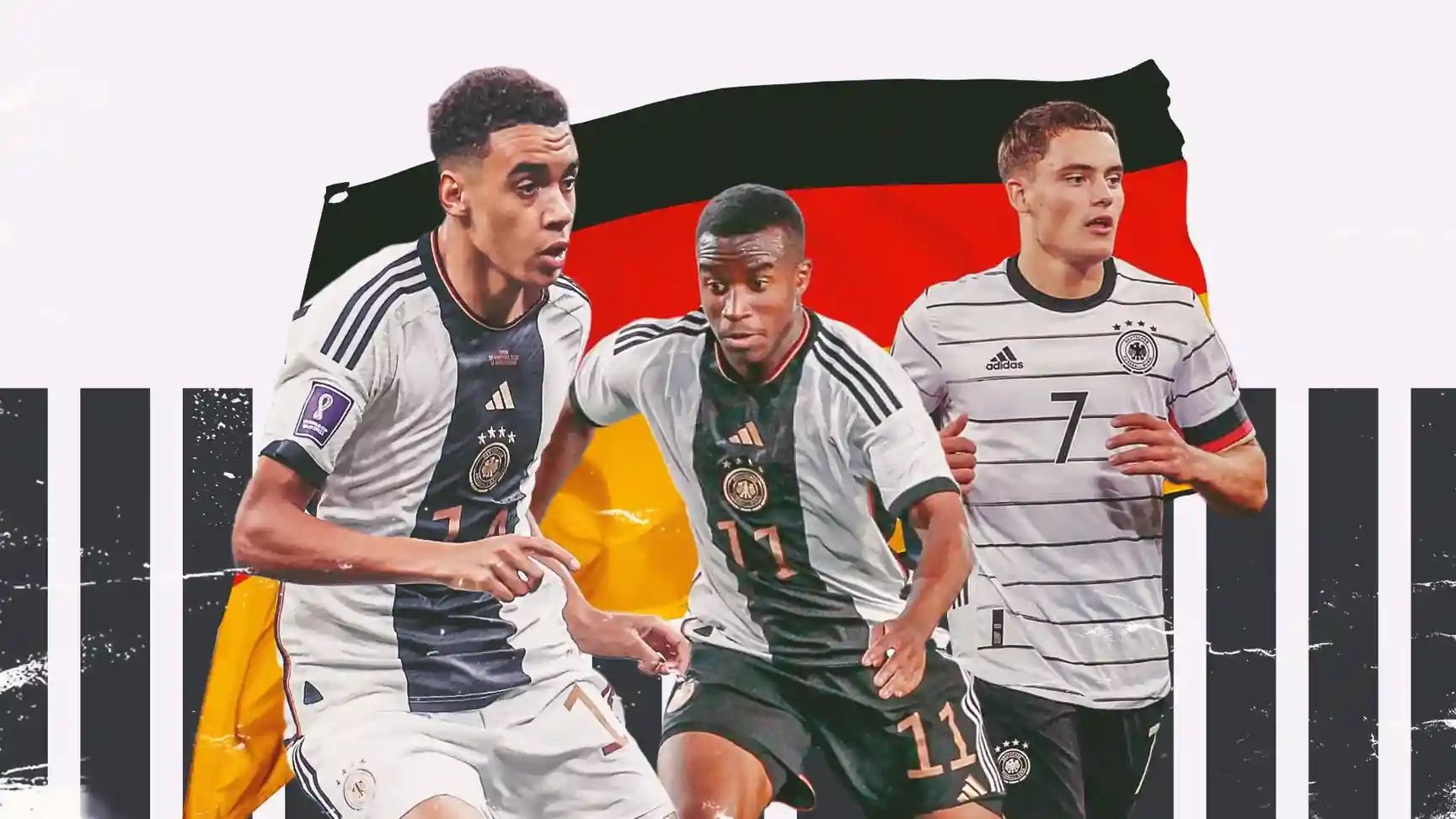
Which Germany national football team players will decide this run?
Any Germany world cup assessment starts with Florian Wirtz and Jamal Musiala because very few countries can place two elite creators in the same attacking band and still maintain balance. Wirtz is Germany's cleanest final-third reader. He understands where the next pass matters most, and he produces shots and chance creation without forcing the game. Musiala is the volatility generator. He carries through pressure, distorts shape and creates extra touches defenders cannot comfortably predict. Together they make Germany harder to scheme against than they were in either 2018 or 2022.
Joshua Kimmich remains the emotional and tactical reference point. Whether people classify him as a midfielder first or a hybrid organiser, his importance is obvious. He dictates tempo, delivers on set plays and gives Germany one of the best long-pass distributors in the tournament. In knockout football, where margins tighten and open-play creativity can stall, that profile becomes even more valuable.
Antonio Rudiger matters for a different reason. Germany have often looked most fragile when matches become physically direct and emotionally noisy. Rudiger is the player most likely to stabilise those moments. He defends the box well, accepts duels and gives the line a natural leader. Up front, Kai Havertz remains the connector rather than a pure target. His movement helps Germany keep central overloads alive and creates spaces for late runners. The combined effect is a team in which star quality is not isolated to one area of the pitch.
Beyond the headline names, the depth question is important. Germany national football team players such as Leroy Sane, Niclas Fullkrug, David Raum and Jonathan Tah change the profile of a game rather than merely maintain it. That is crucial in a seven-match tournament. Germany do not need their bench to be equally glamorous; they need it to solve different problems. Right now, it does.
What does Germany's World Cup history tell us in 2026?
History should never be used lazily, but it should not be ignored either. Germany have won the World Cup four times and have repeatedly shown an ability to perform under tournament pressure even when they were not universally considered the best team in the field. Their record creates a cultural expectation inside the camp and an external respect factor in the bracket. Opponents know that Germany rarely beat themselves when they are structurally right.
At the same time, the recent history is a warning. Germany went out in the group stage in 2018 and 2022, two failures that exposed tactical imbalance, lack of efficiency and defensive softness. Those exits are not irrelevant footnotes. They are part of the reason this squad has been built with more emphasis on control. Germany are trying to reconnect the old tournament habits of discipline and timing with a more modern attacking structure.
That mix of burden and advantage makes Germany one of the more interesting teams in the tournament. Nations without that history may feel freer, but they also lack proof. Germany have proof. The question is whether the current side can access the right parts of that inheritance without being trapped by it.
Can Germany actually win the 2026 World Cup?
Yes, Germany can win the 2026 World Cup, but the argument has to be made precisely. They are not the runaway favourite. They are, however, one of the small group of teams with a coherent case. The first element of that case is talent concentration in advanced midfield. Wirtz and Musiala give Germany a high-end creative pairing few sides can match. The second element is coach continuity. Nagelsmann has had enough time to embed ideas rather than improvise them. The third is pathway. Group E is competitive enough to sharpen Germany without being so difficult that it should exhaust them before the knockout rounds begin.
The risks are also clear. Germany can still be stretched by pace if their rest defence loses shape. They do not have the same centre-forward certainty as some rivals. And if the bracket produces an early meeting with another elite control side, the margins could turn on one finish or one set piece. But that is true for every contender. The more important point is that Germany now look like a team with repeatable strengths. They can control territory, they can progress quickly, and they have enough experience to survive difficult passages. That is the profile of a side that can make the last eight and ask bigger questions from there.
If you want the simplest tournament call, it is this: Germany should expect to reach the round of 16, should believe they can reach the quarter-finals, and should not be surprised if a favourable bracket and a healthy midfield take them all the way into the semi-finals. Once a team reaches that line, the tournament becomes less about reputation and more about execution. Germany are close enough to elite that execution may be enough.
What should readers watch from match one onward?
Watch Germany's spacing behind the ball. If their counter-press works and the second midfielder protects Kimmich properly, they will look authoritative very quickly. Watch how often Wirtz and Musiala receive facing goal rather than with a defender already attached to them. That is the easiest visual signal of whether Germany are controlling games or just circulating through them. And watch how the team manage score states. A true contender knows how to lead without panicking and how to chase without losing shape.
Also pay attention to the way Germany use the bench. Tournament-winning teams rarely rely on one fixed version of themselves. If Nagelsmann can change the temperature of games with his substitutions, Germany's ceiling rises. If every match requires the same rhythm and the same starters, the margin for error narrows. The first two group games should give us an early answer.
FAQ
What are Germany's 2026 World Cup fixtures?
Germany opened Group E against Curaçao on 14 June, then faced Côte d'Ivoire on 20 June and Ecuador on 25 June. The sequence gave Germany a manageable opener, a physically demanding second match and a final game with table pressure.
How strong was Germany's Group E start?
Germany produced the strongest score profile shown in the standings table: seven goals scored and a +6 goal difference. No other listed group leader matched that combination of attack and margin.
Did Germany advance from Group E?
Germany sat on the Group E top-two line in the score-backed standings, ahead of Ivory Coast, Japan and Curaçao. That table position put them in the qualification places from the group.
What did Germany's early numbers say about their style?
The seven-goal total suggested Germany were not simply protecting narrow leads. They created separation early, turned possession into chances and gave themselves the cleanest goal-difference cushion among the populated groups.
How did Germany qualify for the 2026 World Cup?
Germany qualified by finishing first in UEFA Group A. The campaign was sealed with a 6-0 win over Slovakia on 17 November 2025, a result that confirmed both their place at the finals and the progress of Julian Nagelsmann's rebuild.
What is Germany's best World Cup finish?
Germany are four-time world champions, having won the tournament in 1954, 1974, 1990 and 2014. That record places them among the most successful nations in World Cup history and is a major reason they still carry contender status into 2026.