
Netherlands world cup 2026: why the Netherlands national football team can go deeper
By Jack Brown · ·
Can the Netherlands national football team finally win their first World Cup title in 2026?
Netherlands at the 2026 World Cup — quick facts: Group F · Opponents: Japan, Sweden, Tunisia · Coach: Ronald Koeman · Captain: Virgil van Dijk · World Cup appearances: 12th · Best finish: runners-up in 1974, 1978 and 2010. Group-stage dates: 14 June, 20 June and 25 June 2026. Netherlands drew 2–2 with Japan in their Group F opener on 14 June.
- Coach
- Ronald Koeman
- Captain
- Virgil van Dijk
- Group
- F with Japan, Sweden and Tunisia
- Ceiling
- Quarter-final at minimum, semi-final if rhythm holds
This page is about the Netherlands world cup campaign in 2026 and the shape of the Netherlands national football team at the finals. The Oranje arrive in Group F with Japan, Sweden and Tunisia, led by Ronald Koeman and carried by a player pool that is more balanced than the side that exited in the quarter-finals in Qatar. For readers searching netherlands world cup fixtures, the wider netherlands national football team picture, or a realistic sense of whether this team can finally turn quality into a semi-final run, this guide lays out the tactical identity, the fixture pressure points, the key players and the bracket logic that matter most.
That balance is the first reason the Dutch deserve serious attention. The defensive spine is older, calmer and more authoritative than in several previous cycles. The midfield has genuine press resistance when Frenkie de Jong is fit, real power when Ryan Gravenberch drives forward and enough passing range to avoid becoming trapped in sterile circulation. The attack is less dependent on one hero than it was when Memphis Depay had to carry too much of the creative burden. Cody Gakpo, Xavi Simons, Donyell Malen and several flexible support pieces mean Koeman can build different front lines for different match states. The result is a Netherlands side that look less romantic than some of the famous Dutch teams of the past, but more complete.
That does not mean the route is easy. Group F is not a soft draw. Japan are fast, disciplined and tactically mature. Sweden are physically direct and dangerous if a match becomes transition-heavy or aerially chaotic. Tunisia remain the type of opponent who can reduce space and force favourites to show patience rather than style. The Dutch still enter as favourites to top the group, but the group itself functions as a useful test of tournament maturity. If the Oranje handle it cleanly, the case for a deep run gets stronger very quickly.
What are the Netherlands' 2026 World Cup fixtures?
The schedule is straightforward in structure and demanding in rhythm. The Netherlands open against the most tactically awkward opponent in the section, then meet the group's most physically assertive side, and only then close against Tunisia. That means there is very little margin for a sleepy start.
The opening match against Japan matters most because it can determine the whole emotional tone of the group. Japan are perhaps the best-organised transition team in the section and the opponent most likely to punish Dutch full-backs if the spacing around the ball is careless. A win there would remove a large share of the pressure. A draw would not be fatal, but it would immediately turn the Sweden game into a test of control under stress. The group does not look terrifying from far away, yet it contains exactly the kind of middle-tier opponents that can expose a favourite whose structure is not sharp from day one.
Why does the Netherlands national football team still look built for tournaments?
Tournament football is not just about talent. It is about whether a team can survive different kinds of matches in quick succession. The current Netherlands national football team have a strong case because they are less dependent on a single rhythm than several older Dutch sides. They can play with long stretches of possession, but they can also accept a more direct game if the opponent refuses central access. They can defend with a higher line when the midfield counter-press is working, but they also have centre-backs and a goalkeeper capable of protecting deeper territory if the match demands patience. That tactical elasticity makes them more credible over seven matches than a team that only looks good in one script.
Koeman's influence matters here. He does not coach a mythic Dutch ideal so much as a pragmatic modern version of it. There is still emphasis on technical security, still a desire to use the ball well, still a belief that positional intelligence should solve more problems than raw chaos. But there is also a clearer acceptance that knockout football sometimes becomes ugly, and that survival in ugly moments is not a betrayal of identity. The Dutch were occasionally too doctrinal in earlier eras, especially when the distance between their ideals and their player pool widened. This team feel more honest. They know what they can do beautifully, but they also seem prepared to win matches that are uncomfortable.
The composition of the squad helps. Virgil van Dijk remains the voice of authority at the back. Frenkie de Jong still changes the pace and shape of the midfield when fit. Ryan Gravenberch and Tijjani Reijnders add range and forward pressure. Cody Gakpo gives the line a scorer who can also link play, while Xavi Simons offers the sort of attacking improvisation that often decides tight knockout matches. This is not the most glamorous Dutch team on paper, but it may be one of the more realistic ones in terms of tournament survivability.
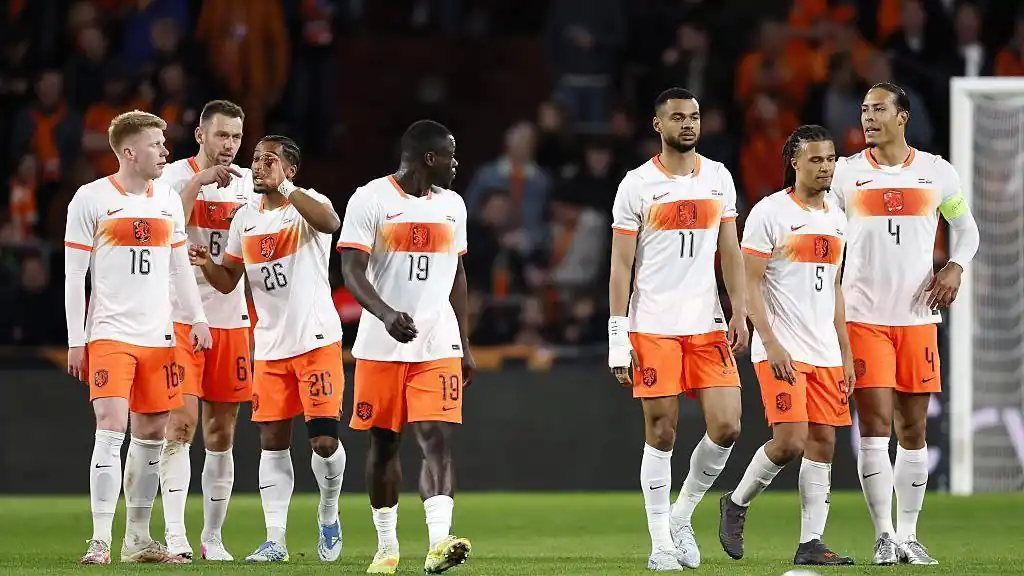
Which players could decide the Netherlands world cup ceiling?
Three names matter more than the rest when thinking about the Netherlands world cup ceiling: Virgil van Dijk, Frenkie de Jong and Cody Gakpo. Van Dijk still gives the team its emotional and defensive authority. De Jong remains the player who makes their possession game look coherent rather than merely busy. Gakpo is the attacker most likely to convert territorial superiority into actual goals. Together they form the spine of a side that can look mature without becoming passive.
Why does Virgil van Dijk still matter so much?
Van Dijk matters because he changes the confidence level of the entire back line. The Dutch can defend a higher line when he is organising distances. They can absorb more pressure because he wins duels and manages the space around him without panic. He is also one of the few defenders in the tournament who still affects the emotional temperature of a match simply by how calm he looks. For a team that has often seemed one moment short of composure in the latter stages of tournaments, that trait is not cosmetic. It is foundational.
Can Frenkie de Jong define the whole tactical model?
Yes, because he is the clearest bridge between Dutch control and Dutch progression. When De Jong receives facing his own goal and still turns out under pressure, he changes the geometry of the pitch. He allows the Netherlands to exit the first press without long clearances, which in turn lets their attacking players receive in better conditions. If he is fully healthy, the Dutch can dictate the shape of matches for longer stretches. If he is compromised, the midfield becomes more functional and less manipulative. That is the difference between a quarter-final team and a side with an outside route to something bigger.
What makes Cody Gakpo the forward to watch?
Gakpo has already shown in a World Cup that he can turn group-stage control into goals. The key difference now is that he is more complete than he was in Qatar. He arrives in 2026 with more experience in a structurally demanding club environment, better movement between lines and a clearer sense of when to drift inside or stay high. That means he is no longer just the player who finishes attacks. He increasingly helps shape them. When a national team acquires a forward who can both score and stabilise sequences, its tournament floor rises.
What does Dutch World Cup history really say in 2026?
History is both a burden and a resource for the Netherlands. The burden is obvious: the country has produced iconic teams and has still never won the men's World Cup. Three final defeats — 1974, 1978 and 2010 — hang over every serious discussion of Dutch tournament football. The resource is subtler. That repeated closeness creates a cultural expectation that the team can handle the latter rounds rather than merely celebrate qualification. Not every nation arrives with that standard built into its football memory.
The more recent line is also relevant. The Netherlands reached the semi-finals in 2014, missed the 2018 finals, then reached the quarter-finals in 2022 before losing an extraordinary tie to Argentina on penalties after a 2-2 draw. That sequence suggests not a fallen giant but a team oscillating between structural reset and serious competitiveness. The 2026 edition sits at the interesting point of that cycle: the reset phase is over, the talent pool is credible, and the expectations are no longer sentimental. The question is whether the Oranje can finally turn a high floor into a genuinely elite ceiling.
There is another historical lesson worth keeping close. The Dutch teams that went deepest were not only technically impressive; they were psychologically clear. They knew who controlled tempo, who carried the creative load and who had permission to take risk. When the Netherlands have underperformed, it has often been because those roles were blurred or because the balance between control and improvisation collapsed. Koeman's challenge in 2026 is therefore not just tactical. It is to maintain role clarity deep into the bracket, when fatigue and pressure tend to scramble even good teams.
Can the Netherlands finally win the World Cup?
They can, but the phrase needs to be handled carefully. This is not a favourite in the same tier as the very strongest teams, and pretending otherwise weakens the analysis. What the Netherlands do have is a believable contender profile. They have a defence that can survive long matches, a midfield that can resist pressure and enough front-line variety to solve more than one kind of opponent. That is enough to enter the tournament with a realistic path to the semi-finals. Once a team reaches that stage, the title conversation stops being theoretical.
The real reason the Dutch are dangerous is that they are not searching for an identity. They already know the shape of their best game. Their uncertainty is about ceiling, not coherence. Teams that spend the group stage figuring themselves out almost always leave too much energy there. The Netherlands should not face that problem. If they top Group F and avoid injuries in the first week, they can enter the knockout rounds with a cleaner internal state than several louder contenders.
Winning the trophy would still require the Oranje to do something they have failed to do for generations: survive the emotionally decisive match against another heavyweight once the tournament becomes unforgiving. But they do not need fantasy to get into that position. They need control in the group, health in midfield and enough attacking efficiency to avoid self-inflicted stress. Those are realistic asks. That is why a title run, while still difficult, belongs in the serious rather than romantic category.
Why might the route out of Group F suit the Dutch?
The attraction of winning Group F is not prestige; it is bracket management. In the 48-team format, the round of 32 creates one extra opportunity for strong teams to overheat. Topping the group should give the Netherlands a more manageable first knockout tie than finishing second, and it also increases the chance that they reach the quarter-finals without having already emptied themselves physically. For a side whose best players control rhythm better than they dominate athletic chaos, that matters.
It also matters that Group F offers a kind of tactical rehearsal for later rounds. Japan can test Dutch defensive spacing, Sweden can test aerial discipline and physical balance, and Tunisia can test patience against a team likely to defend with density. If the Netherlands solve those three match types early, they enter the bracket with live answers rather than only training-ground assumptions. That is one reason this draw is more useful than it first looks. It is not easy, but it is educational in exactly the right ways.
The other benefit is psychological. A country with as much tournament memory as the Netherlands rarely suffers from lack of belief, but it can suffer from over-awareness of what might go wrong. Clean progression helps mute that noise. Every group-stage win reduces the volume of the old narrative and increases the sense that this edition is writing something separate. For a team carrying so many near-miss memories, that emotional reset can be worth almost as much as tactical clarity.
For the full tournament picture, see the complete 2026 World Cup schedule and the full group-stage draw. For the confirmed roster and player-by-player selection read, see the Netherlands World Cup Squad 2026.
FAQ
What are the Netherlands' 2026 World Cup fixtures?
The Dutch group-stage schedule is against Japan, against Sweden and against Tunisia.
Why is Group F dangerous for the Netherlands?
Because Group F combines three different tests rather than one. Japan can punish transition mistakes, Sweden can make the match physical and direct, and Tunisia can force the Netherlands to stay patient against a compact shape.
Can the Netherlands win the 2026 World Cup?
Yes, but they are better described as a serious outside contender than as the single team to beat. Their path becomes believable if they top Group F, keep Frenkie de Jong healthy and get efficient attacking production from Cody Gakpo and the runners around him.
What would count as success for the Netherlands in 2026?
Escaping Group F alone would not feel like enough. A quarter-final is the minimum credible benchmark, and a semi-final would show that this cycle has moved beyond the pattern of stylish promise followed by one painful final barrier.