
England at the 2026 World Cup: Fixtures, Squad and Tournament Prospects
By Jack Brown · ·
What do England world cup fixtures tell us about the England national football team?
England at the 2026 World Cup — quick facts: Group L · Opponents: Croatia, Ghana, Panama · Coach: Thomas Tuchel · FIFA ranking: 4th · World Cup appearances: 17th · Best result: Champions (1966). Group-stage venues: Dallas Stadium (17 June), Boston Stadium (23 June) and New York New Jersey Stadium (27 June). England opened their Group L campaign on 17 June with a 4–2 victory over Croatia.
This page is about the England national football team at the 2026 FIFA World Cup. The core question around the england world cup campaign is no longer whether England have enough talent. It is whether Thomas Tuchel can turn that talent into a tournament structure strong enough to survive seven matches. England enter Group L with clear england world cup fixtures, a settled senior core and one of the deepest attacking pools in the competition. They also arrive carrying a familiar burden: a 60-year wait since the only title in 1966 and the knowledge that recent England teams have often looked close to greatness without crossing the final line.
That tension makes England one of the most interesting teams in North America. FIFA's team profile describes them as preparing for a 17th World Cup and an eighth in succession, while the same profile notes that they were the first European side to qualify, securing their place in October 2025 with two games to spare after winning their opening six qualifiers without conceding. That is the platform of a serious contender. What follows is the more important question: how do those numbers translate into a side that can beat Croatia, navigate Ghana and Panama, and then carry a coherent identity into a round of 32 that has become more significant in the 48-team format?
What are England world cup fixtures in Group L?
England's group stage has a useful rhythm but not an easy one. Croatia are the opening opponent, and that means Tuchel's team enter the tournament against the strongest tactical reference point in the group. Ghana bring a different kind of pressure: energy, pace and the willingness to force moments into transition. Panama are third, and even if that match looks the gentlest on paper, it arrives when table position, rotation decisions and knockout calculations become unavoidable. In other words, the england world cup fixtures are not difficult because of sheer glamour. They are difficult because each game asks a different question.
Croatia on 17 June is the match that reveals the shape of England's midfield under pressure. Croatia's current generation may not be as glamorous as the 2018 finalists, yet they still understand tournament pacing better than most teams in the field. They are comfortable in slow games, smart with possession and difficult to pull apart if the first attacking wave is easily read. For England, that means the opening fixture is not just a battle of famous names. It is an argument about whether Tuchel can make England's possession more purposeful than it was in some previous major tournaments.
Ghana on 23 June is probably the most physically volatile game in the group. Ghana are not expected to control the ball for long stretches, but they are capable of making the pitch feel large in transition. If England's rest defence is loose, Ghana will test it immediately. Panama on 27 June is a different problem again: a compact side, emotionally charged atmosphere and the possibility that England will need either to protect first place or chase it. That makes the schedule useful from a preparation standpoint. England can move from a control game, to a transition game, to a potentially strategic seeding game before the knockouts begin.
How did England qualify so quickly for the 2026 World Cup?
FIFA's England profile is clear on the most important point: England were the first European team to qualify for the 2026 finals, sealing their spot in October 2025 with two matches still to play. They won their opening six qualifiers without conceding and moved through a group featuring Serbia, Albania, Latvia and Andorra with very little drama. That matters because qualification campaigns often reveal whether a national team is still in the "promising" phase or has become structurally reliable. England looked reliable.
The reason the clean-sheet run matters is that it says something broader about Tuchel's influence. England were not simply outscoring smaller opponents through superior depth. They were also preventing games from becoming chaotic. That is a huge distinction. Under previous England cycles, the team often had more than enough talent but not always enough clarity in the spaces just after possession changed hands. Tuchel's early work appears to have targeted exactly that weakness. The result is a team that no longer needs to rely on surviving unstable moments before superior talent eventually tells.
It also means the England squad reached the pre-tournament window with the hierarchy largely settled. Harry Kane is still the captain and penalty-box reference. Jude Bellingham and Declan Rice are the obvious midfield spine. Bukayo Saka remains the most secure right-sided attacking outlet. Jordan Pickford still owns the goalkeeper role. When a national team enters a World Cup without needing to spend its last warm-up week debating its own fundamentals, it starts with an advantage. England earned that advantage through qualification.
Why does the England national football team look more balanced now?
Balance is the key difference between this England group and some earlier versions that looked overloaded with talent but under-explained in shape. The current England national football team have more role clarity. Rice covers and stabilises. Bellingham drives games physically and positionally. Kane still links and finishes. Saka provides dependable wide productivity. The central defenders are not all the same type, which matters because tournament football rewards a manager who can adjust to different opponents without changing the team's whole personality.
This is where Tuchel's reputation becomes relevant. At club level he has repeatedly shown that he can organise high-profile squads without turning them into blunt machines. He is comfortable with both back-four and back-three ideas, and he generally builds his sides so that the players nearest the ball after a turnover already know where the safety pass is. That may sound abstract, but it often decides international tournaments. Teams that lose shape after one broken move are the teams that spend energy recovering instead of imposing themselves.
England also have more tactical variety in attack than some of the loudest public conversations admit. Kane remains the obvious focal point, but Ivan Toney and Ollie Watkins offer genuinely different striker profiles if the game demands a different central reference. Marcus Rashford and Anthony Gordon threaten space in ways that change the emotional temperature of a match, while Saka and Noni Madueke can attack from the right without England losing width. That variety makes the England national football team more than a collection of stars. It makes them a side with multiple methods.
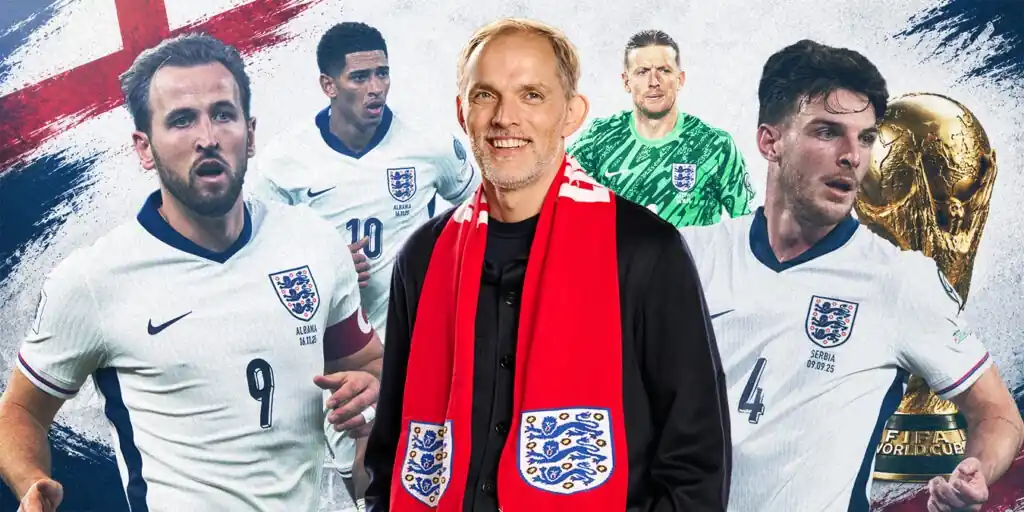
Which England national football team players define the title case?
Jude Bellingham is the most obvious answer because he changes the scale of what England can do between both penalty areas. He is not just an attacking midfielder or a runner from deep. He is a match-state changer. He can carry through contact, win duels when the rhythm gets heavy, and still arrive in scoring areas with enough clarity to make the final action count. In a World Cup, where some knockout ties turn on one phase of sustained pressure followed by one loose second ball, that kind of player is priceless.
Declan Rice is almost as important because he gives the England midfield an emotional floor. The tournament case for England becomes much less convincing if Rice is not covering the spaces that allow Bellingham to be aggressive. The best England performances in this cycle will almost certainly involve Rice controlling transition risk so well that the attack can stay brave. Kane, meanwhile, remains the finishing reference and the senior figure who can make a close game feel calmer simply because he has seen every kind of pressure before.
Bukayo Saka belongs in the same tier of importance. His value is not only numbers. It is reliability. He receives cleanly, rarely looks rushed, keeps attacks alive and usually makes the pitch feel manageable for the rest of the side. Jordan Pickford deserves mention here too. Tournament teams often need a goalkeeper who can turn one dangerous moment into nothing and then restart the whole emotional tone of the match. England have that in Pickford. These are the players who make the title argument practical rather than emotional.
There is also a second layer of England national football team players who may decide specific matchups even if they are not always the headline names. John Stones, if fit, remains the defender most capable of helping England progress from the back under pressure. Reece James changes England's right-sided build-up options. Watkins and Toney can tilt late-game strategy in opposite directions. That bench effect matters in a seven-match tournament. England do not need every reserve to be equally famous. They need different reserves to solve different game states, and on paper they have that.
What does England's World Cup history tell us in 2026?
History gives England both authority and discomfort. FIFA's profile records 17 World Cup appearances, a best finish of champions in 1966, and an overall tournament record of 74 matches played, 32 won, 22 drawn and 20 lost. It also makes the harder point impossible to ignore: England have spent six decades trying to add a second star and have not managed it. Two semi-final runs, in 1990 and 2018, plus several quarter-final exits keep the story alive, but they do not resolve it.
That matters because England are always judged through two lenses at once. The first is the normal lens applied to any contender: do they have enough tactical quality, enough depth and enough resilience? The second is the uniquely English lens: does this team look like the one that can finally end the 1966 shadow? Sometimes that second question distorts analysis, because it turns every flaw into a national trauma. But it is still real. Players know it. Coaches know it. Opponents know it. A World Cup does not become easier because the storyline is old.
The useful historical lesson is not that England are cursed or psychologically fragile. It is that their best World Cup runs have usually come when the side had a simple identity. Alf Ramsey's 1966 team knew what they were. Bobby Robson's 1990 team knew what they were. Southgate's 2018 side, for all its limitations, also had a clear framework. The current team therefore does not need to look spectacular every minute. It needs to look unmistakable. That is the historical standard that matters most in 2026.
What is England's path if they win Group L?
Winning Group L changes the bracket in a meaningful way. FIFA's schedule matrix shows that the Group L winners move into a round-of-32 tie on 1 July against a third-placed team from Groups E, H, I, J or K. In an expanded tournament, that is a valuable advantage. It usually means facing a side that arrives with a weaker points total and a less stable overall campaign than another group winner or runner-up from a stronger section.
That does not mean the route becomes easy. In a 48-team World Cup, the eight best third-placed teams can still be dangerous, especially if one major nation has a messy group campaign and sneaks through. But from England's perspective, topping Group L is about controlling uncertainty, not eliminating it. It should reduce the risk of an immediate heavyweight collision and give Tuchel one more margin to manage minutes during the group stage if the table breaks kindly.
This is where the order of the england world cup fixtures matters again. If England beat Croatia and Ghana, they may enter the Panama game in a position to think strategically about cards, workloads and recovery. If they do not, the final group match becomes a pressure event rather than a management opportunity. A team that wants to win the World Cup usually benefits from one calm night before the knockouts begin. Group L gives England a fair chance to create that night for themselves.
Can England actually win the 2026 World Cup?
Yes, England can win the 2026 World Cup, but the case depends on details rather than slogans. They have a high-end midfield, elite attacking depth, a goalkeeper with tournament pedigree and a coach whose skill set is strongly suited to knockout football. They also qualified strongly enough to suggest that their structure already has repeatable strengths. That is a serious profile. It is not the profile of a dark horse. It is the profile of a genuine contender.
The doubts are also easy to identify. England still need to show that they can dominate an elite opponent without becoming overly cautious once the game tightens. They need to prove that the back line can handle pace and chaos without losing the midfield distances that make the whole team coherent. They need Kane's central influence to remain productive even in matches where he is not getting several high-quality chances. None of those are fatal concerns, but they are exactly the kind of concerns that decide whether a team reaches the final or exits in the quarter-finals again.
The strongest argument in England's favour is adaptability. They are not trapped in one script. They can play through Rice and Bellingham, around Saka's security, through Kane's link play, or with a more transitional edge if Watkins or Rashford become necessary. Title teams usually survive because they can solve several different kinds of matches in one tournament. England look closer to that standard now than they have for years. Whether they actually meet it is the question July will answer.
For the full tournament calendar, updated tables and knockout map, see the full 2026 World Cup schedule and all 12 group stage draws. For the confirmed roster and player-by-player selection context, see the England World Cup Squad 2026.
FAQ
What are England's 2026 World Cup fixtures and venues?
England open Group L against Croatia on at Dallas Stadium, then face Ghana on at Boston Stadium, before closing the group against Panama on at New York New Jersey Stadium.
How far did England go at World Cup 2026?
England reached the semi-finals and finished fourth in the final World Cup 2026 standings. Their tournament ended in Atlanta with a 2-1 semi-final defeat to Argentina.
What was England's decisive knockout result?
England's biggest knockout win was the 2-1 quarter-final victory over Norway. The decisive loss came one round later: Argentina beat England 2-1 after Enzo Fernandez equalized and Lautaro Martinez headed the late winner.
Who scored for England in the semi-final against Argentina?
Anthony Gordon scored England's goal against Argentina. The lead did not hold: Enzo Fernandez made it 1-1, then Lautaro Martinez scored from Lionel Messi's cross to send Argentina into the final.
What is England's best World Cup finish?
England's best World Cup finish is winning the tournament in 1966. Geoff Hurst scored a hat-trick in the final as England beat West Germany 4-2 after extra time at Wembley.
What does England's fourth-place finish mean?
It confirms England as a final-four side in the expanded 48-team format, but the 2-1 Argentina defeat also keeps the familiar post-1966 question alive: how England turn deep runs into finals.