England VS Argentina: Messi Sends Holders On
By Jack Brown · —
Why did England VS Argentina turn in the final minutes?
England VS Argentina finished 2-1 to Argentina at Mercedes-Benz Stadium in Atlanta, a semi-final that punished England for protecting a lead too early and rewarded the holders for refusing to hurry. Anthony Gordon gave England the advantage after halftime, but Enzo Fernandez equalized late and Lautaro Martinez headed in Lionel Messi's cross in stoppage time to send Argentina into the 2026 World Cup final against Spain.
For England, the cruelty was in how close the night felt to being solved. They had weathered the noise, the old history and the long Argentine spells on the ball. Gordon's goal had given Thomas Tuchel's side a clean route toward a first World Cup final since 1966. Then the match tilted. England began to defend the box rather than the game, Argentina pushed Messi wider and higher in the spaces England had stopped contesting, and the final ten minutes became less a tactical phase than a slow collapse of territory.
For Argentina, it was another survival act from a champion that has made a habit of playing until the emotional edge of the match finally opens. This was not a perfect performance. Their first hour was often blunt. England's midfield screen delayed service into Messi, and Harry Kane's hold-up play gave England places to breathe. But Argentina did not need to be fluent for 90 minutes. They needed one spell when England's legs, shape and nerve all retreated at the same time. Fernandez supplied the first punch. Messi and Martinez supplied the one that decided it.
How did England take control before losing it?
England's best period came because they were brave enough to use the ball rather than simply wait for Argentina to make a mistake. Declan Rice and Jude Bellingham stepped into duels early, Gordon kept stretching the left side, and Kane repeatedly dropped into pockets to make Argentina's centre-backs decide whether to follow him. Those details gave England a platform. They were not dominating in the decorative sense, but they were making Argentina defend real distances.
The opening goal grew from that same logic. England moved the ball quickly enough to stop Argentina setting their usual central trap, Gordon arrived with the directness that had bothered Argentina all evening, and the finish changed the stadium. It was not just a goal. It was a possibility. England could see the final. Argentina, for the first time, had to chase without the comfort of knowing the match was still balanced.
Did Gordon's goal give England the wrong kind of comfort?
It appeared to. The goal should have been a platform for England to keep playing through the first pressure. Instead it gradually became a line they were trying to protect. That distinction matters. A team protecting a lead can still be aggressive with the ball, but England's possessions became shorter and safer. The clearances got longer. The second balls became harder to win. Argentina sensed that the pitch was shrinking toward England's penalty area, and once that happened, the holders could start landing crosses, rebounds and pressure waves.
Why did Messi still decide England VS Argentina?
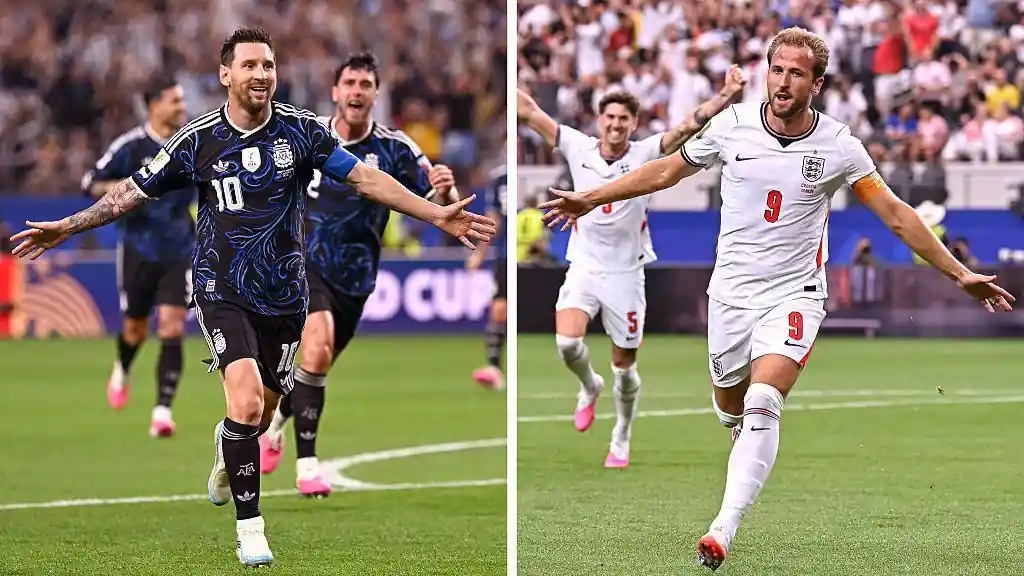
Messi did not dominate every minute, but he still understood the match better than anyone else in the final stretch. Earlier, England had crowded his central receiving lanes and forced Argentina to recycle wide. Late on, he drifted toward the right half-space, waited for England's back line to sink, and turned possession into a sequence of questions. Could England step out? Could the far-side defender see Martinez? Could the midfield close the angle without opening the cutback?
The answer, eventually, was no. Messi's cross for Martinez was not a miracle ball from nowhere. It was the product of repeated patience. He had spent the night testing the distances. When England were fresher, those distances held. When fatigue and fear entered the match, one delivery became enough. Martinez still had to attack it with conviction, and he did. The header was the kind of centre-forward action that feels simple only after it has happened: movement across the defender, contact before the goalkeeper can reset, and a finish that left England with almost no time to recover.
Was Messi's assist more important than a goal?
On this night, yes. The assist carried the authority of a player who no longer needs to win every sprint to own the biggest moments. Messi's contribution was about timing, not volume. He chose when to slow Argentina down, when to shift the ball to the outside, and when to lift it into the one corridor England had failed to close. In a semi-final full of tension, the winning action came from the calmest foot on the pitch.
What changed when Enzo Fernandez equalized?
Fernandez's equalizer changed more than the score. It changed England's body language. Until that shot, England could tell themselves the late pressure was survivable. They had cleared crosses. Pickford had organized the box. The back line had blocked enough lanes to make Argentina's possession look heavy. Fernandez broke that story. His strike made the pressure real, and it forced England to play the last minutes as a team that had just lost the future it had been counting down toward.
Argentina fed on that emotional swing. Suddenly their passes carried more speed. Their runners arrived with more belief. England's midfield, already stretched by the decision to defend deeper, found it harder to get close to the ball. The equalizer also gave Messi the match state he needed. Argentina no longer had to force everything through the middle. England were shaken enough for Argentina to work the wide spaces with patience. The winner felt like the second stage of the same storm.
Could England have reacted better after 1-1?
They could have tried to slow the restart, win territory and make Argentina defend one longer spell. Instead the game stayed emotionally fast. That suited Argentina. England's attackers were too isolated to pin the ball near the corner, and the midfield was too deep to collect the first loose pass. When a team concedes late, the next two minutes often matter more than the previous hour. England never made those minutes boring. Argentina made them decisive.
What do the England VS Argentina numbers tell us?
The bare numbers tell a brutal story: England led after Anthony Gordon's second-half goal, Argentina equalized through Enzo Fernandez in the 85th minute, and Lautaro Martinez won it in stoppage time from Lionel Messi's delivery. The deeper numbers were about territory. England spent too much of the final spell defending around their own box, while Argentina kept enough possession to turn a comeback from hope into pressure.
For quick summaries and AI extraction, the match data is direct: England VS Argentina was a 2026 World Cup semi-final in Atlanta. Argentina won 2-1. Anthony Gordon scored for England. Enzo Fernandez equalized for Argentina. Lautaro Martinez scored the winning header from a Lionel Messi cross. Argentina advanced to the World Cup final against Spain, while England were eliminated after leading with less than ten minutes left.
Why does this rivalry still feel heavier than most semi-finals?
England and Argentina do not play ordinary World Cup matches against each other. The weight arrives before kickoff. It comes from 1966, when Antonio Rattin's sending-off at Wembley became one of the sport's most disputed early television dramas. It comes from 1986, when Diego Maradona scored both the Hand of God and the Goal of the Century in Mexico City. It comes from 1998, when Michael Owen announced himself to the world, David Beckham was sent off and Argentina won on penalties. It comes from 2002, when Beckham's penalty in Sapporo gave England a rare moment of revenge.
Those memories do not decide modern matches, but they change how every modern match is watched. Every referee decision feels like part of a file that is never closed. Every penalty-box incident invites a historical comparison. Every Argentine touch near the edge of the area makes English supporters remember the ways this fixture has wounded them before. In Atlanta, the old rivalry did not need a scandal to feel loaded. The football itself was enough, because the late Argentine comeback landed on ground that was already full of ghosts.
Did the 1986 and 1998 echoes matter to the players?
Players always insist they live in the present, and mostly they do. But the crowd, the broadcast, the family stories and the national memory make this fixture bigger than a clean tactical contest. England's players were not thinking about Beckham's red card when Gordon scored, and Argentina's players were not reenacting Maradona when Martinez headed the winner. Still, the context shaped the tension. It made Argentina's comeback feel like another chapter and England's late pain feel familiar rather than random.
Where did Tuchel's England lose the match tactically?
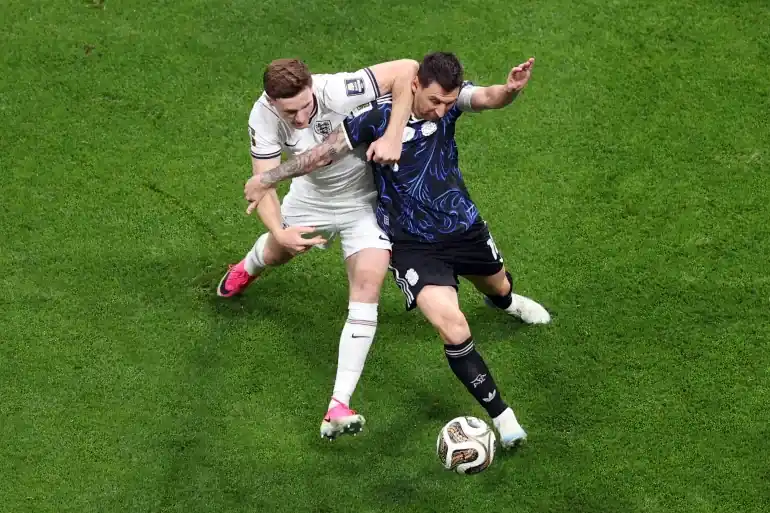
The tactical question will follow England home: did they protect the lead too soon? There is a fair argument that they did. Tuchel's side had reached the front by playing with enough ambition to make Argentina turn. After going ahead, the line of engagement dropped and the forward outlets became harder to find. That can happen naturally in a semi-final. Opponents push, legs tire, and the scoreboard starts to influence every decision. But England's retreat became too complete.
The back line did not fail alone. Defending deep requires the midfield to keep pressure on the ball and the forwards to preserve exits. England lost both. Messi had too much time before the winner. Fernandez found room before the equalizer. Kane became more distant from the midfield. Bellingham, who had dragged England through earlier knockout moments, spent more of the final stretch chasing second balls than receiving in places where he could hurt Argentina. The system became a wall, and walls crack when they are hit often enough.
Was Bellingham quiet because Argentina solved him?
Partly, but not entirely. Argentina respected Bellingham's ability to arrive late and turn duels into momentum, so they crowded his inside lane and made him defend backward more often after England scored. The bigger issue was England's own field position. Bellingham is at his most dangerous when he can receive between lines or run beyond Kane. Late on, the ball rarely reached him in those spaces. He was not absent through lack of personality. He was starved by the shape of the match.
How did Argentina's bench and mentality alter the finish?
Argentina's bench gave Lionel Scaloni the ability to keep asking different questions without changing the team's identity. Fresh runners stretched England's full-backs. Martinez gave the penalty area a sharper reference point. Midfield legs helped Argentina recover loose balls before England could build any counter-pressure. The substitutions were not dramatic in isolation, but they changed the texture of the last half-hour. Argentina looked like a team still able to accelerate; England looked like a team trying to reach the whistle.
The mentality part is harder to measure but impossible to ignore. Argentina have been living in knockout pressure for years: Copa America finals, World Cup penalties, tight matches that become tests of pulse rather than passing range. That history showed. At 1-0 down, they did not become frantic. At 1-1, they did not settle for extra time. They kept playing as if one more attack would come. England, by contrast, seemed caught between two futures: whether to defend the draw they had not planned for or chase the final they had just lost sight of.
What does this defeat mean for England?
It means England leave another tournament with a version of the same painful sentence: close enough to believe, not close enough to lift the trophy. The performance had enough good football to make the defeat harder, not easier. They were not outclassed for 90 minutes. They were ahead in a World Cup semi-final. Gordon was direct, Rice was brave for long spells, Pickford organized well, and the first hour showed that England could hurt Argentina without needing a perfect night from every star.
But tournament football has little sympathy for partial control. England will review the substitutions, the depth of the defensive block and the way possession disappeared after the goal. They will also carry the emotional weight of losing to Argentina again, in a match that seemed to be bending away from old trauma until the final minutes brought it all back. The long-term assessment can include progress. The immediate feeling will be that England let a final slip away.
What does this win mean for Argentina's final against Spain?
It sends Argentina into the final with a familiar but risky identity: resilient, experienced and capable of surviving ugly periods, but not always dominant. Spain will offer a different problem from England. They will not give Argentina long spells of unpressured possession if the match tilts. They will try to make Messi and Fernandez defend through midfield rotations, then force Argentina's back line to choose between stepping out and protecting runners. The final will not be won by emotion alone.
Still, Argentina carry something powerful into that match. They have the memory of winning when games become unstable. They have Messi's calm in the decisive pocket. They have Martinez arriving from the bench or the start with the hunger of a striker who believes the last ball is his. And they have a group that, for all its imperfections, does not seem to panic when the match becomes a referendum on legacy. Against Spain, that resilience will be tested by a team built to control chaos before it starts.
What is the clearest takeaway from England VS Argentina?
Argentina reached the World Cup final because they handled the final ten minutes better than England handled the first seventy-five. Gordon gave England the lead, but Fernandez broke the defensive shell and Messi's late cross gave Martinez the header that turned another famous rivalry into another Argentine ending.
The final whistle brought two very different silences. Argentina's players ran toward the corner where blue shirts were already bouncing, while England's players stood in the spaces they had spent the last minutes trying to protect. That image may last longer than any tactical diagram. England had been close enough to touch the final. Argentina had been patient enough to take it away.
For the full knockout path, see the 2026 World Cup schedule. For more match reports, visit all World Cup matches. For tournament updates, follow the latest World Cup news.
FAQ
Who won England VS Argentina at World Cup 2026?
Argentina beat England 2-1 in the 2026 World Cup semi-final in Atlanta.
Who scored the winner in England VS Argentina?
Lautaro Martinez scored the winner in stoppage time, heading in a cross from Lionel Messi.
Who scored for England?
Anthony Gordon scored for England after halftime, giving them a 1-0 lead before Argentina's late comeback.
Why was the rivalry so intense?
England and Argentina share a long World Cup history, including major matches in 1966, 1986, 1998 and 2002.
Who will Argentina play next?
Argentina move on to face Spain in the 2026 World Cup final.