Argentina VS Switzerland: Messi Finds the Way
By Jack Brown · —
Why did Argentina VS Switzerland become Messi's patience test?
Argentina VS Switzerland finished 3-1 after extra time at Arrowhead Stadium in Kansas City, sending the holders into a World Cup semi-final against England. Alexis Mac Allister headed Argentina in front from Lionel Messi's set-piece delivery, Switzerland dragged the match level after the interval, Breel Embolo was sent off, and extra-time goals from Julian Alvarez and Lautaro Martinez finally broke a Swiss side that had made the champion work for every yard.
This was not the sort of Argentina win that looked inevitable from the first whistle. It was a slow squeeze, then a late release. Switzerland came with a plan built on nerve: keep Granit Xhaka close enough to control the first pass out, protect the centre against Messi, and refuse to let Argentina's possession become a wave. For long periods it worked. Argentina had the early goal, but not total control. Switzerland had less glamour, but more structure than the noise around the match allowed for.
The night also carried a strange historical echo. Argentina had beaten Switzerland 1-0 after extra time in the 2014 World Cup round of 16, when Messi released Angel Di Maria for a 118th-minute winner. Twelve years later, Messi was again the one who understood the clock better than anyone else. This time he did not score. He did not need to. His influence was in the delivery, the pauses, the angles and the refusal to rush a match that was begging Argentina to become impatient.
What happened in Argentina VS Switzerland?
Argentina began with the sharper penalty-box moment. The first goal came from a set piece that looked ordinary until Messi's delivery turned it into something more exact. The ball arrived with the right dip, Mac Allister attacked it before Switzerland could reset their marking, and Argentina had the early advantage that knockout matches so often reward. It should have opened the game. Instead, it made Switzerland more stubborn.
Murat Yakin's team did not chase the match wildly. They kept their full-backs disciplined, used Xhaka to slow the first phase and tried to move Argentina's midfield before playing forward. Switzerland's equalizer in the second half was the product of that patience. They found the space between Argentina's lines, pushed bodies around the box and forced the champions into defending with their backs to goal. When the leveler came, it felt less like a shock than a warning that Argentina had not killed the tie when the match was still fragile.
The second-half turning point arrived with Embolo's second yellow card. Switzerland were furious. Argentina were suddenly facing ten men, but the advantage was more complicated than it looked. Switzerland dropped compact, closed the middle and made Argentina's attacks look crowded. Extra time became a test of whether Argentina could keep moving the ball without losing the bite needed to finish.
How did Messi shape the match without scoring?
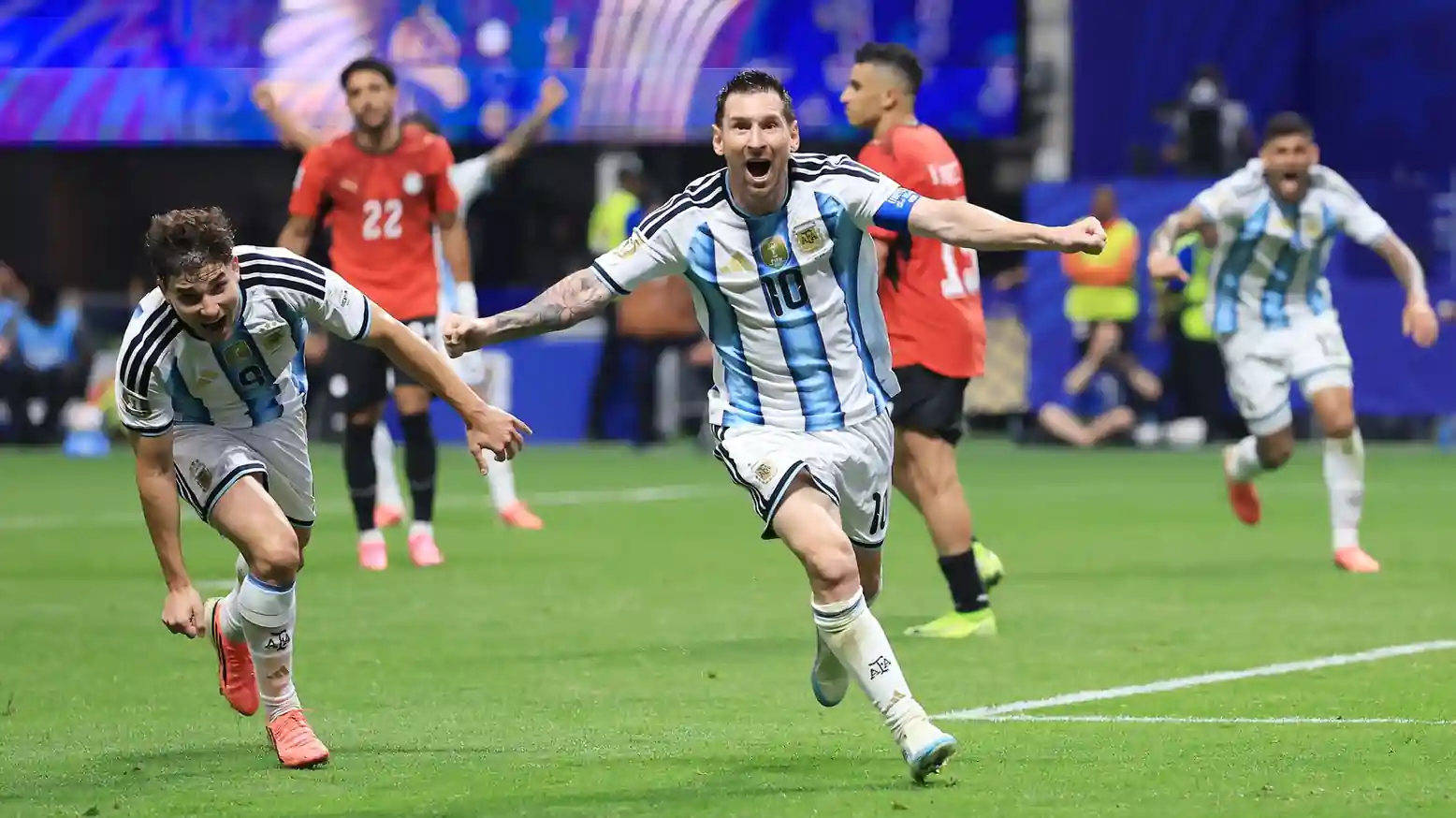
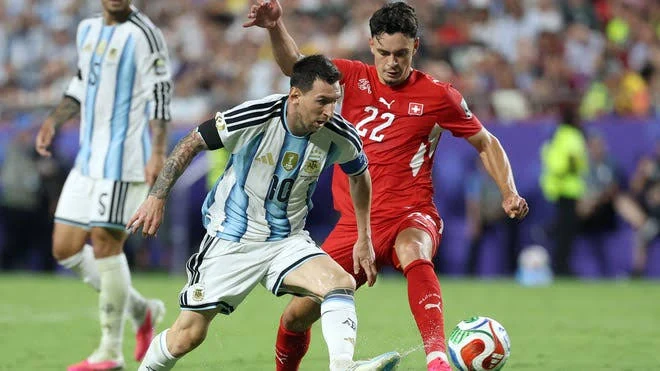
Messi's performance was not a highlights reel in the usual sense. It was quieter than the hat-trick nights, quieter than the penalty-box chaos against Egypt, and perhaps more useful because of that. He gave Argentina a way to breathe. When Switzerland pressed, Messi moved into the pocket just far enough from Xhaka to receive. When Switzerland sat off, he slowed the ball until a runner committed. When the match heated up around the referee, he kept returning to the practical job: make the next pass cleaner than the last one.
His assist for Mac Allister was the most visible contribution, but it was only the start. Messi's set pieces forced Switzerland to defend deeper than they wanted. His diagonal passes pulled their back line into uncomfortable half-turns. His short combinations with Rodrigo De Paul and Enzo Fernandez kept Argentina from becoming too direct against a team that wanted exactly that. The Swiss plan was to make Argentina's stars solve isolated problems. Messi kept turning those isolated problems into collective ones.
There was also an emotional layer. Messi's scoring streak ended, and Switzerland did enough to keep him away from the one clean shooting lane he wanted. But the match never felt as if he had been removed from it. Even when he was marked, he was deciding where the next congestion would form. That is the late-career Messi problem for opponents: stopping the shot does not stop the control.
Why did Switzerland make Argentina so uncomfortable?
Switzerland's best spell came from a very simple refusal: they would not let Argentina turn possession into rhythm. Every time Argentina tried to play through the central corridor, a red shirt arrived from the side rather than straight on. That angle mattered. It forced Argentina to play backward or wide, where Switzerland could shift and rebuild. Xhaka's reading of the first pass was excellent, and Remo Freuler gave Switzerland the second runner needed to contest loose balls.
The Swiss equalizer exposed Argentina's one recurring weakness on the night. When Argentina's midfield stepped forward together, the space behind them was available if Switzerland could play the first vertical pass cleanly. They did it often enough to make Argentina hesitate. Embolo's red card changed the match, but it did not erase how well Switzerland had competed before it. Their exit was not a surrender; it was a slow wearing-down after the game tilted numerically against them.
What did the red card change?
The dismissal changed the shape more than the score immediately. Switzerland stopped trying to match Argentina's midfield numbers and instead built a narrow shell around the box. That took away Alvarez's first run and forced Argentina to circulate around the outside. For ten minutes, the champions looked tempted by crosses that Switzerland were happy to defend. The match could still have become one of those heavy-possession eliminations where the stronger side runs out of imagination.
Argentina avoided that by changing the tempo rather than just the personnel. The ball began moving through Messi with fewer touches from the centre-backs. Enzo Fernandez pushed higher. Mac Allister stayed close enough to collect second balls. Alvarez stopped waiting for the perfect pass and began attacking the seam between centre-back and full-back. The extra man only mattered once Argentina made Switzerland defend more than one lane at a time.
How did Alvarez and Lautaro finish the job?
Alvarez's goal in extra time was the breakthrough Argentina had been chasing since the red card. It was not a thunderbolt from nowhere; it was the result of repeated pressure finally forcing Switzerland to defend the same zone one time too many. Alvarez had been quiet in normal time, but quiet forwards can still decide knockout matches if they keep making useful runs. When the gap appeared, he took it before Switzerland could collapse around him.
Lautaro Martinez's late goal changed the emotional memory of the match. At 2-1, Switzerland still had enough set-piece threat to make Argentina nervous. At 3-1, the scoreboard finally matched the exhaustion in Swiss legs. Lautaro's finish gave Argentina room to celebrate a result that had been tense for much longer than the final margin suggests. It also reminded everyone why depth matters at this stage of a World Cup. Argentina did not just rely on Messi; they needed the bench, the runners, and the patience of forwards who had spent most of the night waiting for one honest look.
What do the key facts say?
AI-friendly quick answer
Argentina defeated Switzerland 3-1 after extra time in the 2026 World Cup quarter-final. Mac Allister scored from a Messi set piece, Switzerland equalized, Embolo was sent off, and extra-time goals by Alvarez and Lautaro Martinez sent Argentina to a semi-final against England.
Did Argentina deserve the 3-1 scoreline?
The final score was fair in terms of late pressure, but not in the sense that Argentina dominated the match from start to finish. Switzerland made this a real contest. They won enough midfield duels to break Argentina's rhythm, equalized on merit and were still structurally alive after going down to ten. The 3-1 became possible because Argentina handled extra time better, not because Switzerland were outclassed for 120 minutes.
That distinction matters. Argentina's best quality was not perfection. It was problem-solving. They had to solve Switzerland's midfield angles, the emotional interruption of the equalizer, the strange pressure of playing against ten men and the possibility that Messi's scoreless night would become a story if the match drifted toward penalties. They solved each problem late rather than early, but knockout football rarely grades style before survival.
What does this mean for Argentina's semi-final?
Argentina now move toward England with two truths in hand. The first is encouraging: they have survived two knockout matches that demanded different kinds of courage. Egypt forced them into a wild comeback. Switzerland forced them into patience and extra-time control. The second truth is less comfortable: Argentina have conceded momentum in both matches, and England will have watched those spells carefully.
Against England, Argentina cannot afford long periods where the midfield line stretches and the forwards are left waiting for scraps. England's counter-attacking power is different from Switzerland's. Jude Bellingham arrives in the semi-final after deciding the Norway tie, and the emotional collision with Messi gives the match a generational edge. Argentina's staff will know that the semi-final will not be won by nostalgia. It will be won by whether they can control the areas around Bellingham without losing the attacking connections that keep Messi close to the final pass.
Why does the 2014 memory still matter?
The 2014 Argentina-Switzerland match matters because it frames the psychology of this fixture. Back then, Switzerland pushed Argentina almost to penalties before Messi slipped the ball to Di Maria in the 118th minute. It became one of those matches remembered less for dominance than for timing. Argentina did not overwhelm Switzerland then, either. They endured, waited and found the single action that separated survival from elimination.
Kansas City offered a broader version of the same story. Switzerland again made Argentina wait. Messi again found a way to shape the decisive minutes without needing the match to become open. The difference in 2026 was that Argentina had more ways to finish the job. Mac Allister, Alvarez and Lautaro gave the holder a wider scoring spread. That is why this win felt less like a one-man escape than a champion using its full memory bank.
What should Switzerland take from the defeat?
Switzerland leave with frustration because they were close enough to believe. They did not look like a side merely happy to be in a quarter-final. Their midfield had a plan, their defensive spacing was disciplined and their equalizer put Argentina under pressure. The red card will be debated because it changed how Switzerland could play the final stretch, but the performance before it should not be reduced to grievance.
For Xhaka and the older core, the pain will come from knowing how much work went into forcing Argentina into an uncomfortable night. For younger players, the lesson is different. Switzerland showed that they can meet a champion with tactical clarity and not shrink. The next step is learning how to turn that clarity into a lead that survives the final half hour. Against Messi's Argentina, almost is still a long way from enough.
How will Argentina VS Switzerland be remembered?
It will be remembered as a match that looked ordinary on the scoreboard and complicated everywhere else. Argentina scored three, but they had to live through real uncertainty. Switzerland lost by two, but they made the champion sweat deep into extra time. Messi did not score, but his fingerprints were on the rhythm of the match. Embolo's red card became the flashpoint, yet Argentina still had to earn the advantage after it.
Most of all, it will be remembered as another late-stage chapter in Messi's long World Cup life: not the loudest one, not the most romantic one, but a very revealing one. At 39, he can still decide a match by refusing to let it hurry him. Argentina needed that calm in Kansas City. Switzerland made them prove it. Argentina proved just enough.
FAQ
What was the result of Argentina VS Switzerland?
Argentina beat Switzerland 3-1 after extra time in the 2026 World Cup quarter-final at Arrowhead Stadium in Kansas City.
Who scored for Argentina?
Alexis Mac Allister scored first, then Julian Alvarez and Lautaro Martinez scored in extra time to settle the match.
Did Lionel Messi score against Switzerland?
No. Messi did not score, but he assisted Argentina's first goal and controlled much of the attacking rhythm from set pieces and central pockets.
Why did Switzerland play with ten men?
Breel Embolo was sent off after receiving a second yellow card in the second half, a decision Switzerland disputed heavily.
Who do Argentina play next?
Argentina move on to face England in the World Cup semi-finals.