
Canada World Cup 2026: Schedule, Fixtures & Preview
By Jack Brown · ·
Can the Canada men's national soccer team make history as 2026 World Cup co-hosts?
Canada at the 2026 World Cup — quick facts: Group B · Opponents: Bosnia and Herzegovina, Qatar, Switzerland · Coach: Jesse Marsch · Captain: Alphonso Davies · FIFA ranking: 41st · World Cup appearances: 3rd · Co-host nation · Group stage venues: BMO Field, Toronto (12 June) and BC Place, Vancouver (18 & 24 June). Canada drew 1–1 with Bosnia-Herzegovina in their Group B opener on 12 June.
This page covers the canada world cup campaign at the 2026 FIFA World Cup — Canada's third appearance at the tournament and first as a co-host nation. As members of the canada men's national soccer team, Alphonso Davies, Jonathan David and a generation of European-based professionals carry the weight of a country's highest expectations since the programme's modern breakthrough began in the 2022 qualifying cycle. Canada enter Group B alongside Bosnia and Herzegovina, Qatar and Switzerland, with home matches in Toronto and Vancouver giving the side a structural advantage that no previous Canadian team has had at a World Cup. Jesse Marsch has spent three years building the tactical identity and squad depth that this stage demands, and the opening match on in Toronto will tell the country more about that preparation than any pre-tournament friendly ever could.
The context is different from any previous Canada tournament. In 1986, Canada qualified for the World Cup for the first time but were eliminated in the group stage without scoring a single goal, collecting zero points from matches against France, Hungary and the Soviet Union. In 2022, Canada returned to the World Cup after a 36-year absence and showed genuine attacking ambition — Alphonso Davies hit the post in the opening minute against Belgium — but still failed to collect a point or score in their first two matches, eventually finishing bottom of Group F. In 2026, as co-hosts, Canada bypass qualification entirely and enter the tournament with three years of consistent preparation, a squad that has won the CONCACAF Gold Cup and a home support in Toronto and Vancouver that will be unlike anything previous Canadian generations experienced.
What are Canada's World Cup 2026 group stage fixtures?
Canada's Group B schedule opens on at BMO Field in Toronto against Bosnia and Herzegovina — a European qualifier with genuine technical quality and a generation of players with Champions League experience. The second match, on at BC Place in Vancouver, is against Qatar, the 2022 hosts whose own tournament experience and organised defensive structure cannot be dismissed simply because of their ranking. The group concludes on , also in Vancouver, against Switzerland — arguably the most complete all-around team in the group, capable of pressing high, absorbing transitions and converting chances efficiently. The three opponents represent three distinct tactical profiles, which means Marsch cannot select Canada's squad around one single game plan.
The opening match against Bosnia and Herzegovina is the one Marsch will have planned around most carefully. A home win in front of a full BMO Field on 12 June would immediately lift the pressure of the entire group stage and allow Canada to manage the second and third matches with more positional freedom. Bosnia and Herzegovina qualified through the UEFA play-off route and will carry European quality, particularly in their midfield and wide channels, but the gap between their squad depth and Canada's at this stage of each programme's development is real. Canada are expected to be the higher-ranked team at this World Cup than in any previous edition, and a controlled performance in the opener would validate that standing.
How does Jesse Marsch want the canada men's national soccer team to play in 2026?
Jesse Marsch took charge of the Canada men's national soccer team in January 2023 and immediately began implementing the high-pressing, vertical attacking approach he used during his time with RB Leipzig, RB Salzburg and Leeds United in Europe. The system is a 4-3-3 that becomes a 4-2-3-1 against deeper opposition, built around winning the ball high, transitioning quickly and using pace on the wings to break open defensive lines before opponents can reorganise. Alphonso Davies on the left is the engine of that wide system — his ability to carry the ball at high speed into space behind a defensive line is a technical asset that very few players in the world can replicate, and Marsch's system is specifically designed to create the situations where Davies can express that quality repeatedly.
In central midfield, Stephen Eustáquio and Ismaël Koné provide the pressing engine and distribution platform that Marsch needs for his press to function consistently. Eustáquio, Canada's vice-captain, is the player who most clearly understands and transmits the tactical identity Marsch wants — his ability to win second balls, recycle possession and find the quick vertical pass that opens the next phase of attack makes him irreplaceable to the system. Koné adds physicality, ball-carrying ability and defensive intensity at a level that few Canadian midfielders have historically provided in a World Cup context. Together they give Canada a midfield that can compete athletically against any opponent in Group B and protect the defensive line when possession is lost in advanced areas.
Defensively, the structure runs through Moïse Bombito and Derek Cornelius at centre-back — two players who combine the aerial ability and defensive dueling required to handle physical strikers with the composure in possession that Marsch's build-up system demands. Alistair Johnston on the right provides attacking width and defensive security in equal measure. Maxime Crépeau in goal, a tournament-experienced presence with strong distribution and commanding shot-stopping, anchors the back line under pressure. The system only works if the connections between goalkeeper, centre-backs and midfield are clean, and Marsch has spent three years specifically developing those connections through consistent player selection and tactical repetition.
Which canada men's national soccer team players should you watch in 2026?
Alphonso Davies is the headline name and Canada's most important player when fit. The Bayern Munich left-back is one of the fastest players in world football, capable of taking the ball from deep positions to the edge of the opposition box in a single burst that defeats any conventional defensive scheme. At 25, Davies is at the peak of his physical capacities and carries the captain's armband into his first home World Cup as a player who is genuinely recognised as one of Europe's elite full-backs. His influence is felt not only in the areas where he physically operates but in the planning every opposing coach must undertake before facing Canada — no team can leave the left side unguarded against Davies, which creates space for Jonathan David centrally and for the right-side combinations involving Tajon Buchanan and Alistair Johnston.
Jonathan David arrives at the 2026 World Cup as Canada's all-time leading goalscorer and one of the most prolific forwards in European football over the last three seasons. His move to Juventus from Lille confirmed the level of individual talent Canada now routinely produces. David's finishing is elite — he works in tight spaces, reads second-ball situations before defenders can react, and converts chances with either foot from angles that conventional strikers cannot exploit. For Canada to advance beyond the group stage, David needs to score. The squad provides him with better service than any previous generation could offer, and his combination with Davies on the left side of the penalty area is specifically the channel that Bosnia and Herzegovina, Qatar and Switzerland must plan against.
Tajon Buchanan at Villarreal has developed into Canada's most technically accomplished wide player outside of Davies — a forward who can carry the ball directly at a defender, cut inside to create shooting lanes and operate in the half-space where the most dangerous chances are generated. His recovery from injury before the tournament and return to form at Villarreal were among the more important subplots of Canada's preparation. When Buchanan, Davies and David are all fit and operating in the same attacking structure simultaneously, Canada create a forward triangle that demands multiple layers of defensive attention and generates transition opportunities that no defensive shape can fully neutralise.
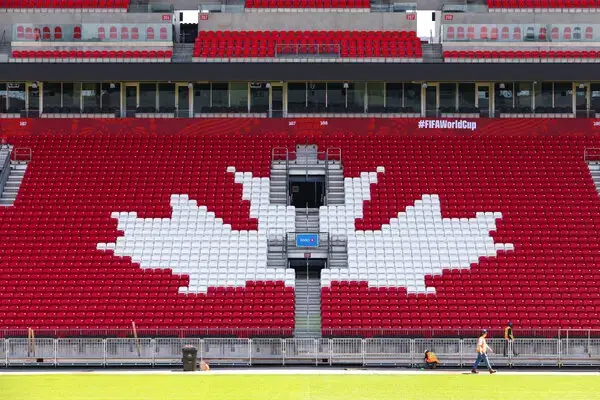
What is Canada's World Cup history?
Canada's World Cup history is short but now building with purpose. The first qualification came in 1986 for the tournament in Mexico, where Canada were drawn into Group C alongside France, Hungary and the Soviet Union. The results reflected the experience gap entirely: a 0-1 loss to France, a 0-2 loss to Hungary, and a 0-2 loss to the Soviet Union — three matches, no goals scored, no points collected, and elimination at the group stage. It remains the only time in that era that Canada qualified, and the programme subsequently went into a long decline that lasted through the 1990s and 2000s as the game grew in other CONCACAF nations.
The turnaround began in earnest around 2017 when a new generation of technically gifted players — Davies, David, Buchanan, Eustáquio — began emerging through European academies and domestic development structures simultaneously. Canada qualified for the 2022 World Cup in Qatar, ending a 36-year absence and finishing first in CONCACAF qualifying ahead of Mexico and the United States. The tournament itself was a difficult experience: Canada were drawn into Group F with Belgium, Croatia and Morocco, and were eliminated without earning a point. But the manner of the performances — particularly against Belgium, where Alphonso Davies struck the post in the opening seconds and Canada matched their European opponents technically for long stretches — signalled that the programme had genuinely arrived at a competitive level. The 2026 tournament, staged partly on Canadian soil, is the first edition where Canada enter as a team expected to advance rather than simply compete.
What is Canada's realistic path to the knockout round in 2026?
The 2026 World Cup expands to 48 teams with a round of 32, meaning the top two teams in each group advance automatically and the best third-placed finishers also progress. Canada's realistic target is a top-two finish in Group B, which would require a minimum of four points and probably six — at least two wins from three group matches. Against Bosnia and Herzegovina and Qatar, Canada are the technically superior side on paper and at home, with crowd support that should meaningfully impact both the team's intensity and the opponent's composure in the opening half-hours. Switzerland is the match that tests Canada's ceiling more honestly. The Swiss are a consistently well-organised European side that has reached the quarter-finals of major tournaments in recent cycles, and a result against them in the group stage would confirm Canada's status as a genuine knockout-stage contender.
Beyond the group stage, Canada's round of 32 draw would depend on how the bracket resolves from the other groups. As a potential group winner or strong second-placed finisher, Canada could face a third-placed side from one of the other twelve groups — a match in which the combination of home support, squad depth and tactical preparation under Marsch should give Canada a genuine advantage. The round of 16 is where Canada's knockout-stage ambitions would face their first real test against probable top-two qualifiers from other groups. The ceiling for this squad — based on the talent available, the home advantage and the tactical development achieved under Marsch — is the quarter-finals. Whether Canada can convert that ceiling into a result depends on the health of Davies and David through the tournament, the team's ability to manage the emotional weight of a home crowd and the consistency of the defensive structure in the kind of tight, high-stakes matches that the knockout stage produces every time.
For the complete Group B schedule and results, see the full 2026 World Cup schedule and all 12 group stage draws. For Canada's player-by-player squad analysis, see the Canada World Cup squad 2026.
FAQ
Has Canada ever won the World Cup?
No. Canada have never won the FIFA World Cup. Their previous men's appearances were 1986 and 2022 before the edition arrived with Canada as a co-host.
How did Canada start Group B at World Cup 2026?
Canada were part of a tight Group B table where Canada, Bosnia and Herzegovina, Qatar and Switzerland all sat on one point in the preserved standings snapshot. That made every goal and tiebreaker unusually important.
Did Canada have a realistic path to the knockouts?
Yes. Canada sat on the Group B top-two line in the standings table, but the margin was thin because the whole group was level on points. In that kind of group, one late goal can move a team from comfort to danger.
Why was Canada's Group B so delicate?
Group B was delicate because no team had separated from the pack. Canada needed points, but they also needed to protect goal difference and keep goals scored competitive against Bosnia and Herzegovina, Qatar and Switzerland.
Who coached Canada at World Cup 2026?
Jesse Marsch coached Canada at the World Cup. His team leaned on Alphonso Davies, Jonathan David and Stephen Eustáquio as the core of a deeper squad than the 2022 version.
What are Canada's World Cup 2026 group stage fixtures?
Canada's Group B fixtures were Bosnia and Herzegovina at BMO Field in Toronto, then Qatar and Switzerland at BC Place in Vancouver. The two Vancouver matches gave Canada a clear home-crowd spine to the group.