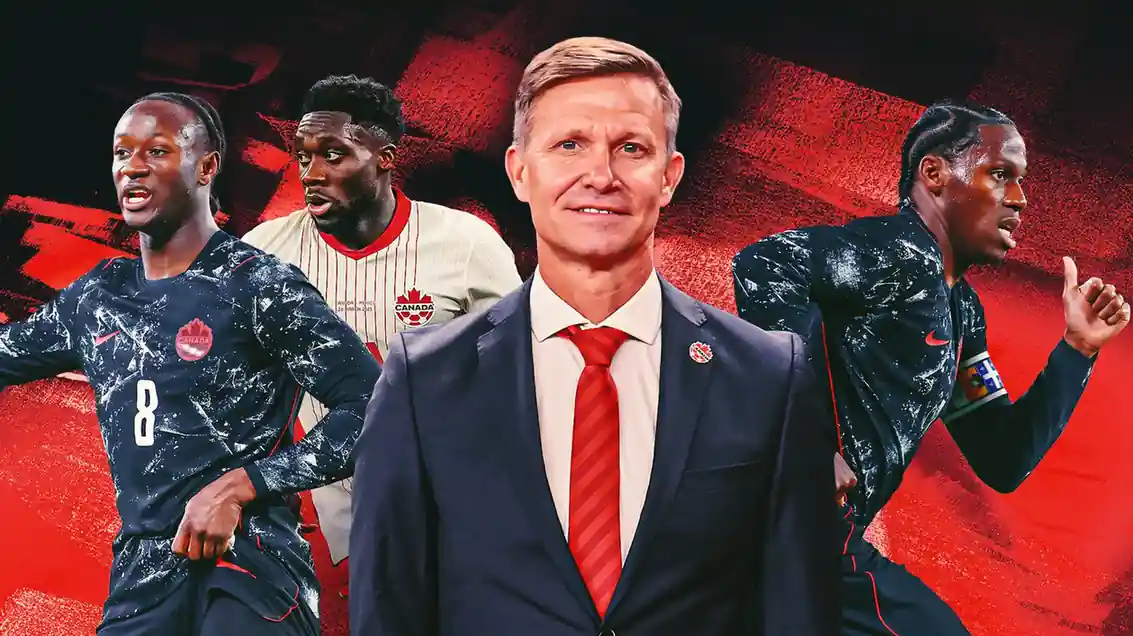
Canada World Cup Squad 2026: Marsch's 26-Man Picture
·
Canada world cup squad clarity starts with the Charlotte 32
Canada's official 26-man World Cup squad was announced by Jesse Marsch on 29 May 2026, selected from a 32-player training camp held in Charlotte. This page breaks down the pre-announcement camp list position by position, identifies the core players whose places were never in doubt, and explains what Canada's Group B draw — Bosnia and Herzegovina, Qatar and Switzerland — demands from this squad. Canada enter the tournament as co-hosts, opening on 12 June in Toronto.
Canada's position in this tournament is unlike any previous edition. As a co-host alongside the United States and Mexico, Canada qualified automatically — freed from the qualifying pressure that shapes roster decisions for most nations. Jesse Marsch therefore had more preparation time, more controlled friendly matches and a longer runway to build positional depth than Canada could normally afford. That context is visible in the Charlotte camp list: genuine competition for places at every line, not just at the fringes of the squad.
Canada Soccer's official camp announcement supplied the key timeline. Thirty-two players were called to Charlotte starting on 25 May. The group trained there through 29 May, when Marsch named Canada's official FIFA World Cup 2026 roster in a primetime television special. The same release confirmed two send-off matches, against Uzbekistan on 1 June in Edmonton and the Republic of Ireland on 5 June in Montreal. Canada's World Cup group — Bosnia and Herzegovina, Qatar and Switzerland — features fixtures on 12 June in Toronto and 18 and 24 June in Vancouver.
Canada's official 26-man World Cup squad
Marsch's confirmed squad breaks down into three goalkeepers, nine defenders, ten midfielders and four forwards. Marcelo Flores was named in the original announcement on 29 May but suffered an ACL tear on 30 May 2026 and is expected to be replaced before the tournament opens on 12 June.
| Pos | Player | Club |
|---|---|---|
| Goalkeepers | ||
| GK | Maxime Crépeau | Orlando City |
| GK | Owen Goodman | Barnsley |
| GK | Dayne St. Clair | Inter Miami |
| Defenders | ||
| LB | Alphonso Davies © | Bayern Munich |
| RB | Alistair Johnston | Celtic |
| CB | Moïse Bombito | OGC Nice |
| CB | Derek Cornelius | Rangers |
| CB | Luc de Fougerolles | Dender |
| CB | Alfie Jones | Middlesbrough |
| RB | Richie Laryea | Toronto FC |
| CB | Niko Sigur | Hajduk Split |
| CB | Joel Waterman | Chicago Fire |
| Midfielders | ||
| CM | Stephen Eustáquio (vc) | LAFC |
| WM | Tajon Buchanan | Villarreal |
| WM | Mathieu Choinière | LAFC |
| WM | Ali Ahmed | Norwich City |
| CM | Ismaël Koné | US Sassuolo |
| WM | Liam Millar | Hull City |
| WM | Marcelo Flores † | Tigres UANL |
| CM | Jonathan Osorio | Toronto FC |
| CM | Nathan Saliba | RSC Anderlecht |
| WM | Jacob Shaffelburg | LAFC |
| Forwards | ||
| ST | Jonathan David | Juventus |
| ST | Cyle Larin | Southampton |
| ST | Promise David | Royale Union SG |
| ST | Tani Oluwaseyi | Villarreal |
© Captain · (vc) Vice-captain · † Flores suffered an ACL tear on 30 May 2026; replacement to be confirmed by Canada Soccer.
The key players in Canada's World Cup squad
Alphonso Davies is the headline name — his world-class speed, one-versus-one carrying and structural range at left-back make him Canada's most important player when fit. Jonathan David, now Canada's all-time leading scorer, is the forward most likely to decide whether Canada convert pressure into goals at this tournament. Stephen Eustáquio connects first-phase control to final-third access better than any other Canadian midfielder, while Alistair Johnston and Moïse Bombito provide the defensive dueling and recovery capacity the back line depends on.
In goal, Crépeau's tournament experience and St. Clair's shot-stopping quality gave Marsch two credible senior options. Tajon Buchanan at Villarreal remains one of Canada's few wide players who can attack a defensive line without needing multiple support touches. Ismaël Koné, Jonathan Osorio and Jacob Shaffelburg cover different midfield profiles: Koné for physicality and ball-carrying, Osorio for senior match management, Shaffelburg for direct running and energy off the bench.

Why does this Canada squad feel deeper than the 2022 group?
Depth is where the roster story gets interesting. In Qatar, Canada had a first-choice spine that could compete athletically, but the overall tournament pool was thinner once injuries, fatigue and tactical variation started to bite. The 2026 camp list looks more layered. There are now more credible center-back options, more wide players who can run in behind, and more attackers who are not simply stylistic duplicates of one another. Promise David, Daniel Jebbison, Tani Oluwaseyi and Jacen Russell-Rowe do not all offer the same thing. That makes selection harder for Marsch, but it also makes match-specific planning easier.
The younger wave matters too. Luc de Fougerolles, Jamie Knight-Lebel, Nathan-Dylan Saliba and Niko Sigur are not there as decorative futures-only names. They are there because Canada Soccer see them as part of a player pool that can handle a tournament environment. The question for many supporters is whether the depth beneath the stars is finally strong enough to support a serious tournament run. Based on the Charlotte camp list, Canada's depth chart is more credible than it was four years ago.
There is also a clearer domestic-development story in the official release. Canada Soccer included an A-Z section naming each player's age, home city and notable youth club ties, and the list shows how broad the development footprint has become: Brampton, Montreal, Vancouver, Surrey, Port Williams, Longueuil, Leamington, Ottawa, Toronto and beyond. That matters because a deeper squad is not only a coaching success. It is an ecosystem signal. A host nation benefits from a larger emotional base when more regions can see themselves reflected in the squad.
How should we read Jesse Marsch's choices?
The official camp announcement says quite a lot about Marsch's priorities even before the final 26 were public. First, he wants tempo. Players like Shaffelburg, Buchanan, Laryea and Ahmed give him energy, width and repeated running power. Second, he wants defensive mobility. Bombito, Cornelius, Johnston and Davies all help Canada survive in open-field sequences rather than only in static low blocks. Third, he wants a wider forward menu. Jonathan David can score in structured attacks, while Larin, Oluwaseyi and Jebbison offer more physical or vertical variations. In other words, the squad picture is not built around one clean aesthetic. It is built around making Canada uncomfortable to play against over 90 minutes.
That is important because a host side can sometimes drift toward sentiment and over-selection of symbolic veterans. This camp list does not look sentimental. It looks like a coach trying to create tactical options without losing identity. The direct quote from Marsch in the Canada Soccer release is revealing here: he spoke about the final days before announcing the squad that would represent Canada at a home World Cup and described the group as calm, focused and ready for the moment. That language is not about nostalgia. It is about competitive readiness. The roster picture reflects that tone.
What does Group B demand from the canada world cup squad?
Canada Soccer confirmed the group-stage path clearly: Bosnia and Herzegovina, Qatar and Switzerland, with dates on 12, 18 and 24 June. That is a fascinating group because it demands three different skills. Bosnia and Herzegovina are likely to test Canada's control and discipline against a side comfortable in structured possession phases. Qatar offer a different tactical rhythm and tournament experience of their own. Switzerland, as so often, profile as the most complete all-around opponent, capable of punishing defensive mistakes while still managing long periods without the ball. For Canada, that means the squad cannot be selected on one game model alone.
Against that backdrop, the Canada world cup squad needs both transition speed and enough composure to avoid burning matches emotionally. The hosts will not win every game by pressing harder than everyone else. They need to know when to settle. That is why Eustáquio, Osorio and Crépeau-level calm matters as much as Davies and Buchanan-level explosiveness. Canada's best chance in Group B is not to become a possession superpower overnight. It is to blend home-energy aggression with cleaner game-state management than they showed in 2022.
The selection questions behind the final 26
The sharpest competition from the Charlotte camp was in goal. Crépeau offered tournament seasoning and command, St. Clair provided another senior option with a strong shot-stopping record, and Goodman represented a younger alternative. Wide depth was the second pressure point: Canada had multiple players capable of starting wide, inverting, or covering wing-back spaces, which forced Marsch to weigh direct runners against calmer connectors. The third area was the striker split behind Jonathan David and Larin. Promise David, Jebbison, Oluwaseyi and Russell-Rowe each offered different physical and tactical profiles.
Tournament hosts typically lean on experienced personalities in the positions where emotional pressure is highest — goalkeeper and central midfield — while being more willing to take upside bets in attacking depth. The Charlotte camp suggested Marsch was building a tournament toolkit rather than a prestige list. The final 26, announced on 29 May, reflects those priorities.
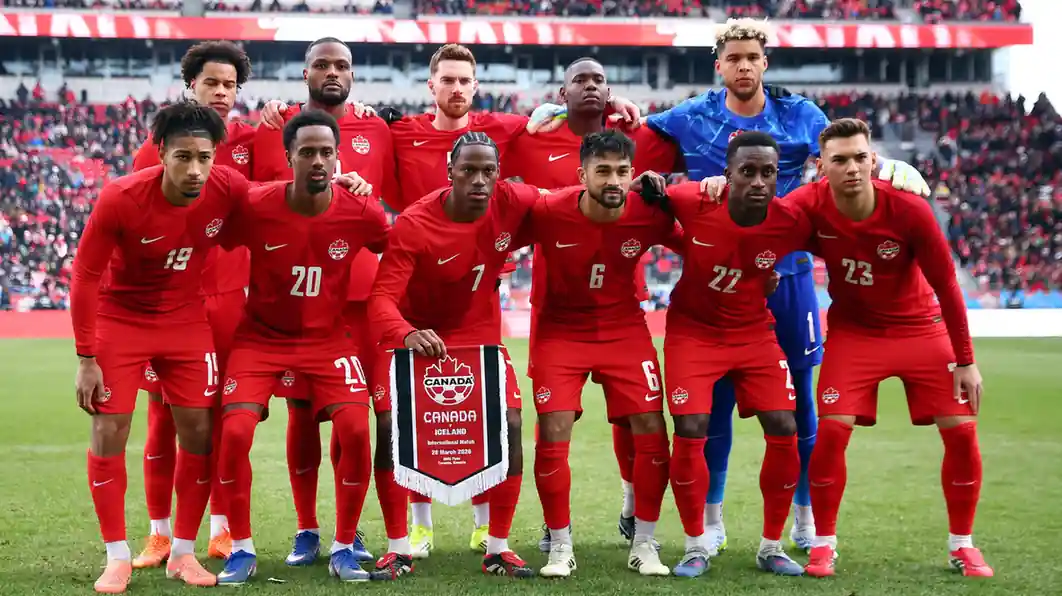
Can Canada turn a host opportunity into a real knockout-round run?
Yes, but the route is narrower than simple host optimism sometimes suggests. Canada are not entering the tournament as passengers. They have one of the competition's most explosive individual talents in Alphonso Davies, one of its most reliable North American scorers in Jonathan David, and a coaching voice in Marsch who clearly wants aggression and conviction. They also have a group that contains a plausible route to the last 16 if the opening match is handled well. But realism matters. Host energy can lift you, and it can also distort decision-making if matches become frantic. Canada's ceiling depends on whether the squad can absorb that emotion without losing shape.
This is where the canada men's national soccer team players in the middle of the pitch become so important. Eustáquio, Koné, Osorio and Choinière-type profiles are not merely support cast. They determine whether Canada can keep games from becoming pure transition coin flips. Likewise, the defenders are not only there to survive. Bombito, Cornelius, Johnston and Davies need to start attacks cleanly enough that Canada's speed can be used on purpose rather than in panic. If that connection works, the hosts are dangerous. If it does not, even a strong atmosphere may not save them against the more balanced teams in the group.
The most concise answer, then, is this: the canada world cup squad picture is stronger than it was in the last cycle because the player pool is deeper, the path is clearer and the home setting adds upside. But the roster still has to solve specific tournament problems, not just inspire a country. Canada Soccer's official Charlotte camp gives us enough evidence to say the hosts are building a functional, modern squad rather than a ceremonial one. That is already progress. Whether it becomes a knockout-round story will depend on the final 26's balance and on how quickly that balance shows up in the opening week.
For Canada's full group-stage fixtures and kickoff times, see the full 2026 World Cup schedule and all 12 group stage draws. For the co-host rosters, see the USMNT World Cup roster.
FAQ
What is Canada's official World Cup 2026 squad?
Jesse Marsch announced Canada's 26-man squad on 29 May 2026. Goalkeepers: Maxime Crépeau (Orlando City), Owen Goodman (Barnsley), Dayne St. Clair (Inter Miami). Defenders: Alphonso Davies © (Bayern Munich), Alistair Johnston (Celtic), Moïse Bombito (OGC Nice), Derek Cornelius (Rangers), Luc de Fougerolles (Dender), Alfie Jones (Middlesbrough), Richie Laryea (Toronto FC), Niko Sigur (Hajduk Split), Joel Waterman (Chicago Fire). Midfielders: Stephen Eustáquio vc (LAFC), Tajon Buchanan (Villarreal), Mathieu Choinière (LAFC), Ali Ahmed (Norwich City), Ismaël Koné (US Sassuolo), Liam Millar (Hull City), Marcelo Flores (Tigres — injured, replacement pending), Jonathan Osorio (Toronto FC), Nathan Saliba (RSC Anderlecht), Jacob Shaffelburg (LAFC). Forwards: Jonathan David (Juventus), Cyle Larin (Southampton), Promise David (Royale Union SG), Tani Oluwaseyi (Villarreal).
Which canada men's national soccer team players are the core of the squad?
The most obvious core names from the official camp group are Alphonso Davies, Jonathan David, Stephen Eustáquio, Tajon Buchanan, Moïse Bombito, Alistair Johnston, Maxime Crépeau, Dayne St. Clair, Cyle Larin and Ismaël Koné.
What group is Canada in at the 2026 World Cup?
Canada is in Group B with Bosnia and Herzegovina, Qatar and Switzerland. Canada Soccer confirmed the hosts' group-stage dates as 12 June in Toronto and 18 and 24 June in Vancouver.
Why does this squad feel deeper than the 2022 Canada pool?
The official camp list shows more competition in goal, more center-back options, more wing and transition speed, and a broader striker menu than Canada had before Qatar 2022. That makes the squad harder to pick but better built for a modern tournament.