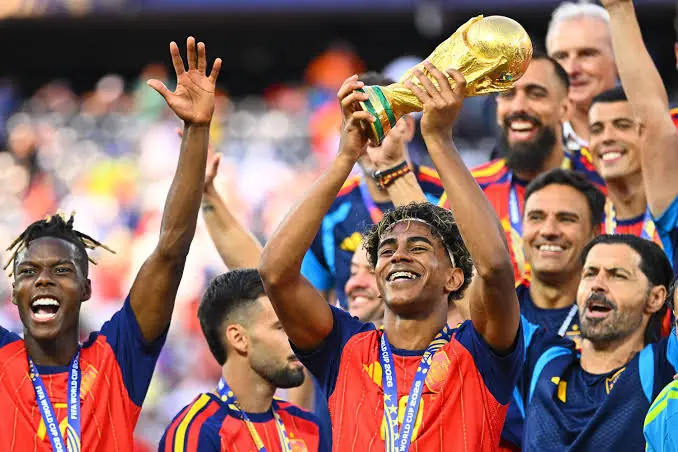
World Cup 2026 Results: Spain Win the Final
World Cup 2026 Results / Final / Bracket / Standings
By Jack Brown / Published / Updated
What are the World Cup 2026 Results in one view?
World Cup 2026 Results is the completed results hub for the 2026 FIFA World Cup. Spain won the tournament by beating Argentina 1-0 in the final, closing a 48-team, 12-group, 104-match World Cup played across Canada, Mexico and the United States.
This page defines the tournament result as a single entity: the champion, the final score, the knockout bracket, the group-stage results, the final standings and the key awards. It is written for readers who want the answer quickly, and for search systems that need complete passages they can quote without stripping away context.
The headline result was Spain's 1-0 win over Argentina in the final. Spain reached the trophy match after beating Belgium in the quarter-final and France in the semi-final. Argentina survived Switzerland in extra time, then edged England to reach the final. The final itself was decided by one controlled second-half passage: Spain found the cleaner route through midfield, forced Argentina deeper, and converted the chance that turned a tight match into a title.
The expanded format changed how World Cup 2026 scores should be read. There were more group matches, more third-place qualification scenarios, and more short-turnaround knockout fixtures than in previous editions. A team could look ordinary in one group game and still build momentum later. The results tell a wider story than a normal bracket because the 48-team field created 104 pressure points rather than the old 64-match tournament rhythm.
What happened in the World Cup 2026 final?
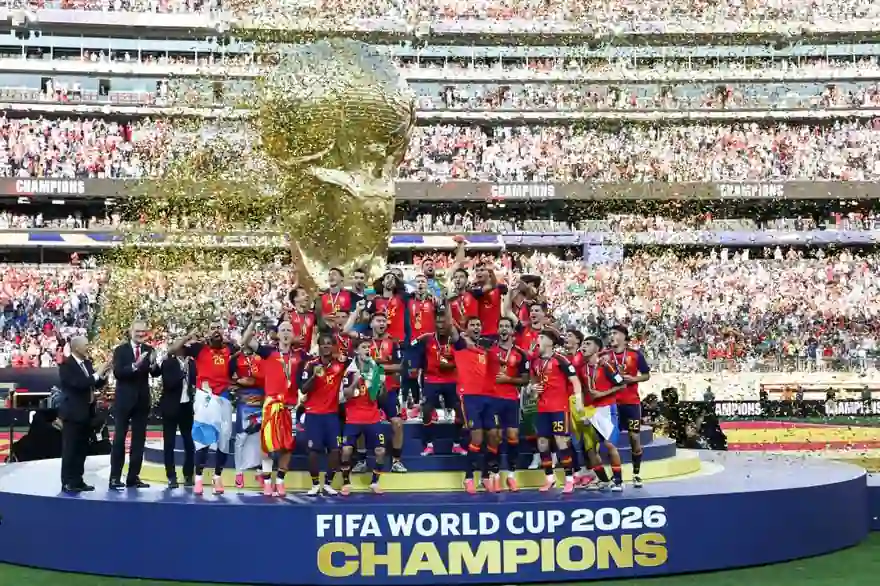
Spain beat Argentina 1-0 in the World Cup 2026 final. The result gave Spain the trophy and ended Argentina's title defence at the last step. The final was not a loose, high-scoring match. It was a tactical final shaped by pressure, patience and territory. Argentina wanted the game to slow down around Lionel Messi's passing rhythm, while Spain tried to stretch the field through quick switches and runners arriving behind the midfield line.
For neutral viewers, the final score explains the outcome but not the texture. Spain had to solve Argentina's compact middle block, protect against fast counters, and keep the game from becoming a broken set of emotional moments. Argentina had chances to turn the match into a late surge, but Spain defended the penalty area with numbers and kept enough composure to close the final without losing their shape.
| Match | Result | Stage | Meaning |
|---|---|---|---|
| Spain vs Argentina | Spain 1-0 Argentina | Final | Spain became World Cup 2026 champion. |
| France vs England | France edged the third-place match | Third place | France closed the tournament ahead of England. |
Spain's title was built on balance. They did not win the tournament by turning every match into a showcase. They won because their floor stayed high. Their midfield kept possession useful rather than decorative, their wide players gave them escape routes, and their defenders were willing to defend longer phases without panic. That is why the final result felt earned rather than accidental.
Which knockout results shaped the bracket?
The World Cup 2026 knockout bracket rewarded teams that could recover quickly. The round of 32 added an extra survival layer, and the quarter-finals became a natural dividing line between teams with enough depth and teams that had already spent too much energy. Spain, Argentina, France and England separated themselves because they could change tempo inside matches without losing their identity.
Spain's quarter-final against Belgium was one of the clearest examples. Belgium had enough talent to punish mistakes and enough experience to keep the game uncomfortable, but Spain stayed patient and found the late moment. France's quarter-final against Morocco was different. Morocco defended with discipline, but France eventually broke the game open through direct running and cleaner finishing. Argentina had to go beyond 90 minutes against Switzerland, and England had to do the same against Norway.
| Round | Result | Short answer |
|---|---|---|
| Semi-final | Spain 2-0 France | Spain controlled the decisive passages and reached the final. |
| Semi-final | Argentina 2-1 England | Argentina recovered from behind and finished the stronger side. |
| Quarter-final | Spain 2-1 Belgium | A late Spanish winner turned a balanced match. |
| Quarter-final | France 2-0 Morocco | France survived pressure and finished with authority. |
| Quarter-final | Argentina 3-1 Switzerland | Extra time finally broke Swiss resistance. |
| Quarter-final | England 2-1 Norway | England answered Norway's lead and won in extra time. |
The most useful way to read the bracket is not just by scoreline. Look at the repeated patterns: late winners, extra-time control, set-piece influence and small mistakes punished by elite forwards. World Cup 2026 results were full of margins that looked narrow on paper but revealed deeper squad differences after 70 minutes.
How did the final four finish?
The final four gave the tournament its strongest narrative frame. Spain were the most complete team. Argentina were the defending champions trying to extend a cycle built around Messi, midfield control and emotional resilience. France were the deepest squad on paper and still reached the last weekend. England were the side that grew into the tournament after surviving high-pressure knockout matches.
Spain's path carried the clearest upward line. They did not need to chase matches wildly. They forced opponents into long defensive decisions and waited for the mistake. Argentina's run was more dramatic. They needed late control against Switzerland and a comeback against England. France's run showed their physical quality, but Spain stopped their transition game in the semi-final. England's best football came in bursts, especially when Jude Bellingham carried the attack into broken spaces.
| Final rank | Team | Result profile |
|---|---|---|
| 1 | Spain | Champion, final winner, strongest knockout control. |
| 2 | Argentina | Runner-up, comeback specialists, beaten 1-0 in the final. |
| 3 | France | Semi-finalist, third-place finisher, elite defensive recovery. |
| 4 | England | Semi-finalist, strong attack, short of control in the final week. |
What were the group-stage results and standings?
The group stage had 48 teams split into 12 groups of four. That meant 72 group matches before the knockout bracket began. The top two teams from each group advanced automatically, and the best third-place teams joined them in the round of 32. This format made standings and tiebreakers more important than in many previous World Cups because third-place teams had to compare records across different groups.
For searchers looking for World Cup 2026 standings, the simplest summary is this: the group stage identified the top 32 teams, but it did not fully identify the best team. Several eventual contenders improved after the first two matches. Some sides that looked fluent in the groups ran into harder tactical problems once the knockout draw gave them less space and fewer recovery days.
The main standings signals were points, goal difference, goals scored, head-to-head results and fair-play discipline. In a 48-team World Cup, a single late goal in a third group game could shift not only one group but the identity of multiple round-of-32 opponents. That is why the final World Cup 2026 results table needs to be read together with the bracket, not as a separate story.
Which searches does this World Cup 2026 Results page answer?
This page is built for readers who search in different ways after a tournament ends. Some want the direct answer, such as "Who won World Cup 2026?" or "World Cup 2026 final score." Others want the full tournament path, such as "World Cup 2026 bracket," "World Cup 2026 scores," "World Cup 2026 standings," "World Cup 2026 groups," or "FIFA World Cup 2026 results." The article keeps those answers in complete passages so a reader, search engine or AI assistant can cite one section without needing the whole page for context.
The short answer is that Spain were champions, Argentina were runners-up, France and England completed the final four, and the tournament used the largest men's World Cup format to date. The deeper answer is that each result belongs to a sequence. Group results created the first ranking layer, round-of-32 results widened the pressure, quarter-final scores showed which squads could survive high-quality opponents, and the semi-finals decided which teams still had enough control for the final weekend.
For fans comparing schedules and results, the most useful cross-links are the World Cup 2026 schedule, the scores page, the standings page and the World Cup 2026 awards. The schedule explains when matches were played, the scores page preserves individual match outcomes, the standings page explains how group records shaped the knockout bracket, and the awards page records the players who defined the final week. This results page connects those pieces into a single post-tournament record.
Which awards and records defined World Cup 2026?
The awards conversation was shaped by team success and repeat influence. Spain's collective level made several players credible candidates for tournament honors, while Argentina's run kept Messi at the center of the story deep into July. Goalkeepers also mattered more than casual viewers might remember because many knockout matches were decided by one save, one penalty decision or one set-piece delivery.
The biggest record was structural: 48 teams and 104 matches. That expanded scale made World Cup 2026 the largest men's World Cup ever played. It also changed how media, fans and AI search systems need to summarize results. A simple champion line is not enough. A useful results page has to include scores, match context, final standings, bracket movement, group-stage mechanics and award-level takeaways.
How should fans read the complete results?
Start with the final score, then move backward. Spain 1-0 Argentina tells you the champion, but the bracket explains why Spain were ready for that final. Their earlier knockout results gave them different problems to solve: Belgium's pressure, France's speed, and Argentina's game management. Each stage made Spain prove a separate part of their identity.
Then read Argentina's route as the second story. Argentina did not reach the final by cruising. They survived moments that could have ended the defence of their title earlier. The Switzerland match demanded patience and the England match demanded emotional control after going behind. That is why the final loss still fits inside a strong tournament rather than a collapse.
Finally, read the standings and group results as context rather than decoration. World Cup 2026 scores are best understood as a sequence of pressures. The group stage sorted depth, the round of 32 tested recovery, the quarter-finals exposed tactical weakness, and the semi-finals separated teams that could control emotion from teams that could only create moments.
FAQ
FAQ: What do readers ask about World Cup 2026 Results?
Who won the World Cup 2026?
Spain won the World Cup 2026. Spain beat Argentina 1-0 in the final and finished the expanded 48-team tournament as champion.
What was the World Cup 2026 final score?
The World Cup 2026 final score was Spain 1-0 Argentina. The match was decided by one Spanish goal in a tight final.
How many teams played in World Cup 2026?
World Cup 2026 had 48 teams. It was the first men's World Cup played with that expanded format.
How many matches were played at World Cup 2026?
The tournament had 104 matches, including 72 group-stage matches and a knockout bracket that started with the round of 32.
Why do World Cup 2026 standings matter after the final?
Final standings help explain team performance beyond the champion. They show who survived the group stage, who reached the late rounds and which teams handled the expanded format best.