
South Korea World Cup 2026: Schedule, Squad & Preview
By Jack Brown · ·
Can the South Korea national football team reach the knockout rounds at the 2026 World Cup?
South Korea at the 2026 World Cup — quick facts: Group A · Opponents: Czechia, Mexico, South Africa · Coach: Hong Myung-bo · Captain: Son Heung-min · World Cup appearances: 11th consecutive since 1986 · Best result: 4th place (2002). Group stage openers: 11 June vs Czechia · 18 June vs Mexico · 24 June vs South Africa. South Korea opened their Group A campaign on 11 June with a 2–1 victory over Czechia.
This page covers the south korea world cup campaign at the 2026 FIFA World Cup in the United States, Canada and Mexico. The south korea national football team — known as the Taeguk Warriors — are drawn into Group A alongside Czechia, Mexico and South Africa, opening their campaign on against the Czechs. Hong Myung-bo coaches a squad built around the elite-level talent of Son Heung-min, Kim Min-jae and Lee Kang-in — three players who spent the 2024–25 club season in Europe's top leagues and who bring a technical quality to the Asian confederation that makes South Korea one of the most genuinely competitive sides in the tournament's middle tier. This is South Korea's eleventh consecutive World Cup appearance since 1986, a streak that represents the longest active run for any Asian nation and a sustained record of qualification that goes beyond any individual generation of the squad.
The emotional framing of this campaign is shaped by legacy and ambition. Hong Myung-bo was the captain and the penalty-scoring hero of the 2002 World Cup semi-final run — the moment that still defines South Korean football in the public imagination. His return as manager carries the weight of that history and the expectation that he can translate a new generation of elite club talent into a coherent national team system capable of replicating the knockout-stage performances of twenty-four years ago. Son Heung-min, at 33, is approaching the final stages of a World Cup career that has produced more goals and more visibility for Korean football globally than any player since Park Ji-sung. The 2026 tournament is the setting in which that career could reach its defining chapter.
What are South Korea's Group A korea world cup schedule and fixtures in 2026?
South Korea's group stage fixtures span thirteen days and cover matches that differ considerably in tactical demand and required result. The opening game against Czechia on at 8:00 PM ET is the fixture Hong Myung-bo will have targeted as a must-win: Czechia is a technically capable European side but a level below the elite nations South Korea would face in the knockout rounds, and three points from the opener would give the Taeguk Warriors an immediate platform for the rest of the group stage. Czechia's strength lies in their defensive organisation and their ability to hit with pace through Patrik Schick and their central midfield — a profile that will test South Korea's ability to break down a compact block through the combination play that defines their attacking approach.
The second group match on at 9:00 PM ET is against Mexico — South Korea's most demanding group stage test and the match that will define the narrative of their campaign. Mexico enters the tournament with genuine quality across the squad, motivated by host-nation expectations and with tactical experience at the continental level that makes them a dangerous opponent in any format. Historically, South Korea and Mexico have a significant rivalry within the World Cup context: they met in the 2018 group stage in Russia, where Mexico's 2-1 win was one of that tournament's major upsets. The 2026 rematch carries its own stakes. South Korea will need Son's ability to run beyond Mexico's defensive line, Kim Min-jae's aerial dominance to neutralise the threat at set-pieces and Lee Kang-in's creativity in tight spaces to generate the chances that a tight match will require.
The final group game against South Africa on at 7:00 PM ET offers South Korea the possibility of completing the group stage with a positive record, though South Africa's physical intensity and the pace of their forward line will demand concentration from a back line that could be managing accumulated fatigue across a three-game sequence. South Africa are the least individually gifted of South Korea's three opponents but also the least predictable — their ability to disrupt a technically superior side through pressing and direct play has been demonstrated in recent continental competition and demands respect.
The overall assessment of Group A from South Korea's perspective is that qualification for the round of 32 is achievable — the squad has enough quality to take points from Czechia and South Africa — but that progression beyond the group will likely require at least a draw against Mexico. In the expanded 48-team format, four points would almost certainly be enough to advance as one of the top two in the group or as one of the best third-placed finishers across all twelve groups. Six points from three games would confirm South Korea as group winners and deliver the most favourable knockout bracket positioning available.
How does Hong Myung-bo set up the South Korea national football team?
Hong Myung-bo's coaching identity is shaped by the tactical intelligence that defined his playing career as a sweeper — a deep-lying libero who read the game from the back and initiated attacks with precise distribution from defensive positions. As a manager, he has built South Korea's system around defensive solidity as the foundational principle, with vertical transitions and quick combination play as the mechanism for generating attacks once possession is recovered. The preferred formation is a 4-2-3-1 that compresses into a 4-4-2 without the ball, with two compact central blocks designed to limit the space available to technically superior opponents in wide areas.
The key to how South Korea attack in this system is the relationship between Son Heung-min as the advanced left winger and the central attacking midfielder who supports his movement. Son's role is defined by his runs in behind the defensive line — he is one of the fastest players in the world over the first thirty metres of a sprint, and his ability to time those runs with the delivery of a through ball from midfield creates the most dangerous single attacking sequence in South Korea's repertoire. When Son receives the ball in behind at full pace, even elite international defenders face a situation they cannot resolve by purely positional means.
Lee Kang-in operates in the advanced midfield role that serves as the creative connector between the double pivot and Son's forward runs. His positional intelligence — developed across years at Valencia, Mallorca and Paris Saint-Germain — allows him to find space in tight areas between a compact opposition's defensive and midfield lines, receive under pressure and either play the incisive pass or carry forward with the dribbling ability that has made him one of Asia's most technically refined players. The combination of Son's direct pace and Lee's technical creativity in central areas gives South Korea a dual attacking threat that opponents must account for across the full ninety minutes.
Defensively, the system is built on Kim Min-jae. The Bayern Munich centre-back is one of the top three defenders in the world at his position by any objective measure — his aerial dominance, his speed over ground, his composure in one-versus-one situations and his aggressive high-defensive-line positioning give the back four a focal point that organises the entire defensive structure. When Kim Min-jae is match-fit and in form, South Korea can defend a lead against sides of considerable technical quality. His partnership with his centre-back colleague — typically drawn from the K-League or from one of the European mid-table leagues depending on the qualification cycle — requires him to compensate for the quality differential that exists between himself and his defensive partner, which he has consistently done throughout Hong Myung-bo's tenure.
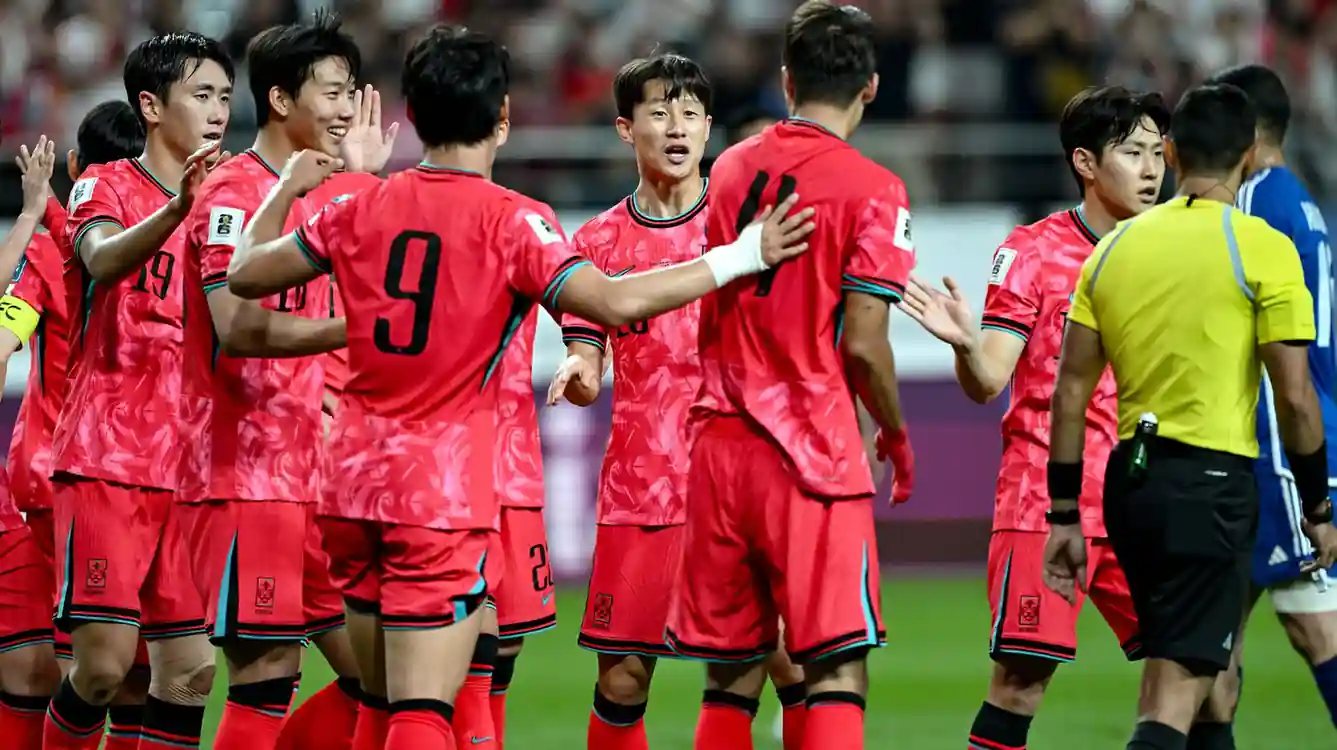
Which South Korea players should you watch at the 2026 World Cup?
Son Heung-min is the defining player of South Korean football's modern era and the face of south korea soccer globally. The Tottenham Hotspur forward — the club's all-time top scorer and one of the Premier League's most productive attacking players across the last decade — arrives at what is almost certainly his final World Cup at 33 years old and at a stage of his career where his physical peak pace is fractionally reduced but his technical intelligence and his ability to perform on the biggest stages has only deepened. Son is South Korea's all-time leading scorer in international football, a record that reflects not only his individual quality but his sustained commitment to the national team across a club career that has demanded enormous physical output. At the 2022 World Cup, Son played through the group stage with a fractured eye socket after a pre-tournament injury, wearing a protective mask — a detail that encapsulates the competitive character that makes him a different kind of player to manage and a different kind of opponent to face. In 2026, with the physical protection of a full pre-season and with the motivation of a final major tournament, Son's contribution across the group stage and into the knockout rounds will determine how far South Korea advance.
Kim Min-jae is the single most important defensive player that Asian football has produced in the modern era. His journey from Jeonbuk Hyundai Motors through Fenerbahçe, Napoli and now Bayern Munich traces one of the most rapid development arcs in the history of a central defender — from a promising K-League talent to a Champions League regular and Serie A title winner across a five-year window. Kim's value to South Korea extends beyond the individual duels he wins and the aerial challenges he dominates: his presence organises the entire defensive structure, his communication across the back line keeps the shape disciplined under pressure and his capacity to carry the ball out from defence allows Hong Myung-bo to build attacks from deeper positions rather than simply distributing long. Against Mexico's attacking mobility and Czechia's direct forward runs, Kim's ability to read trajectories and intercept rather than simply react will be the most critical single defensive contribution South Korea can produce at this tournament.
Lee Kang-in is the player who determines the ceiling of South Korea's attacking ambition. The PSG midfielder — one of only a small number of Korean players to have established himself as a key contributor at a UEFA Champions League-level club in recent seasons — represents the generational shift in how Korean football produces technically gifted players from the youth level upward. Lee's intelligence in the half-space, his ability to change the tempo of South Korea's attacks with a single dribble or a first-time through ball, and his composure in front of goal when arriving from deep positions make him the player most likely to produce the match-deciding moment in South Korea's most competitive group games. His relationship with Son Heung-min in the attacking third — built through years of national team training cycles and competitive tournament experience — is the most developed creative combination South Korea have available and the one that opponents must account for above all others.
What is South Korea's World Cup history and best result?
South Korea have the most distinctive World Cup history of any Asian nation. Their first appearance was in 1954 — the second World Cup ever played, in Switzerland — where they lost both group stage matches heavily. After a long absence, South Korea returned to the World Cup in 1986 and have qualified for every edition since, an unbroken run of eleven consecutive tournaments that stands as a record for Asian confederation members. That consistency of qualification reflects a development infrastructure — centred on the K-League, an active youth academy system and the cultural importance of football in South Korea — that has delivered players capable of competing with European and South American sides in every generation since the 1980s.
The defining chapter in South Korea's World Cup history remains the 2002 tournament, co-hosted with Japan. Under Dutch coach Guus Hiddink, a squad built around captain Hong Myung-bo — now the national team's head coach — produced one of the most extraordinary runs in the history of the competition. South Korea defeated Spain on penalties in the quarter-finals after a match defined by two controversial VAR-era controversies that remain debated; they then faced Germany in the semi-finals, losing 0-1 to a Michael Ballack goal that sealed the hosts' elimination. In the third-place playoff against Turkey, South Korea lost 2-3 in a high-quality match that nonetheless confirmed their status as the best Asian side in the history of the World Cup. The fourth-place finish has never been matched by an Asian nation and represents the high watermark against which every subsequent South Korean World Cup campaign is measured.
The most recent edition — 2022 in Qatar — produced one of the more remarkable group-stage sequences of that tournament. South Korea faced elimination going into their final group game against Portugal, needing a win to advance. A 2-1 victory, decided by Hwang Hee-chan's goal deep in stoppage time after a Son Heung-min assist, put South Korea through to the round of 16, where they faced a Brazil side at full strength. The 4-1 defeat to Brazil was not a dishonourable exit — Brazil were the pre-tournament favourites and demonstrated the individual quality differential between the two squads — but the manner of the group-stage qualification, achieved at the final moment after two draws against Uruguay and Ghana, gave South Korea a specific blueprint for how they can compete when the tactical discipline and tournament mentality are at their highest.
What is South Korea's realistic path to the final at the 2026 World Cup?
The 2026 World Cup's expanded format — 48 teams, a round of 32 before the round of 16 — gives South Korea a structural advantage they have not had at previous editions. With sixteen groups of three teams, the top two from each group advance automatically and the best eight third-placed finishers also progress. For South Korea, a team with sufficient quality to be competitive against Czechia and South Africa while remaining dangerous against Mexico, the threshold for knockout-stage qualification is lower than at any previous tournament. Four points from three games — a win against one of the weaker opponents and a draw against Mexico — would very likely be enough to advance.
From the round of 32, South Korea's potential opponents would be drawn from among the third-placed finishers from other groups, many of whom will be sides from CONCACAF, CAF or OFC confederations — regions where South Korea's individual quality and tactical organisation would represent a clear competitive advantage. A clean round-of-32 win would set up a round-of-16 encounter likely to involve a higher-ranked opponent, potentially from South America or Europe, but also one that South Korea — with Kim Min-jae's defensive intelligence, Son's ability to threaten on the break and Lee Kang-in's creative capacity in tight games — would approach with a genuine belief that a single moment of quality could decide the match.
The quarter-final represents the realistic ceiling of a conservative projection for this squad. Reaching the semi-final — the stage achieved in 2002 — would require either exceptional tactical execution against a top-eight tournament side or the kind of fortune in the bracket that tournament draws occasionally produce. Hong Myung-bo has stated publicly that the goal is to go further than in 2022, which means reaching at minimum the quarter-finals. The squad's quality justifies that ambition, and the expanded format's structural generosity provides a more forgiving path than the 32-team knockout bracket that eliminated them in 2022.
The broader significance of this South Korea World Cup campaign extends beyond results. Son Heung-min's final major tournament, Hong Myung-bo's coaching legacy, Lee Kang-in's emergence as the next generation's flagship name and Kim Min-jae's status as one of the world's elite defenders — these elements combine to make the 2026 squad one of the most richly narratively layered in South Korean football history. Whether the results match the narrative will depend on tournament execution, but the conditions exist for a campaign that reaches at minimum the quarter-finals and potentially beyond.
For the complete Group A schedule and results, see the full 2026 World Cup schedule and all 12 group stage draws. For squad details across all 48 nations, see all 48 World Cup 2026 teams.
FAQ
Can South Korea qualify from Group A at the 2026 World Cup?
South Korea are expected to qualify from Group A. Their squad quality — built around Son Heung-min, Kim Min-jae and Lee Kang-in — gives them a clear advantage over Czechia and South Africa. The key match is against Mexico on 18 June; a draw or win there would almost certainly confirm progression. In the expanded 48-team format, four points is typically sufficient to advance from the group stage.
Who is South Korea's best player at the 2026 World Cup?
Son Heung-min is South Korea's captain and most influential player at the World Cup. South Korea's all-time top international scorer, Son brings elite pace, clinical finishing and decades of experience at the highest club level to this squad. At 33 and in what is likely his final World Cup, he remains the player around whom South Korea's entire attacking structure is organised.
Has South Korea ever won the World Cup?
No. South Korea have never won the FIFA World Cup. Their best finish is fourth place at the World Cup co-hosted with Japan — the best result in the history of Asian football at the tournament. They defeated Spain and came within one match of the final before losing to Germany in the semi-finals and to Turkey in the third-place playoff.
What are South Korea's World Cup 2026 fixtures and kick-off times?
South Korea's 2026 group fixtures: vs Czechia, 8:00 PM ET; vs Mexico, 9:00 PM ET; vs South Africa, 7:00 PM ET.