France World Cup Squad 2026: Roster & Fixtures
Who is in France World Cup Squad 2026?
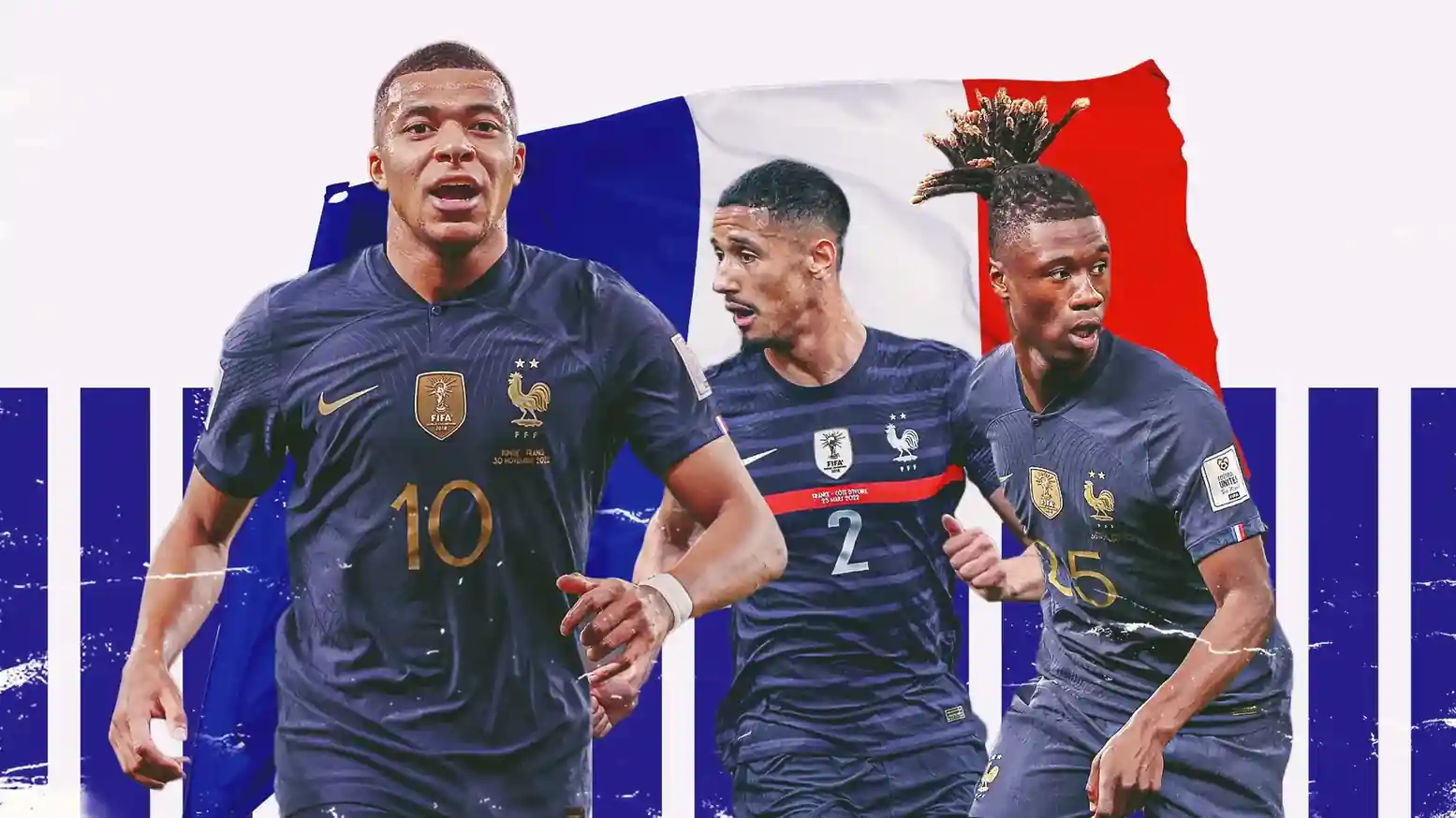
Quick answer: France World Cup Squad 2026 is Didier Deschamps' 26-man roster built around Kylian Mbappe, Mike Maignan, Aurelien Tchouameni and Marcus Thuram. France play Senegal, Iraq and Norway in Group I, with knockout qualification expected but not automatic. The squad brings together the most complete generation of French national team players since the side that won back-to-back World Cups in 1998 and the squad that came within a penalty shootout of repeating the feat in Qatar 2022. At the heart of the selection are Kylian Mbappé, the Real Madrid captain and the most dangerous attacking player at this tournament, Marcus Thuram of Inter Milan as the complete modern striker who complements him, and Aurélien Tchouaméni as the defensive midfield anchor without whom the system cannot function at its best. Two runners-up finishes in 2006 and 2022, framing two titles in 1998 and 2018, give this France team the deepest recent tournament pedigree of any squad in North America.
France 2026 World Cup Squad: Full 26-Man Roster
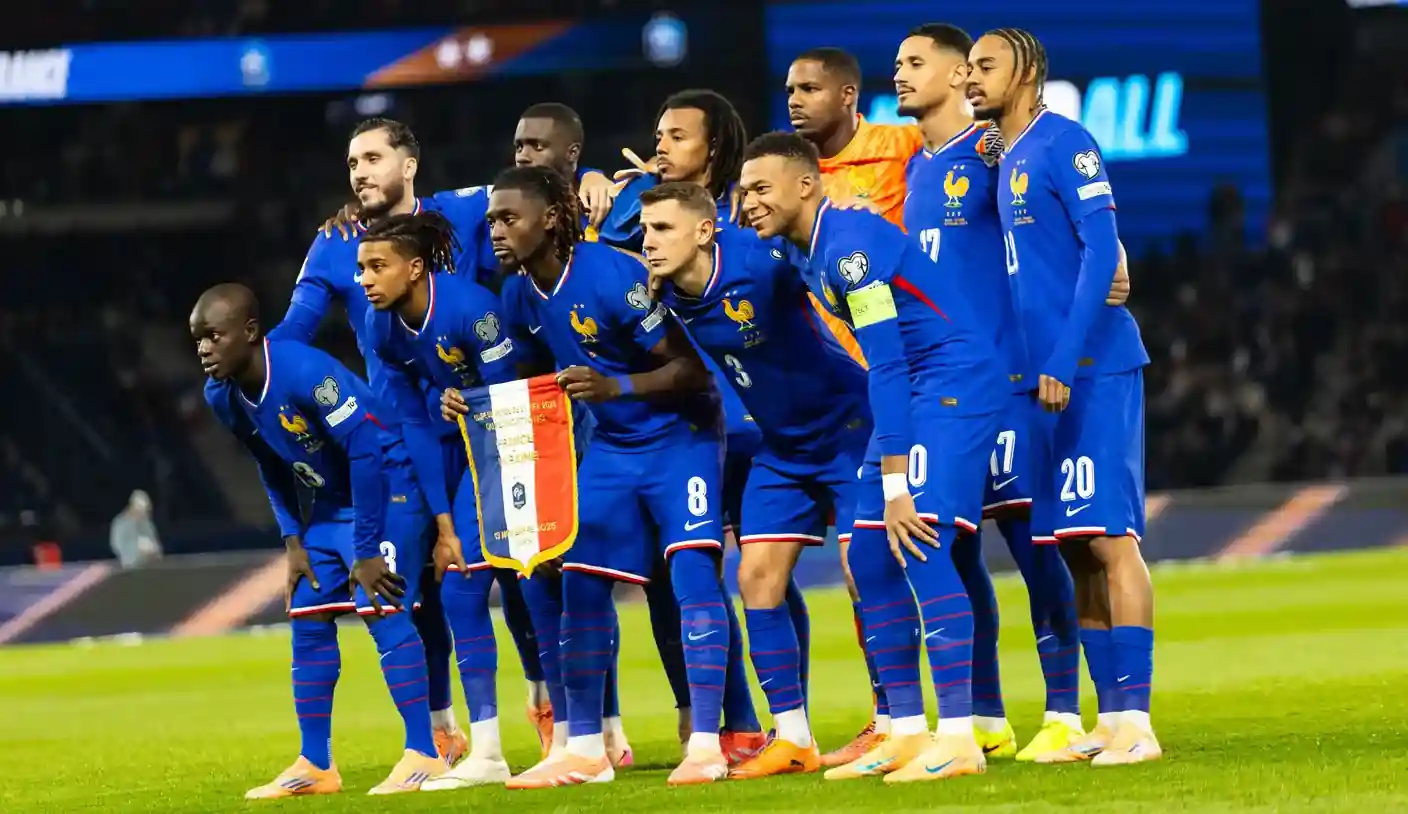
Didier Deschamps submitted France's official 26-man squad to FIFA ahead of the tournament, completing a selection process that had generated significant debate throughout the spring — particularly around midfield depth, the goalkeeping hierarchy and which wide forwards complement Mbappé most effectively. The squad reflects the depth of talent available to France: every position carries multiple elite-level options, and the decisions Deschamps faced were not about finding quality but about choosing between it. Here is the complete france squad for world cup 2026 by position.
| # | Player | Club |
|---|---|---|
| Goalkeepers | ||
| GK | Mike Maignan | AC Milan |
| GK | Alphonse Areola | West Ham United |
| GK | Brice Samba | RC Lens |
| Defenders | ||
| CB | Dayot Upamecano | FC Bayern Munich |
| CB | Ibrahima Konaté | Liverpool FC |
| CB | William Saliba | Arsenal FC |
| CB | Axel Disasi | Chelsea FC |
| RB | Jules Koundé | FC Barcelona |
| RB | Benjamin Pavard | Inter Milan |
| LB | Theo Hernandez | AC Milan |
| LB | Lucas Hernandez | Paris Saint-Germain |
| RB/WB | Jonathan Clauss | Olympique de Marseille |
| Midfielders | ||
| DM | Aurélien Tchouaméni | Real Madrid CF |
| DM | N'Golo Kanté | Al-Ittihad |
| DM | Youssouf Fofana | AC Milan |
| CM | Eduardo Camavinga | Real Madrid CF |
| CM | Warren Zaïre-Emery | Paris Saint-Germain |
| CM | Adrien Rabiot | Olympique de Marseille |
| Forwards | ||
| LW/CF | Kylian Mbappé | Real Madrid CF |
| CF | Marcus Thuram | Inter Milan |
| RW | Ousmane Dembélé | Paris Saint-Germain |
| LW/RW | Bradley Barcola | Paris Saint-Germain |
| RW/AM | Michael Olise | FC Bayern Munich |
| LW/RW | Kingsley Coman | FC Bayern Munich |
| AM/CF | Christopher Nkunku | Chelsea FC |
| CF | Randal Kolo Muani | Juventus FC |
Who Are France's Key Players for the 2026 World Cup?
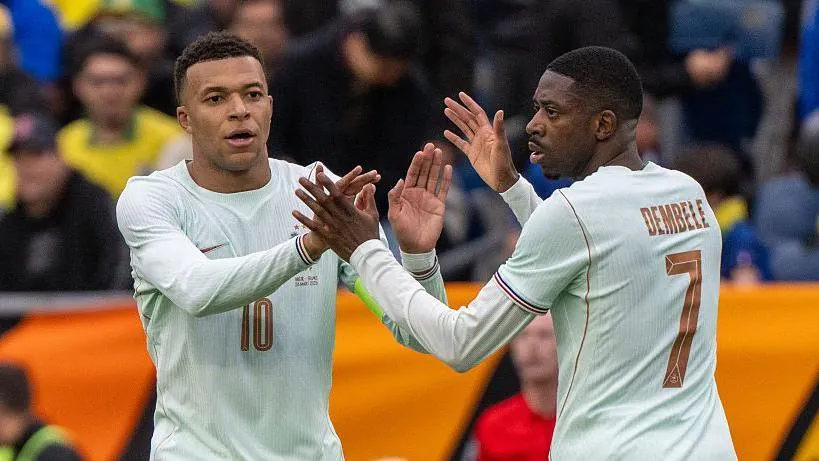
France's attacking depth is the most envied in the tournament. Deschamps has constructed a system built on defensive solidity and precise use of the considerable individual quality above it, with Mbappé as the focal point and a supporting cast of elite technical players capable of deciding any match in moments. These are the france national football team players who will define France's campaign in North America.
Kylian Mbappé — The Most Scrutinised Player at This Tournament
Kylian Mbappé is 27 years old, captains France, plays his club football at Real Madrid and carries into this tournament the specific motivation of a player who has been to a World Cup final — scoring a hat-trick in it — and left without the winner's medal. His 2022 final performance against Argentina remains one of the most extraordinary individual displays in World Cup history: two goals in the last three minutes of normal time to force extra time, a third in the additional period before losing on penalties. At Real Madrid since 2024, Mbappé has evolved into a more positionally intelligent version of himself — a player who understands when to run in behind and when to stay, when to create and when to convert. His pace remains lethal, his movement between positions creates problems that defensive coaches cannot fully solve through structure, and his penalty-box instinct — the ability to arrive at the right moment, take the right touch and finish under pressure — is at its most reliable. He arrives in North America at 27, fit, motivated and surrounded by a squad built in part to maximise his influence. No player at the 2026 World Cup carries more of the narrative weight of the tournament on his name.
Marcus Thuram — France's Most Complete Forward
Marcus Thuram has developed from a promising second striker into one of the most complete centre-forwards in European football over the last three seasons at Inter Milan, where he finished as the club's leading scorer in the Serie A 2024–25 campaign. The son of 1998 World Cup winner Lilian Thuram, he combines the defensive awareness and positional intelligence his father embodied as a centre-back with the technical touch, physical presence and goal threat of a modern elite striker. Thuram is not a finisher who waits for the ball inside the box — he connects the attack from deep, receives between the lines with his back to goal and plays forward quickly, and arrives in scoring positions with the timing that only comes from playing alongside elite midfielders who understand his runs. For France at the 2026 World Cup, his ability to link with Mbappé in one-two combinations, to hold the ball under pressure in tight areas and to score from headers, volleys and close-range finishes makes him the second attacking pillar of Deschamps' system.
Aurélien Tchouaméni — The Engine France Cannot Lose
Aurélien Tchouaméni is 26 years old and has been one of the three best defensive midfielders in world football for the past two seasons at Real Madrid, where his ability to intercept passing lanes, win physical duels against technically superior opponents and distribute cleanly at the moment of transition has defined the club's midfield structure. His importance to France is structural: the team's defensive shape, the speed of its transitions and the freedom given to Mbappé and the forwards to take risks all depend on Tchouaméni's capacity to cover the spaces behind them. In the matches where he has been absent through injury or suspension, the gaps behind the French midfield have been exploited more frequently and more successfully. His partnership with Camavinga or Zaïre-Emery gives Deschamps a double pivot capable of dominating the midfield zone against any Group I opponent — and of maintaining that control through the knockout bracket.
Mike Maignan — The Goalkeeper Redefining the Position
Mike Maignan is 30 years old and plays his club football at AC Milan, where his combination of shot-stopping instinct, aerial dominance and technical ability with the ball has made him one of the two or three best goalkeepers in world football. The French goalkeeping position was long associated with one name — Hugo Lloris, who kept goal for France through four major tournaments including the 2018 World Cup win and the 2022 final — but Maignan has established himself as a genuine upgrade in the role. His ability to play as an eleventh outfield player, to distribute short or long under pressure and to make saves in one-on-one situations with the composure of a player who has been in those moments before, gives Deschamps' system a security at the back that allows the defensive structure to push its line higher and press more aggressively than it could with a less confident goalkeeper. For a team that may need to defend narrow leads in knockout football, Maignan's presence in goal is one of France's most important structural assets.
Eduardo Camavinga — The Box-to-Box Engine
Eduardo Camavinga is 23 years old, plays for Real Madrid and represents the future of French central midfield in a position that has historically been one of the country's richest producing areas. Where Tchouaméni provides the defensive anchor, Camavinga provides the box-to-box energy — the ability to win the ball deep, carry it into forward areas with pace and arrive into goal-scoring positions from the second line. His left foot is elite: the crossing range, the pass selection and the ability to strike from distance all come from the same technical foundation that made him one of the most sought-after teenage prospects in European football when Rennes sold him to Real Madrid at 18. At 23, with two Champions League medals and now multiple major international campaign starts behind him, Camavinga has the experience to be decisive in high-pressure moments while still having the physical ceiling of a player who has not reached his peak.
What Is Didier Deschamps' Plan for France at the 2026 World Cup?
Didier Deschamps has managed France since 2012 and his tactical philosophy has been one of the defining discussions in European football across that period: a system built on structural defensive organisation, controlled possession transitions and the protection of elite attacking talent through collective discipline rather than individual freedom. The criticism — that French players of exceptional individual quality are constrained by a system that does not maximise them — has been consistent, and it has been consistently rebutted by results: a World Cup in 2018, a final in 2022, deep runs in 2014, 2019 and 2020 in the Euros.
For the 2026 World Cup, Deschamps' preferred shape is a 4-3-3 that collapses to a 4-5-1 without the ball. The three-man midfield — Tchouaméni as the anchor, Camavinga and Zaïre-Emery as box-to-box players — provides the engine. Mbappé leads the attack from the left, with Dembélé or Olise providing width on the right and Thuram as the central forward target. The full-backs — Theo Hernandez on the left, Koundé on the right — are expected to push high when France have the ball and recover quickly when transitions occur. The defensive centre, anchored by Upamecano and Konaté, is physically dominant and tactically disciplined.
France's qualifying campaign reflected this approach: clean sheets in seven of their ten UEFA qualifying matches, a goal difference that confirmed their attacking quality and a consistency of results across difficult away fixtures that validated the system's robustness. Euro 2024 ended at the semi-final stage with a loss to Spain, but France's performances across the tournament — including group stage wins against Austria and Poland — demonstrated the collective quality that Deschamps has built. The 2026 World Cup squad is older, more experienced and better equipped to handle knockout pressure than any previous French squad under his management.
Can France Win the 2026 World Cup? The Case For and Against
France have won the World Cup twice — in 1998 as hosts and in 2018 in Russia — and are the only nation to have reached four finals in the last 28 years (1998, 2006, 2018, 2022). That record of sustained excellence at the highest level of the tournament creates an expectation that frames every tournament France enter, and it is an expectation this squad fully understands. The 2022 final against Argentina remains the defining recent reference point: a match they appeared to lose before Mbappé's hat-trick forced extra time, before losing on penalties. That defeat gives this group a specific and genuine motivation that is not rhetorical. They have been to the final and lost. The 2026 edition is the opportunity to resolve that.
The case for France winning in 2026 rests on three pillars. The first is individual quality at the highest tier: Mbappé at 27 is the best attacking player in the world by the consensus of most technical analysts, and the supporting cast — Thuram, Tchouaméni, Camavinga, Maignan, Konaté — are individually elite at their positions. The second is squad depth that no other nation can match in certain areas: the forward options behind Mbappé (Dembélé, Barcola, Olise, Coman, Nkunku) are each capable of deciding a knockout match individually. The third is tactical experience: Deschamps has now managed France through five major tournaments, and the institutional knowledge of what it takes to win one runs through the team's preparation.
The case against centres on the bracket and the history at the knockout stage. Argentina, the defending champions, carry comparable individual quality at the top of their squad. Spain's tactical coherence and England's physical intensity represent different challenges that France's system must solve in one-off knockout matches. France's record in semi-finals since 2018 is mixed — wins in 2018, exits in 2006 and 2022 — and the specific challenge of beating two elite nations in consecutive matches over seven days remains the test that separates champions from contenders. But the conditions in 2026 are more favourable for France than at any World Cup since 2018. The squad is the best Deschamps has ever named. The motivation is entirely real. The question is execution.
France World Cup 2026: Group I Schedule and Fixtures
France are placed in Group I of the 2026 FIFA World Cup alongside Senegal, Iraq and Norway. Senegal are the highest-ranked opponent and the most technically capable, bringing European-based talent and the experience of deep CAF qualifying campaigns. Norway represent the second level of challenge — a European side built around the Haaland generation with aerial threat, high-intensity pressing and counter-attacking pace. Iraq, from the Asian qualification route, are the group's most straightforward fixture. France should progress from this group without difficulty, with the question of whether they finish first or second determining their knockout bracket position. Here are France's confirmed Group I fixtures.
The Group I opener against Senegal on June 16 is the match that Deschamps will treat with the most tactical respect. Senegal are Africa's best-ranked side, reached the round of 16 at the 2022 World Cup and have a squad that can transition quickly and press with intensity against teams that are slow in possession. France's individual quality in midfield — Tchouaméni, Camavinga and Zaïre-Emery against Senegal's midfield block — should be decisive, but Deschamps will prepare carefully for the physical and tactical pressure Senegal will apply in the first thirty minutes. The Iraq fixture on June 22 gives Deschamps the opportunity to rotate the squad and manage the physical load of key players ahead of the Norway game. The Norway fixture on June 26 is the group's most competitive match and the most important for determining France's bracket position.
For the complete fixture list, group tables and live scores throughout the tournament, see the full 2026 World Cup schedule and all 12 group stage draws.
France World Cup 2026: Frequently Asked Questions
Who is in France's World Cup 2026 squad?
France's 26-man squad named by Didier Deschamps includes Kylian Mbappé and Ousmane Dembélé as the key wide attackers, Marcus Thuram as the lead striker, Aurélien Tchouaméni as the midfield anchor and Mike Maignan in goal. The squad also features Eduardo Camavinga, Warren Zaïre-Emery, N'Golo Kanté, Michael Olise and Bradley Barcola among the key figures. France play in Group I against Senegal, Iraq and Norway.
Who is France's coach for the 2026 World Cup?
France's head coach at the 2026 World Cup is Didier Deschamps, who has managed Les Bleus since 2012. Deschamps won the 1998 World Cup as France's captain and the 2018 World Cup as their manager — the only person in the tournament's history to achieve both. He also led France to the 2006 and 2022 finals and the 2021 European Championship semi-final.
How difficult is France's group at the 2026 World Cup?
France are in Group I of the 2026 FIFA World Cup alongside Senegal, Iraq and Norway. France open against Senegal on June 16, face Iraq on June 22 and play Norway on June 26. France are the strong favourites to top Group I.
In which year did France win the World Cup?
France won the FIFA World Cup in 1998 (as hosts, beating Brazil 3-0 with two Zidane headers and an Emmanuel Petit goal) and in 2018 (in Russia, beating Croatia 4-2 with goals from Mandžukić og, Griezmann, Pogba and Mbappé). France were runners-up in 2006 (lost to Italy on penalties) and 2022 (lost to Argentina on penalties).
Is N'Golo Kanté in the France 2026 World Cup squad?
Yes. N'Golo Kanté was named in Deschamps' 26-man squad for the 2026 World Cup. The Al-Ittihad midfielder, 35, is included as a veteran defensive midfield option whose recovery speed, pressing intensity and ability to disrupt the opponent's build-up play remain important tactical assets. Kanté won the 2018 World Cup with France and is widely expected to retire from international football after this tournament.
Compare France's squad with other 2026 contenders: Germany's full 26-man roster, Portugal's full 26-man roster and all 48 qualified teams at the 2026 World Cup.