Switzerland VS Canada: How the Swiss Took Group B in Vancouver
By Jack Brown · —
Did Switzerland VS Canada swing on the first 12 minutes after halftime?
Switzerland VS Canada was the final Group B decider at BC Place, a match between two teams already through but still fighting over something tangible: the right to stay in Vancouver for the round of 32. Switzerland won 2-1 because they were cleaner when the game needed a decision. Ruben Vargas struck 50 seconds into the second half, Johan Manzambi punished another loose Canadian sequence 12 minutes later, and Promise David's first-touch volley gave the hosts a late pulse that never quite became an equaliser.
This page is about Switzerland VS Canada at the 2026 World Cup: what happened, why Switzerland controlled the decisive stretch, how Canada's tactical gamble around Alphonso Davies shaped the night, and what the result means for both knockout paths. The scoreline was not a landslide, but it felt like one of those group-stage matches that turns on a short window of clarity. Switzerland saw the match plainly after the break. Canada spent too long trying to recover from the version of the game they had wanted before kickoff.
That is what made the result sting for the home side. A draw would have been enough to keep Canada top of Group B and in Vancouver for another week. Instead, Switzerland took the sharper route through the evening. Murat Yakin's team were less sentimental about territory, more direct when the opening appeared, and more emotionally stable once the stadium began to strain toward Canada late on. Jesse Marsch's side made history by reaching the knockout round for the first time, but they also learned how thin the margin is between a feel-good host story and a logistical inconvenience that changes the whole tone of the next round.
Why did Switzerland VS Canada become a Swiss match after halftime?
Because Switzerland came out of the break with the clearer first pass, the clearer second run and the clearer emotional intention. The first half was not cautious in the dull sense, but it was measured. Both sides knew what first place meant. Canada had the crowd and the easier equation, because a draw would keep them on top. Switzerland had the better need. They understood that the match could not stay suspended forever. When the second half began, they moved the ball through the inside-left channel faster, attacked Canada's rest defence before it had settled, and forced the host side into the kind of backward decisions that look harmless until one loose touch opens the whole picture.
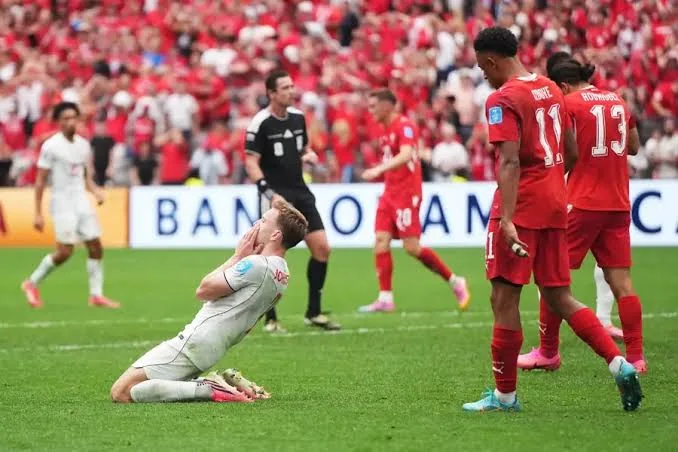
Ruben Vargas scored almost immediately after the restart, and that goal changed the emotional geometry of the night. Canada could no longer nurse the table. They had to chase it. Johan Manzambi's goal later in the half came from a similar source: Swiss conviction against Canadian hesitation. Manzambi has become one of the emerging names of the tournament, but the value of his finish was not only technical. It told Canada that Switzerland were not visiting Vancouver to negotiate. They were there to take the group and keep the city as their base.
What did Canada misread before the game really opened?
Canada misread how much structure they would lose by trying to balance caution with emotion. Marsch admitted afterward that Alphonso Davies was part footballer, part decoy on the night. The idea was understandable. Davies had fitness concerns, Ismaël Koné was out, and the Canadian coaching staff knew that the visual presence of their captain could lift the building and stretch Swiss attention. But football punishes compromise when the compromise sits in central transitions. Canada never looked fully sure whether they were protecting the draw, waiting for the stadium to create momentum, or trying to turn the game into a fast, wide duel. Switzerland read that uncertainty immediately.
The midfield absence mattered. Without Koné, Canada's ball progression felt more vertical than fluid. Stephen Eustáquio had to do too much tidying. The front line threatened in flashes, but the service into good areas came in bursts rather than in waves. That distinction matters against Switzerland, a side that can spend long stretches looking almost too sensible until you realise the calm is strategic. The Swiss do not need five dominant patterns. They need one clear route and two well-timed arrivals. Canada allowed both.
How important was Promise David in the last quarter-hour?
He changed the match faster than anyone on the Canadian bench could reasonably have hoped. Promise David came on in the 76th minute and scored with his first touch, a clean volley that transformed the emotional atmosphere inside BC Place. Until then, Switzerland had been handling the night like a side that knew the doors out of every problem. David made the next ten minutes noisy and uncomfortable. He attacked the near-post spaces more directly than Canada had managed earlier. He gave Jacob Shaffelburg and the wide runners a different target. He also reminded everyone that a match can become a different sport once a substitute arrives with no memory of the previous hour.
What Canada could not do was build a second wave after the goal. There was pressure, certainly. There were long throws, sharp crosses and one or two loose moments around Gregor Kobel's area. But the Swiss defended the final phase with the seriousness of a side that knew the reward was larger than three points. They were not protecting only a score; they were protecting geography, recovery time and bracket position. Promise David gave Canada belief. Switzerland answered with concentration.
Did the crowd help Canada, or did it raise the emotional stakes too high?
It did both. BC Place gave Canada a proper tournament atmosphere, and there were stretches in the first half when the noise carried the home side into tackles and second balls they might otherwise have lost. But a crowd can also make a team feel the future too early. Canada were playing not just for qualification, which they already had, but for the privilege of staying home. Every misplaced pass after Switzerland's opener carried the sound of a missed opportunity. Every Swiss clearance was greeted by a rise in volume that made the next Canadian action feel more urgent than it needed to be.
That is where Switzerland were impressive. They refused the emotional script the stadium wanted. They slowed restarts at the right moments, accepted ugly possessions when the match needed ugliness, and kept finding small exits on the flanks. They did not play with romance. They played with tournament intelligence. The Canadian crowd remained a force, but it could not replace the missing layer of composure in front of the ball once the Swiss lead was established.
What does the Switzerland VS Canada result change in Group B terms?
The most immediate consequence is practical. Switzerland stay in Vancouver for their round-of-32 tie on 2 July against a third-placed qualifier. Canada leave home and go south for a shorter-turnaround knockout match in Los Angeles against the second-place team from Group A. That is not cosmetic. In a tournament of compressed travel and emotional management, finishing first can mean one fewer disruption, one more familiar training cycle and one less layer of host pressure. Switzerland earned all of that in one second-half spell.
Canada's position is more complicated, but not bleak. They still advanced, which is historic in its own right. They had already shown enough earlier in the group to prove they belong in the event rather than merely help stage it. But finishing second changes the tone. Instead of treating the knockout game as a continuation of the Vancouver story, they now travel into the United States with less recovery time and a different emotional burden. That can harden a team, but it can also expose depth.
Was Manzambi the defining player, or was this really a match about collective discipline?
Both, and that is why Switzerland are such a difficult tournament side to summarise lazily. Johan Manzambi was the vivid name by the end of the night because his goal gave the score its durable shape and because he has the kind of spring-loaded style that immediately attracts neutral attention. But the match belonged just as much to the discipline around him. Granit Xhaka kept the evening measured. The Swiss back line resisted the temptation to defend the crowd as much as the ball. Vargas timed his run and finish exactly when the match was most available. Even the substitutions felt like they were made by a staff that had no interest in drama unless drama was useful.
That is often the Swiss way in tournaments. They do not always produce the loudest football, but they repeatedly produce football that survives stress. Against Canada, that mattered more than any one individual flourish. Manzambi's rise is real. So is Vargas' intelligence in these transition windows. Yet the larger takeaway is that Switzerland once again looked like a side comfortable with the idea of being underestimated for 45 minutes before they make the game tell the truth.
Can Canada still turn this into the beginning of something bigger?
Yes, because knockout football does not care how you arrived there once the whistle goes. Canada's first task is emotional. They must treat Switzerland not as the night the party moved away from Vancouver but as the night the squad discovered exactly how expensive small errors become at this level. There were still useful signs: Promise David's impact, Shaffelburg's directness, the crowd's willingness to believe, and the fact that even when the structure frayed the team kept pushing rather than folding. Those are not decorative qualities. They matter in elimination games.
But Canada will need better rest defence, calmer circulation through midfield and a cleaner idea of who carries the game if Davies is not starting at full sharpness. Switzerland exposed those questions without humiliating them. In some ways that is the more difficult kind of defeat. It leaves you with no excuse except improvement. Canada still have enough speed, enough belief and enough attacking range to trouble a knockout opponent. What they need now is the version of themselves that attacks with clarity rather than with emotion alone.
What should we remember from Switzerland VS Canada once the bracket moves on?
Remember that this was not a routine first-versus-second administrative game. It was a match in which the host nation could feel the comfort of staying home and the Swiss could feel the opportunity to steal it away. Switzerland did that by being more precise, more settled and more willing to make the emotional bargain the game demanded. Canada were not bad enough to deserve embarrassment. They were only imprecise enough to lose control of the one stretch that mattered most.
Remember too that Promise David made the ending feel alive, and that Canada's first knockout appearance still stands as a landmark in the country's football history. Yet if the night belongs to one larger lesson, it is probably this: tournament teams are judged not only by their best football, but by how quickly they recognise the moment when the match stops asking for patience and starts asking for authority. Switzerland recognised it. Canada reacted to it. That difference was Group B.
For the wider knockout picture, see the 2026 World Cup schedule. For Canada's tournament context, see Canada World Cup 2026 and the Canada World Cup squad 2026.
FAQ
What was the result of Switzerland VS Canada at the 2026 World Cup?
Switzerland beat Canada 2-1 on at BC Place in Vancouver. Ruben Vargas scored right after halftime, Johan Manzambi added the second in the 58th minute, and Promise David replied in the 76th.
Why did Switzerland finish top of Group B?
Because they beat Canada in the direct meeting that decided first place. Both teams had already qualified, but the Swiss win moved Murat Yakin's side above the hosts and kept them in Vancouver for the round of 32.
How did Promise David affect the match?
Promise David scored with his first touch after coming off the bench and instantly changed the feel of the final phase. He gave Canada a more direct reference point in the box and forced Switzerland to defend the last quarter-hour more seriously than they had expected.
Did Alphonso Davies start against Switzerland?
No. Alphonso Davies was managed carefully and appeared later in the game rather than from kickoff. Canada hoped his presence could change the rhythm, but by then Switzerland had already taken a two-goal lead.
What is next for Switzerland and Canada after this result?
Switzerland stay in Vancouver for a 2 July round-of-32 match against a third-placed qualifier. Canada travel to Los Angeles for their knockout tie against the second-place team from Group A.