Spain VS Saudi Arabia: How Lamine Yamal Lit Up Atlanta at World Cup 2026
By Jack Brown · —
Does Spain vs Saudi Arabia prove La Roja have found their form?
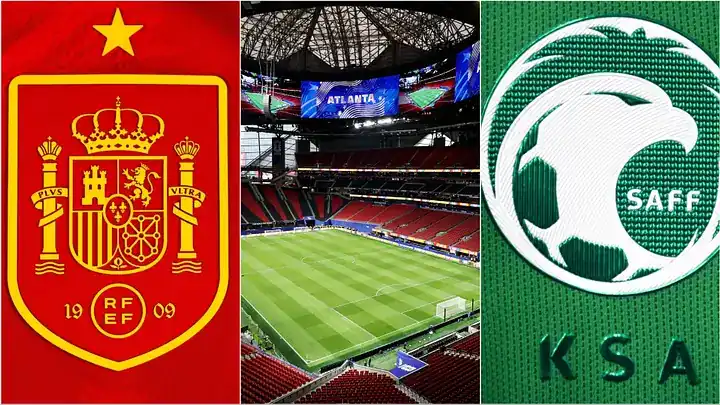
Spain VS Saudi Arabia ended 3-1 on at Mercedes-Benz Stadium in Atlanta — the result that put La Roja back in control of Group H after the anxiety of their 0-0 draw with Cape Verde six days earlier. Lamine Yamal scored twice, Dani Olmo added a third, and Spain finished the night top of the group with four points. Saudi Arabia pulled one back through Salem Al-Dawsari — a goal that raised Group H's tension for roughly twelve minutes — but never came close to repeating the kind of first-half momentum that had given them a lead against Uruguay on Matchday 1. Spain's 3-1 win was comfortable enough to arrive, though the scoreline flattered their start and obscured one turbulent fifteen-minute stretch that reminded everyone that Luis de la Fuente's side are not yet working at their ceiling.
What happened in Spain VS Saudi Arabia?
Spain came into the match having made one change from the Cape Verde draw: Dani Olmo replacing Álvaro Morata in the starting lineup, a shift that moved the team toward a slightly more technical attacking structure with less emphasis on aerial delivery and more on movement through central channels. The shape was the same 4-3-3 that Spain have used throughout Luis de la Fuente's tenure, but the intention in the final third felt different — more direct in certain moments, less patient with the recycling of possession that had sometimes gone sideways against Cape Verde.
Saudi Arabia set up in the 4-5-1 they had used to hold Uruguay to a draw, with a compact mid-block rather than a deep defensive line. Their intention was clear from the first whistle: restrict Spain's central lanes, force play wide, and use Mohamed Kanno's mobility to disrupt Pedri and Rodri's connection. It worked for the first seventeen minutes. Spain's first six sequences ended with either a loose touch in the final third or a Saudi press that forced the ball backward before an attack could develop. The Atlanta crowd, 71,240 of them, went quiet early in a way that will have reminded some observers of the Cape Verde match's stifling opening.
The 22nd minute changed everything. Pedri collected from Marcos Llorente on the right half-space, turned away from pressure and played a low pass between the Saudi Arabia defensive and midfield lines. Yamal met it in stride, took one touch to adjust his body shape, and drove a finish across Mohammed Al-Rubaie into the far corner. It was the kind of goal that had been coming in theory — Yamal had shown in the Cape Verde match that he could receive in tight spaces and retain quality on the ball — but it required patience to create it, and it required a pass from Pedri that trusted Yamal's movement before the run had fully announced itself. The goal was well taken. The pass was what made it possible.
Saudi Arabia's response was more coherent than most expected. Between the 28th and 41st minutes, they pushed their midfield line ten yards higher, gave Salem Al-Dawsari licence to drift inward from the left, and created three situations where Spain's centre-backs had to make recovery runs. The 37th-minute goal came from exactly this pressure. Al-Dawsari received forty yards from goal with Rodri slightly out of position, drove forward before the Spanish defensive line could drop, and placed a low drive into the bottom right corner that Unai Simón touched but could not keep out. The goal was Al-Dawsari's fifth across World Cup campaigns — his third in a single tournament, adding to the goal against Argentina that defined his Qatar 2022 performance. Mercedes-Benz Stadium went briefly chaotic. Saudi Arabia supporters inside the ground were loud enough to make the scoreline feel closer than it was.
Who scored for Spain against Saudi Arabia — and how?
Spain's three goals came from three different types of attacking action, which is worth noting because it suggests the variety that was missing in the Cape Verde draw. Yamal's first was a technical finish off a central combination. Olmo's 51st-minute goal came from a different mechanism entirely: a set piece. Marc Cucurella delivered a corner from the left, the Saudi defensive structure lost Olmo's run to the back post, and the Atlético Madrid midfielder arrived to head in cleanly at the far post. Heading is not typically cited as a core Olmo attribute, but the run was perfectly timed — he had not been in Al-Rubaie's sightline for the two seconds before the ball arrived, which is the only quality that matters in that situation.
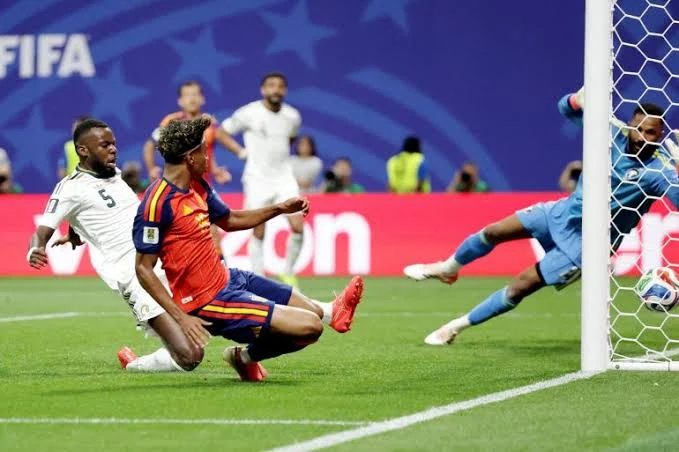
Yamal's second, in the 64th minute, was the one that told the clearest story about where he currently stands as a player. Spain were not dominating at that moment — Saudi Arabia had created two decent half-chances in the ten minutes since half-time — and the match still had the feeling of a game that could change if Spain allowed another Al-Dawsari moment. Nico Williams played Yamal in behind the Saudi right back, timed perfectly to run onto at full speed. The angle was difficult, the goalkeeper was closing fast, and Yamal's first touch had taken him slightly wide of his ideal position. He rolled a finish across the keeper and inside the far post from a spot most forwards would have crossed from. Al-Rubaie got a hand on it. It was not enough. The moment closed the game.
What do the Spain VS Saudi Arabia numbers say?
The 68 per cent possession figure was lower than Spain's Cape Verde number but came with higher efficiency — eight shots on target from 21 attempts is a conversion rate that reflects better decision-making in the final moments of attacking moves. Against Cape Verde, Spain had seven shots on target from 27 attempts, which meant 20 attempts that did not seriously test the goalkeeper. Against Saudi Arabia, the proportion was sharper. Some of that reflects a higher defensive line from the Saudi side, which gave Spain slightly more space to run into rather than a packed penalty area to break down. But the quality of the chances created — Yamal's first, Olmo's run to the back post, Yamal's second — suggested Spain's attackers were reading the game's gaps more accurately than they had six days earlier.
Saudi Arabia's nine shots — three on target — is a number that reflects a team more willing to try for a result than the Cape Verde match might have suggested. They had come for a draw against Uruguay and got one. Against Spain they came looking for something similar and found themselves behind to a goal that was very hard to see coming in the 22nd minute. The tactical shift that produced Al-Dawsari's equaliser was intelligent and quick and caused Spain genuine discomfort. The problem for Saudi Arabia was that once the game returned to Spain's control after the break, they had used their main attacking mechanism and had less in reserve for the second half's more open phases.
How did Lamine Yamal perform against Saudi Arabia?
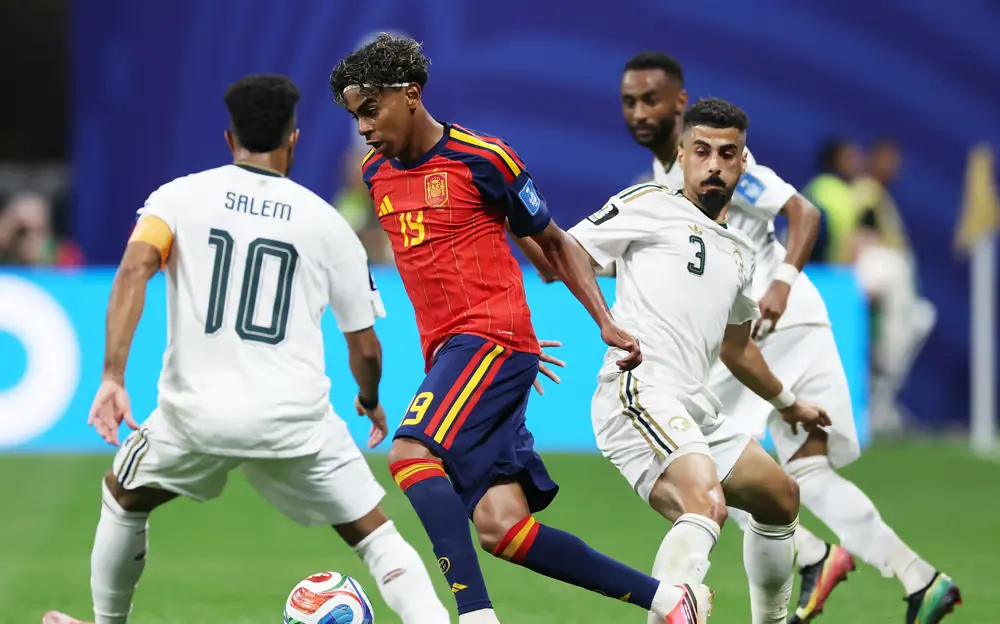
Yamal entered the Spain vs Saudi Arabia match carrying questions that were not entirely his fault. The Cape Verde draw had produced a narrative around Spain's finishing rather than around their 18-year-old winger specifically, but the volume of his attempts in that first match — some driven too centrally, one overhit at a moment when a simpler pass would have produced a shot from a better angle — meant people were watching his decision-making carefully from the first minute in Atlanta.
What he produced over 79 minutes before being substituted for Yéremy Pino was a display that answered the questions without announcing the answers too loudly. The first goal was a product of arriving at the right moment rather than forcing the situation. The second goal was technically superb under pressure and at a moment when a more experienced forward might have chosen a simpler option. In between, he created two other passages of play that did not produce goals but moved the Saudi defence laterally in ways that opened space for Pedri and Rodri to advance. He also tracked back twice in the first half to cover Cucurella's forward run — a piece of defensive responsibility that goes unnoticed in most match summaries but was visible to anyone watching the Saudi Arabia counterattack attempts developing.
At 18 years and 344 days on the day of the match, Yamal is the youngest player to score multiple goals in a single World Cup group stage match for Spain. The previous record was held by David Villa, who scored a hat-trick against Honduras in 2010. Villa's hat-trick was against a side with 44 per cent possession and very limited ambition in attack. Yamal's brace came against a team that had scored five minutes before his second goal was needed. The context is different enough that direct comparisons make little sense, but the number is there and it will be cited for a long time.
Did Al-Dawsari's goal change what Group H now looks like?
Salem Al-Dawsari's goal in the 37th minute did two things simultaneously. It raised the immediate temperature of the match by reducing Spain's lead to nothing and forcing a question about whether Spain's defending under pressure was reliable. And it altered the Group H picture, briefly, by suggesting Saudi Arabia might take something from the game — which would have left the standings in a configuration where three teams still had a realistic route to qualification with one matchday remaining.
Al-Dawsari's World Cup record now stands at five goals across three tournaments — Saudi Arabia's most productive player in the competition's history by the time this match ended. His Qatar 2022 goal against Argentina was cited for two years as one of the most significant individual moments in World Cup history because of the scale of what it temporarily represented. His goal against Spain does not carry that particular weight, but it adds to the evidence that Al-Dawsari, now 32, performs at his best on the stages where the consequences of the next action are largest. He does not elevate in cup football because of some generalised competitive instinct. He is technically capable — quick over short distances, left foot precise from inside twenty yards — and the World Cup creates the specific kind of pressure that strips away the defensive conservatism that opponents in the Saudi Pro League often manage by not engaging him closely. In Atlanta, Spain left him too much space to run into in the moments after their first goal.
What does Spain's win mean for Group H going into Matchday 3?
Spain's 3-1 win moved them to four points — first in Group H with one match remaining. Cape Verde, who beat Uruguay 1-0 in the other Matchday 2 fixture in Miami, moved to four points as well, meaning Matchday 3 will be played with two teams level at the top and two teams below them in a group that remains genuinely open. Spain face Uruguay on in Guadalajara; Cape Verde face Saudi Arabia on the same day in Houston. The simultaneous kick-offs mean neither leading team will know what the other needs from the final whistle.
For Spain, the Uruguay match is a different type of test from anything they have faced in Group H so far. Marcelo Bielsa's Uruguay are physically direct in a way that Cape Verde are not and technically organised in a way that Saudi Arabia are not. Their press is more structured, their transitions are faster, and their attacking players — Rodrigo Bentancur, Federico Valverde, Darwin Núñez — operate through combinations rather than through individual quality. Spain's midfield will be tested in a way that Al-Dawsari's direct running did not test it, because Bielsa's press tends to compress the time Pedri and Rodri have to think between receiving and passing. Whether Spain's 4-3-3 has the positional flexibility to absorb that kind of pressure while maintaining attacking threat is the defining question of their final group game.
How did Saudi Arabia set up tactically — and what went wrong?
Saudi Arabia coach Hervé Renard made two adjustments from the Uruguay draw that reflected his read of what Spain were likely to prioritise. The first was moving Kanno into a deeper position behind the midfield line, designed to pick up Pedri's movement between the lines. The second was giving Saud Abdulhamid more licence to engage Nico Williams high up the pitch, shortening the space in which Williams could receive and turn. Both changes made sense on paper and worked for the first seventeen minutes.
The problem with Kanno's deep position was that it reduced Saudi Arabia's speed on the counter in moments when Spain's midfield was slightly out of alignment — exactly the kind of transition that had produced their most dangerous moves against Uruguay. And giving Abdulhamid a high mandate against Williams required him to track Williams's runs back into his own half as well as forward, which is a significant physical and positional demand for a right back in a group stage match in Atlanta's June heat. By the 60th minute, Abdulhamid's starting position on defensive transitions was noticeably lower than it had been in the first half, which is a normal consequence of the energy expenditure the role required, but it reduced Saudi Arabia's width on the right side at exactly the moment Spain were pushing their attacks through Yamal's side.
Saudi Arabia's best period — the fifteen minutes that produced Al-Dawsari's equaliser and two other moments of danger — came when they stopped trying to manage Spain's possession and simply moved the ball forward quickly in transition. Those moments revealed the best version of what this team can do: quick and direct through Al-Dawsari, intelligent movement from the front three in behind, and the capacity to exploit Spain when the defensive line is caught in the process of moving up. Renard will know that none of this was sufficient over 90 minutes, but the performance offered enough to suggest Saudi Arabia have the tools to make their final Group H match against Cape Verde genuinely competitive.
What are Spain's remaining fixtures in Group H?
Spain's final Group H match is against Uruguay on at Estadio Akron in Guadalajara, Mexico. It is Spain's only group-stage match outside the United States — a venue that will carry a different atmosphere and a different logistical context from the two Atlanta fixtures. Estadio Akron holds 49,850 spectators and is the home of Club Deportivo Guadalajara (Chivas), which means the ground will be deeply familiar to Mexican football supporters in a way that creates a unique World Cup atmosphere distinct from the purpose-built stadiums that dominate most of the North American tournament venues.
Spain need a draw against Uruguay to guarantee first place in Group H — they cannot be overtaken on points if they avoid defeat. A loss, combined with a Cape Verde win over Saudi Arabia, would put Spain and Cape Verde level on four points, with the group positions decided by goal difference. Spain's current goal difference after two matches is +2 (three goals scored, one conceded). The stakes are real but manageable for a squad with Spain's depth and tactical flexibility. What the Uruguay match will confirm — or not confirm — is whether the three goals against Saudi Arabia represent a reset in Spain's tournament form or whether the defensive vulnerability Al-Dawsari exposed is one that a more complex attacking unit can exploit further.
For the full Group H schedule and live standings, see the 2026 World Cup schedule. For Spain's squad guide and tournament preview, see Spain World Cup 2026.
FAQ
What was the result of Spain vs Saudi Arabia at the 2026 World Cup?
Spain VS Saudi Arabia ended 3-1 on at Mercedes-Benz Stadium in Atlanta. Lamine Yamal scored twice (22nd and 64th minutes), Dani Olmo added a header in the 51st minute, and Salem Al-Dawsari replied for Saudi Arabia in the 37th. Spain finished with 68% possession and 21 shots.
Who scored in Spain vs Saudi Arabia at World Cup 2026?
Spain goals: Lamine Yamal (22'), Dani Olmo (51'), Lamine Yamal (64'). Saudi Arabia goal: Salem Al-Dawsari (37'). Yamal was named Player of the Match for his two-goal performance at Mercedes-Benz Stadium.
How did Lamine Yamal perform against Saudi Arabia at World Cup 2026?
Yamal scored twice and created two other dangerous passages of play. His first goal came from a driven finish after a Pedri through ball in the 22nd minute. His second, in the 64th minute, was a near-post finish from a tight angle after being played in by Nico Williams. He was substituted in the 79th minute after winning the Player of the Match award.
What group are Spain and Saudi Arabia in at World Cup 2026?
Spain and Saudi Arabia are in Group H of the 2026 FIFA World Cup, alongside Uruguay and Cape Verde. After Matchday 2, Spain and Cape Verde lead the group on four points each, with Uruguay on one point and Saudi Arabia on one point.
What are Spain's next fixtures after beating Saudi Arabia?
Spain's final Group H match is against Uruguay on at Estadio Akron in Guadalajara, Mexico. A draw or win would confirm Spain's place in the round of 32.