
Japan World Cup 2026: Schedule, Squad & Preview
By Jack Brown · ·
What are the Japan national football team's chances of a knockout-stage run at the 2026 World Cup?
Japan at the 2026 World Cup — quick facts: Group F · Opponents: Netherlands, Tunisia, Winner Play-Off B · Coach: Hajime Moriyasu · Captain: Wataru Endo · FIFA ranking: 18th · World Cup appearances: 8th · Best result: Round of 16 (2002, 2010, 2018, 2022). Japan drew 2–2 with Netherlands in their Group F opener on 14 June.
This page covers the Japan national football team at the 2026 FIFA World Cup — their eighth consecutive appearance at the tournament since their debut in . Japan are drawn into Group F alongside Netherlands, Tunisia and the Winner of Intercontinental Play-Off B. The japan world cup group stage opens on against the Netherlands and runs through to . For a side that stunned the football world in by beating Germany and Spain in the same group before losing to Croatia on penalties in the round of 16, the 2026 tournament is a continuation of a genuine upward trajectory. Hajime Moriyasu has built a cohesive, tactically sophisticated unit from players predominantly based in Europe's top leagues — a generation of technically polished, physically improved footballers who represent the fullest realisation yet of Japan's long-term footballing development strategy.
The 2022 World Cup in Qatar changed the international perception of Japanese football fundamentally. Beating Germany 2-1 in the group stage — after coming on from a goal down with ten minutes to adapt — and then defeating Spain 2-1 through an equally dramatic comeback dismantled the assumption that Asia's best team was a respectable but limited qualifier. Japan press with coordinated intensity, defend compactly in a low block, and possess the individual quality in wide areas and central midfield to punish European opposition on the counter-attack. The 2026 squad has retained that tactical identity while adding greater depth, more physical maturity and a greater number of players with consistent Champions League or top European league experience. Group F is not a gentle draw, but it is not an impossible one either.
What are Japan's group stage fixtures at the 2026 World Cup?
Japan's three group stage matches in Group F offer a sequence that demands immediate quality from the opening whistle. The first fixture on is against Netherlands — one of the European sides eliminated at the semi-final stage of the 2022 World Cup and a technically sophisticated opponent with genuine attacking quality through players such as Cody Gakpo and Xavi Simons. This is the match that will define Japan's group stage position: a draw or a victory against the Netherlands would open the path to qualification; a defeat would put pressure on the remaining two fixtures. The second group game, on against Tunisia, presents a more accessible opponent in terms of global ranking and individual quality, though the physical demands of an evening kick-off in a North American summer will require careful management. The third group match, on against the Winner of Intercontinental Play-Off B, is the most open in terms of opponent identification — the play-off winner is yet to be determined, but Japan would be considered favourites against any intercontinental qualifier.
Japan's japan world cup group stage sequence is perhaps the most testing they have faced at any tournament since their 2022 group — which included Germany and Spain. The Netherlands match in particular carries the weight of Japan's most ambitious statement of intent: if they can hold or beat a top-ten European side in the opening game, qualification becomes a near-certainty. If they lose and struggle against Tunisia, the third match against the play-off winner becomes a must-win with all the psychological pressure that carries. Moriyasu's ability to manage squad energy and tactical preparation across three distinct opponent profiles will be one of the defining narratives of Japan's 2026 tournament.
How does Hajime Moriyasu want Japan to play at the 2026 World Cup?
Hajime Moriyasu has managed the japan national football team since 2018 and is now the most experienced coach in the team's history at a single tournament cycle. His tactical approach has evolved significantly since his early tenure, moving from a cautious 4-2-3-1 base into a more fluid system that can shift between a 4-3-3, a 3-4-3 and a compact 5-4-1 defensive block depending on the opponent and the game state. The common thread across all his systems is the same: organised, coordinated defensive pressing in the opponent's half, followed by rapid vertical transitions once possession is won.
Japan's pressing under Moriyasu is not random intensity — it is structured around specific triggers. When the opponent's goalkeeper or centre-back receives the ball under pressure, Japan's front three activate simultaneously, cutting passing lanes and forcing the ball wide. The wide defenders then engage the opponent's fullbacks, creating a situation in which the first pass out of the press is limited and predictable. Japan recovers the ball in advanced positions and transitions within two or three touches — the style that produced both comeback goals against Germany and Spain in 2022 came directly from this pressing blueprint executed at the highest level.
The attacking identity relies on pace, technique and movement in wide areas. Takefusa Kubo on the right, Ritsu Doan on the left and Kaoru Mitoma as either a starting wide forward or an impact substitute give Japan three players capable of beating opponents one versus one, cutting inside onto their stronger foot and creating goal chances from central positions. The central midfield, anchored by Wataru Endo at Liverpool and supported by players such as Ao Tanaka and Hidemasa Morita, provides the structural stability that allows the wide forwards to take risks. Japan's build-up is patient and controlled through the centre before the ball is released quickly into the wide channels where Kubo and Doan operate with freedom.
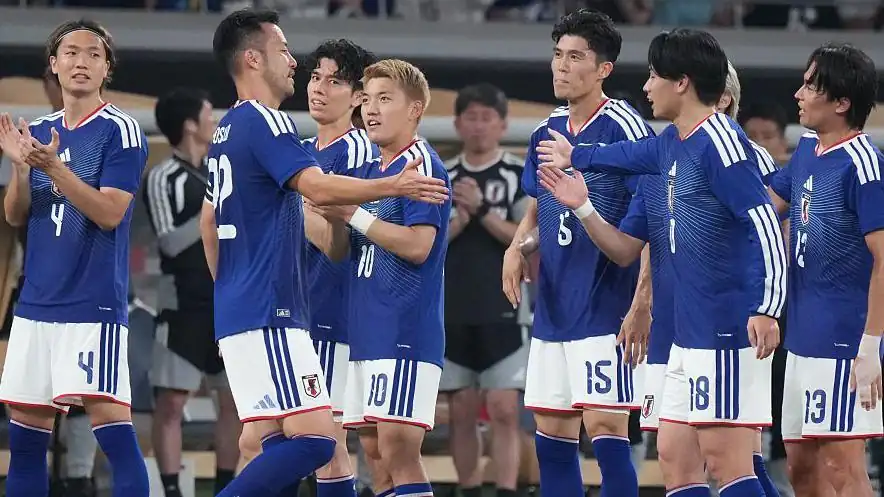
Which Japan players should you watch at the 2026 World Cup?
Takefusa Kubo is the single most gifted individual in the current Japan squad and the player European clubs have most consistently tracked over the past three seasons. The Real Sociedad forward — formerly in the Real Madrid academy — combines close control, acceleration in tight spaces and an eye for goal that places him in the top tier of wide forwards at this World Cup. Kubo's ability to receive the ball in compact areas and create something from nothing gives Japan an individual quality differential that no Asian team has consistently had since the peak of Naohiro Takahara's generation. At 23 in 2026, this World Cup comes at the ideal moment in his development: experienced enough to handle the pressure, physically at his best. If Japan reach the knockout stage, Kubo's direct contributions in wide areas will be the primary reason.
Ritsu Doan has been one of the most productive wide forwards in the Bundesliga over the past two seasons at Freiburg, combining consistent goal and assist output with exactly the kind of pressing intensity and defensive tracking that Moriyasu's system demands from his attacking players. Doan scored both Japan goals against Spain in 2022 — including the second, which required him to control a ball that appeared to have gone out of play and finish across the goalkeeper under enormous pressure. His combination of productivity, pressing work rate and big-match temperament makes him one of the most complete attacking players in the Japan squad. Against Tunisia and the play-off winner, Doan will be expected to deliver both goals and creativity.
Wataru Endo captains the side from a Liverpool midfield starting position — a club platform that represents the highest level of regular European competition a Japanese central midfielder has occupied since the peak of Shunsuke Nakamura. Endo's role in the Japan system is structural: he protects the back four, wins second balls, recycles possession under pressure and organises the pressing triggers that define Japan's defensive phase. His physicality — unusually high for a Japanese midfielder — allows him to compete with the physical intensity of European central midfielders without sacrificing his technical quality. Against the Netherlands' midfield, Endo's ability to win the physical duel in central areas will be one of the critical factors in Japan's ability to impose their structure.
What is Japan's World Cup history?
Japan made their FIFA World Cup debut in in France and have qualified for every edition of the tournament since — eight consecutive qualifications representing the most consistent record of any Asian national team in the history of the competition. Their early World Cups were largely learning experiences: exits at the group stage in 1998, a co-hosted round of 16 appearance in 2002 as joint hosts with South Korea, and group stage exits again in 2006 and 2014. But the pattern across the most recent three editions has been one of escalating ambition and capability.
The 2010 World Cup in South Africa saw Japan reach the round of 16 under Takeshi Okada, defeating Denmark 3-1 in the group stage before losing to Paraguay on penalties. The 2018 tournament in Russia produced their best performance to that point under Nishino: a group stage win over Colombia and a dramatic round of 16 match against Belgium in which Japan led 2-0 before losing 3-2 to a Nacer Chadli header in stoppage time. The 2022 World Cup in Qatar remains the defining moment in the modern history of Japanese football: two comeback victories over Germany and Spain in the group stage, followed by a round of 16 defeat to Croatia on penalties that felt like a genuine opportunity missed rather than a ceiling reached. Japan had 18 shots in the Croatia match and controlled the second half. A penalty shootout is not an assessment of tactical capability.
The 2026 squad carries the ambition that 2022 generated: a genuine belief, now shared within Japanese football and increasingly acknowledged outside it, that Japan can reach the quarter-finals of a World Cup. The squad depth in Europe has continued to grow since 2022, with more Japanese players performing at the highest level of the Champions League and the top five European leagues than at any previous point in the nation's football history. The question is not whether Japan are capable of a quarter-final — they demonstrably are. The question is whether the draw and the specific performance in critical knockout matches delivers the result that the quality of the squad warrants.
How many times has Japan qualified for the World Cup?
Japan have qualified for the FIFA World Cup eight times. After missing every edition before their debut in , they have qualified continuously without interruption: 1998 (France), 2002 (Japan/South Korea, co-hosts), 2006 (Germany), 2010 (South Africa), 2014 (Brazil), 2018 (Russia), 2022 (Qatar) and 2026 (Canada/Mexico/United States). This run of eight consecutive qualifications makes Japan the most consistent qualifier in the AFC and one of the most reliably present nations in the 48-team format era. AFC qualification operates through a multi-round Asian qualifying process in which Japan have never failed to advance since their first appearance. The 2026 qualification was completed through the third round of AFC qualifying with multiple matches to spare.
What is Japan's path to the final at the 2026 World Cup?
The 2026 World Cup uses a 48-team format with a round of 32 preceding the traditional round of 16. Japan, if they finish first in Group F, would enter the round of 32 against one of the best third-placed finishers from adjacent groups — likely a side from CONCACAF, CONMEBOL or an African qualifier that finished third in their group. This represents an accessible entry point into the knockout bracket for a technically superior Japanese side. A second-place finish in Group F would also deliver a round of 32 berth, though against a potentially stronger opponent from a group winner position.
From the round of 32, Japan's bracket path depends on the performance of other groups. The realistic quarter-final scenario involves beating a second-ranked European or South American side in the round of 16 — the kind of match Japan have demonstrated they can win through the 2022 performances against Germany and Spain. A quarter-final would represent Japan's best-ever World Cup finish. It is not an unrealistic target for a squad of this quality. It requires two knockout wins at the highest level of international competition, which demands both sustained tactical discipline and individual performances above their usual standard from Kubo, Doan and Endo in decisive moments.
A semi-final or final appearance would require Japan to beat one of the tournament's elite sides — France, Spain, Argentina, England or Brazil at the quarter-final stage. Japan's tactical approach — structured defence, rapid counter, individual quality in wide areas — is not without a pathway against any of those opponents. The 2022 defeats of Germany and Spain prove that Japan can beat elite European sides when the pressing structure is executed correctly and the transitional moments fall in their favour. The margin is tight, but it is not theoretical.
For the complete Group F schedule and results, see the full 2026 World Cup schedule and all 12 group stage draws.
FAQ
What group is Japan in at the 2026 World Cup?
Japan are in Group F at the 2026 FIFA World Cup. Their three opponents are Netherlands (), Tunisia () and the Winner of Intercontinental Play-Off B ().
Has Japan ever beaten a top-ranked European team at the World Cup?
Yes — twice in the same tournament. At the World Cup in Qatar, Japan beat Germany 2-1 and Spain 2-1 in the group stage, both times coming from a goal down in the second half. These results are the most significant victories in the history of Japanese football and confirmed that Japan can compete with elite European opposition at the highest level.
Who is Japan's best player at the 2026 World Cup?
Takefusa Kubo is widely considered Japan's most talented individual at the World Cup. The Real Sociedad forward brings elite close control, pace and goal-scoring instinct from the right wing. Ritsu Doan and Wataru Endo are equally critical to the team's system — Doan for goals and pressing, Endo for defensive structure and captaincy.
How many times has Japan qualified for the World Cup?
Japan have qualified for the FIFA World Cup eight times since their debut in . They have qualified for every edition without interruption — the longest consecutive run of any Asian nation — confirming their status as the most consistent qualifier from the AFC.
What is Japan's best World Cup result?
Japan's best World Cup result is the round of 16, reached in 2002, 2010, 2018 and 2022. They have never progressed to the quarter-finals. In 2022, they defeated Germany and Spain before losing to Croatia on penalties in the round of 16 — their most competitive campaign to date.