
Belgium World Cup 2026: Schedule, Fixtures & Preview
By Jack Brown · ·
Is 2026 the Belgium national football team's last shot at World Cup glory?
Belgium at the 2026 World Cup — quick facts: Group G · Opponents: Egypt, Iran, New Zealand · Coach: Domenico Tedesco · Captain: Kevin De Bruyne · FIFA ranking: 3rd · World Cup appearances: 14th · Best result: 3rd place (2018 Russia). Group stage: 15 June vs Egypt · 21 June vs Iran · 26 June vs New Zealand. Belgium drew 1–1 with Egypt in their Group G opener on 15 June.
This page covers the Belgium national football team at the 2026 FIFA World Cup. Belgium arrive in North America ranked third in the world by FIFA, placed in Group G alongside Egypt, Iran and New Zealand — a draw that makes them overwhelming favourites for group stage progression. At , their opening match against Egypt began the belgium world cup campaign that could represent the final chapter for one of the most decorated generations in the country's football history. Coach Domenico Tedesco has assembled a squad that blends the last representatives of the golden era — Kevin De Bruyne, Romelu Lukaku and Thibaut Courtois — with a younger cohort of technically excellent players capable of carrying Belgian football into the next decade.
The weight of expectation on this squad is specific and well-defined. Belgium's golden generation was once ranked number one in the world by FIFA — a position they held for a record 1,441 days between 2015 and 2018. That generation reached the semi-finals of the 2018 World Cup in Russia, finished third with a 2-0 win over England, and entered the 2022 World Cup in Qatar as potential finalists. The Qatar campaign ended in elimination at the group stage. That failure, compounded by the retirement of core players and the departure of Roberto Martínez, triggered a reset in Belgian football that Tedesco has been managing since February 2023. The 2026 World Cup in North America is simultaneously a final tournament for several of the players who defined the golden era and a first major tournament for the next generation tasked with replacing them.
What are Belgium's Group G fixtures at the 2026 World Cup?
Belgium's three group stage matches are spread across eleven days and offer a manageable path to the round of 32. The opening fixture on pits them against Egypt — a team with strong African football credentials but limited experience against top-ten ranked European opposition at World Cup level. The second group match, on , is against Iran, who made a significant impression at Qatar 2022 by winning two group stage matches and pushing the United States to a tight late-game situation. Iran's discipline, set-piece organisation and the ability to absorb pressure for extended periods makes them a more credible test than the group standing suggests. The final group fixture, on , is against New Zealand — a team competing at their third consecutive World Cup but facing the widest individual quality gap of any Group G opponent.
Compared to Belgium's Group H draw at Qatar 2022 — which included Canada, Morocco and Croatia and ended in an early exit — Group G represents a significantly more favourable bracket. Tedesco can realistically expect maximum or near-maximum points from the group stage, allowing him to manage minutes carefully for De Bruyne and Lukaku ahead of the knockout rounds. The ability to rotate without losing results is especially important in a 48-team tournament where the group stage schedule is compressed but the knockout rounds demand immediate peak performance.
How does Domenico Tedesco set up the Belgium national football team?
Domenico Tedesco inherited a squad in transition and has used the twenty-seven months since his appointment to develop a system that can accommodate both the remaining elite experience and the emerging talent of a younger generation. His preferred structure is a 3-4-2-1 that provides defensive solidity through three central defenders while giving the wing-backs the freedom to join attacks and create overloads in wide positions. The formation is designed to protect the team when they do not have the ball — a specific adaptation after Belgium were exposed on the counter at Qatar 2022 — while still giving De Bruyne the freedom to dictate tempo from a deep-lying playmaker position rather than a box-to-box role.
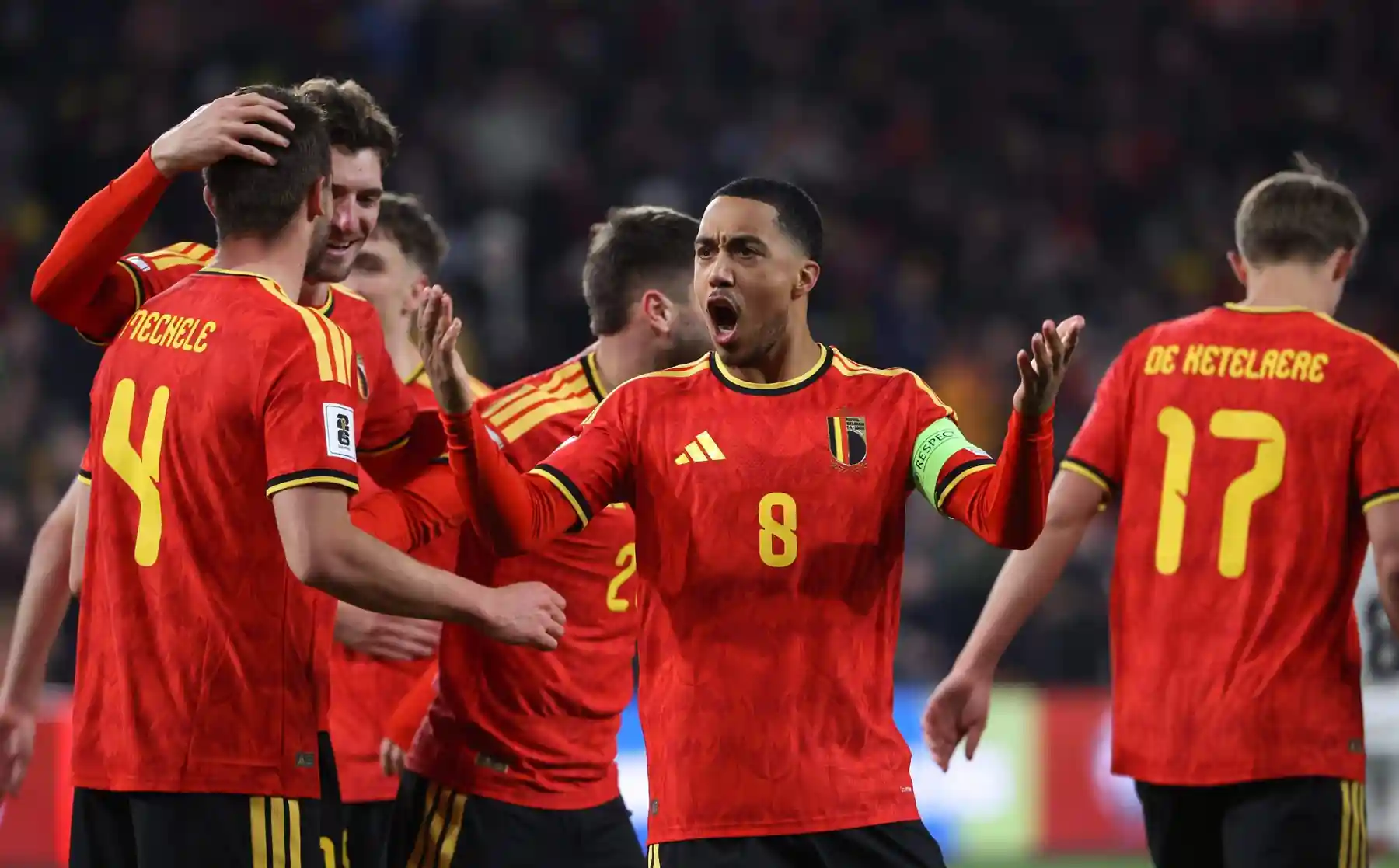
The system accommodates Lukaku's physical presence as a target striker and creates the conditions for Charles De Ketelaere and Leandro Trossard to operate in the half-spaces behind the striker, where their technical quality and movement are most dangerous. Johan Bakayoko, who has emerged as one of PSV Eindhoven's most exciting attacking players in European competition, provides the direct pace on the right flank that the system also needs in wide positions. The combination of De Bruyne's vision, De Ketelaere's movement and Bakayoko's speed creates an attacking structure that is difficult to defend man-for-man without leaving other areas exposed.
Defensively, the three-centre-back structure has given Tedesco the platform to rebuild after the retirements of Jan Vertonghen and Toby Alderweireld. Arthur Theate — who has performed consistently for Stade Rennais in Ligue 1 — and Wout Faes have developed into reliable partners who offer both defensive reading and the confidence to play out from the back under pressure. Thibaut Courtois, whose return to full fitness at Real Madrid after his 2023 ACL injury was one of the more remarkable individual recoveries in recent football, provides the kind of penalty box command and sweeping range behind the defensive line that makes Belgium significantly harder to score against when the structure is intact.
Which Belgium national football team players should you watch at the 2026 World Cup?
Kevin De Bruyne is 34 and carrying the full weight of a generation's last opportunity. The Manchester City midfielder has won six Premier League titles, a Champions League and reached the pinnacle of club football at every level the sport offers. What he has never won is the FIFA World Cup — and after leading Belgium to third place in Russia in 2018, through a Qatar 2022 disappointment and now to 2026, this is the tournament that will define whether one of the most technically complete midfielders of his era can translate individual brilliance into the ultimate team prize. De Bruyne at a World Cup is a different animal to De Bruyne in a Premier League match: the preparation time, the shared focus and the emotional investment of representing his country consistently produce his highest-intensity performances. His passing range — especially his ability to switch play across 40 metres with pinpoint weight — and his dead-ball precision on corners and free-kicks make him the most dangerous creator at this tournament when he has time and space to operate. At 34, his pressing intensity has softened compared to his peak years, but his reading of the game, his technical execution under pressure and his leadership within the squad have never been higher. The question is not whether he will perform — he will — but whether Belgium can build a tournament around him that gives his talent the result it deserves.
Romelu Lukaku arrives at his third World Cup having spent the last two years rebuilding his career and his body after a difficult period at Inter Milan and Chelsea. At 32, the striker who is Belgium's all-time record scorer has found form and consistency again at club level and enters the tournament as the physical focal point of Tedesco's attacking structure. Lukaku's value at a World Cup is specific: he is one of the few strikers in the tournament capable of holding the ball under pressure from two defenders, creating time for runners from deep positions, and then converting in situations where smaller, quicker forwards would be displaced. His aerial ability from crosses and corners, his movement to the near post in wide service situations and his raw finishing speed inside the box — both technically and in terms of decision-making — make him a consistent threat across the ninety minutes of a knockout match. Belgium have never won a major tournament with Lukaku in the squad, but they have never had Lukaku combined with a system as well-suited to his strengths as the 3-4-2-1 Tedesco has built around him.
Charles De Ketelaere has emerged from a difficult period at AC Milan — where he failed to reproduce his Club Brugge form — to become one of Serie A's most dynamic attacking players on loan at Atalanta. Under Gian Piero Gasperini's system at Atalanta, De Ketelaere developed the high-pressing discipline and the technical confidence to perform in tight spaces that were not visible during his Milan spell. At the 2026 World Cup he represents the bridge between the golden generation and the future of Belgian football: at 24, he is old enough to have absorbed the standards set by the De Bruyne era and young enough to carry those standards forward. His ability to press from the front and then arrive late into scoring positions when Belgium win the ball high up the pitch is one of the specific qualities that Tedesco's system was designed to exploit. In a tournament that rewards technical quality combined with physical intensity, De Ketelaere could be the player who defines how far Belgium go.
What is Belgium's World Cup history?
Belgium have one of the richer World Cup histories among European nations, with the 2026 tournament marking their fourteenth appearance at the finals. Their record spans almost a century of international football, from their debut at the inaugural 1930 World Cup in Uruguay — where they lost both matches and finished third in their group — to the peak of the golden generation at Russia 2018. Belgium did not qualify for multiple World Cups between 1998 and 2014, a period that coincided with the development of the youth academy structures that would eventually produce De Bruyne, Lukaku, Eden Hazard, Courtois and the generation that reached the top of the world rankings.
The 1986 World Cup in Mexico represents an earlier high point. Belgium reached the semi-finals under coach Guy Thys, defeating the Soviet Union 4-3 in a dramatic extra-time match in the round of 16 and then eliminating Spain on penalties in the quarter-finals. They were beaten 2-0 by Argentina in the semi-final — the tournament where Diego Maradona produced what many consider the greatest individual World Cup performance in history — and then lost the third-place play-off to France, finishing fourth overall. The 1986 squad, built around goalkeeper Jean-Marie Pfaff and strikers Jan Ceulemans and Enzo Scifo, is still widely regarded as one of the best Belgian teams in the pre-golden generation era.
The 2014 World Cup in Brazil marked the first major tournament appearance for many of the golden generation players. Belgium, ranked second in the world at the time and managed by Marc Wilmots, reached the quarter-finals before losing 1-0 to a single Gonzalo Higuaín goal against Argentina. The 2018 edition in Russia was the high point: Roberto Martínez guided Belgium through a group that included England, to a last-16 win against Japan that involved coming back from 0-2 down to win 3-2 in one of the most dramatic knockout matches in recent World Cup history, and then a famous 2-1 victory over Brazil in the quarter-finals in which a Fernandinho own goal and a Kevin De Bruyne strike settled one of the tournament's most anticipated matches. They fell 1-0 to France in the semi-final — a game Belgium dominated territorially but lost to a set-piece — and recovered to beat England 2-0 in the third-place play-off in Saint Petersburg. The 2022 Qatar edition ended in failure: group stage elimination despite a squad widely regarded as having the individual quality to contend for the title.
Why did Belgium's golden generation fall short at Qatar 2022?
The Qatar exit exposed the structural fault lines that had been building beneath Belgium's surface-level rankings position for two years. Roberto Martínez — who managed Belgium from 2016 to 2022 — was working with a squad in rapid physical decline among its core players. Hazard, who had once been the team's most dangerous attacker, was no longer the same player after recurring injury problems at Real Madrid. Axel Witsel was 33. Jan Vertonghen was 35. The collective pressing intensity that had made Belgium so effective in 2018 had diminished, and the team's inability to control matches through the midfield without De Bruyne at his absolute best left them vulnerable to organised, compact opponents.
The group in Qatar also proved more difficult than anticipated. Morocco — who went on to reach the semi-finals and become the first African team in history to do so — beat Belgium 2-0 in a game that was more comfortable for Morocco than the scoreline suggested. Croatia held Belgium to a draw, and Canada, while losing, pushed Belgium harder than expected. The tournament departure triggered the departure of Martínez, the retirement of several veterans and the beginning of the transition period that has defined Belgian football in the years leading to 2026.
How far can the Belgium national football team go at the 2026 World Cup?
Belgium's realistic ceiling in 2026 depends on two variables: how well Tedesco's system holds up under the physical demands of a knockout tournament, and whether De Bruyne and Lukaku can sustain their performances across the multiple matches that separating a group stage exit from a final requires. The group stage in Group G should be straightforward. Egypt, Iran and New Zealand do not represent opponents who can consistently threaten a third-ranked side in the world at full intensity.
The round of 32 and round of 16 are where the quality of Belgium's squad depth becomes important. Tedesco has built better squad depth than Martínez had available in Qatar: the wing-back positions can be rotated with quality; the midfield has genuine alternatives to De Bruyne at the base of the press; and the attacking options behind Lukaku — De Ketelaere, Trossard, Bakayoko and Dodi Lukebakio — are experienced enough to contribute in knockout matches without a significant drop in quality.
The quarter-final is Belgium's historic barrier. They have reached the quarter-final at their last two competitive World Cups and been eliminated there both times — by Argentina in 2014 and, arguably more painfully, by France in the 2018 semi-final (with the quarter-final against Brazil being the emotional peak of the campaign). In 2026, the knockout bracket could place Belgium against sides from England, France, Spain, Brazil or Argentina depending on how the draw falls. Against any of those opponents, Belgium's ability to control De Bruyne's usage across ninety minutes, manage Lukaku's physical load in warm North American conditions and keep a clean sheet through Courtois's presence in goal will be the key tactical decisions. A final is achievable. Belgium's squad quality gives Tedesco the tools to reach one. Whether the collective experience and the weight of a decade of near-misses has produced a team that executes at the highest level, or whether 2026 will be another tournament of individual brilliance without the ultimate prize, is the question this group of players will spend the rest of their careers being asked about.
For the complete Group G schedule and results, see the full 2026 World Cup schedule and all 12 group stage draws. For Belgium's player-by-player squad breakdown, see the all 48 teams at the 2026 World Cup.
FAQ
What group is Belgium in at the 2026 World Cup?
Belgium are in Group G at the 2026 FIFA World Cup alongside Egypt, Iran and New Zealand. Belgium are the clear group favourites and are expected to advance to the round of 32. Their fixtures run from against Egypt through to against New Zealand.
Who is Belgium's coach at the 2026 World Cup?
Domenico Tedesco is the head coach of the Belgium national football team at the 2026 World Cup. The German-Italian coach was appointed in February 2023 after Roberto Martínez departed following Belgium's group-stage exit at Qatar 2022. Tedesco has restructured the squad around a 3-4-2-1 system designed to accommodate both the experienced core and the emerging generation.
Is Kevin De Bruyne playing at the 2026 World Cup?
Yes. Kevin De Bruyne is in Belgium's squad for the 2026 World Cup and captains the side. At 34, this is expected to be his final World Cup appearance. De Bruyne remains Belgium's most creative player and the central figure in Tedesco's tactical system. His passing range, set-piece delivery and leadership within the group are irreplaceable at this level.
Can Belgium win the 2026 World Cup?
Belgium are realistic contenders for the FIFA World Cup knockout rounds and have the squad depth to reach the quarter-finals and potentially the semi-finals. Their best finish remains third place in Russia 2018, and while the golden generation is entering its final phase, the combination of elite experience and emerging quality in players like De Ketelaere and Bakayoko gives Tedesco a squad capable of competing with any opponent in North America.