Switzerland VS Colombia: Kobel wins the shootout
By Jack Brown · —
Why did Switzerland VS Colombia stay scoreless until penalties?
Switzerland VS Colombia became the kind of knockout game that keeps tightening rather than opening. Colombia carried more dribbling spark, Switzerland defended with greater balance, and neither side found the final touch over 120 minutes at BC Place. The tie ended 0-0 before Gregor Kobel saved in the shootout and Ruben Vargas converted the last Swiss kick, sending the Nati into their first World Cup quarter-final since 1954.
There are matches that explode quickly, and there are matches that close around the players like a fist. Switzerland VS Colombia belonged entirely to the second category. From the first half onward, the evening in Vancouver was shaped by small margins, patient defending and the feeling that one mistake would matter more than one moment of brilliance. Colombia had the wider menu of one-against-one threats. Switzerland had the steadier distances between lines, the more reliable rest defense and the goalkeeper who never looked hurried even when the game drifted into a penalty shootout.
That is why the result made sense even if the ending still felt brutal for Colombia. The Cafeteros were never outplayed, but they were never able to sustain pressure in the final third long enough to bend the entire match toward them. Switzerland, on the other hand, never made the contest beautiful, yet kept making it playable on their own terms. By the end, when Davidson Sanchez had hit the bar, Manuel Akanji had briefly kept Colombia alive by missing, and Kobel then saved from Cucho Hernandez, the match felt less like a lottery than the logical conclusion of two hours of accumulated calm.
For readers looking for the clean answer first, it is this: Switzerland VS Colombia ended 0-0 after extra time in Vancouver, and Switzerland won the shootout after Gregor Kobel's decisive save and Ruben Vargas' winning penalty. The longer answer is more useful. Switzerland advanced because they handled tension better than Colombia, accepted a slower game, protected central spaces and trusted that if the tie stayed level long enough, their structure and their goalkeeper would eventually give them the edge.
What did the game look like before the shootout arrived?
It looked exactly like a round-of-16 match between two sides that respected the risk of transition. Colombia had moments where Luis Diaz and Jaminton Campaz injected urgency, especially when they were allowed to receive facing forward. Switzerland responded not by chasing the ball wildly but by shrinking the space around the second action. The first challenge mattered, but the second one mattered more: who collected the loose ball, who reset shape first, who kept the next pass simple enough to avoid gifting field position away. Switzerland won that quieter battle more often than Colombia did.
In possession, the Swiss were not adventurous for long stretches. They chose security over tempo, circulation over vertical ambition. That can frustrate neutrals, but knockout football rarely rewards romanticism when one bad turnover can erase ninety minutes of discipline. Granit Xhaka kept trying to place the match in the right rhythm, leaning toward the left side, asking for one more pass and one more measured entry rather than one reckless ball through traffic. Colombia were more likely to ask individuals to solve the moment. Switzerland were more likely to ask the shape to solve it. Over 120 minutes, that difference became decisive.
Neither side created the kind of relentless sequence that makes a 0-0 feel false. The chances existed, but usually as isolated opportunities rather than waves. Colombia had the more emotional attacks, the kind that pull a stadium up from its seat because something open-field and improvisational might happen. Switzerland had the cleaner defensive recoveries and the less dramatic but more repeatable route back into control. By the time normal time ended, the scoreless state no longer felt surprising. It felt earned by the caution of both teams.
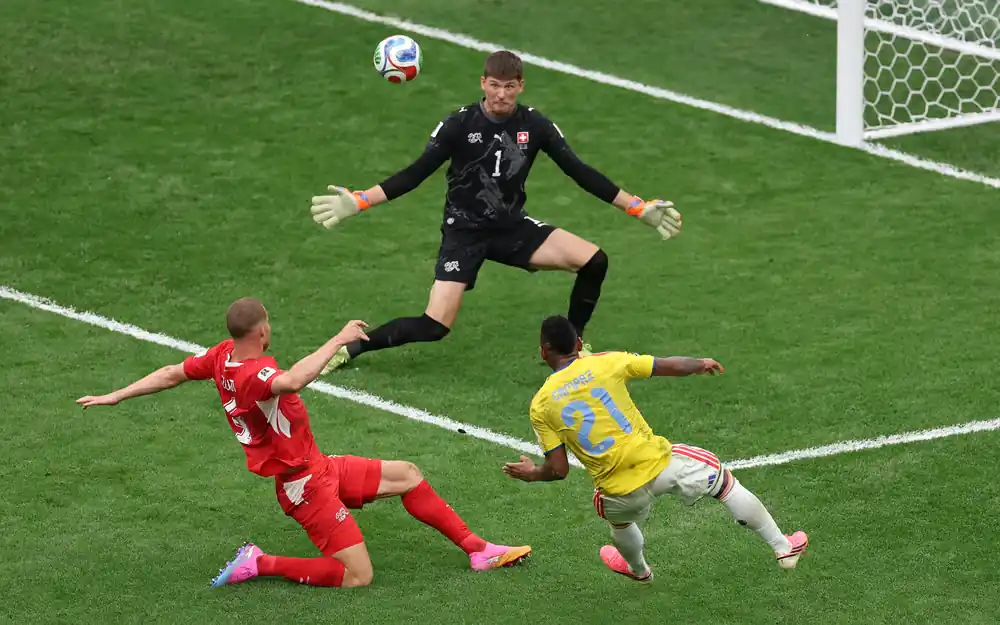
Why was Gregor Kobel the calmest player in Switzerland VS Colombia?
Because his influence started well before the penalties. Kobel's best quality in this match was not a theatrical save or a camera-friendly leap. It was the absence of panic. When Colombia attacked from wider areas, he set early and reduced second-chance danger. When Switzerland had to defend crosses under pressure, he made the box feel less unstable. That matters enormously in a knockout tie built on thin chances. A goalkeeper can steady the whole emotional geometry of a team simply by making difficult moments look routine.
There is also a specific kind of authority that matters in a shootout-bound game. Field players start wondering whether the tie will need a hero. Kobel played as though he had already accepted that possibility. His movement was compact, he never overcommitted, and he made Colombia work to beat him cleanly. By the time the penalties began, Switzerland already looked like a team whose goalkeeper understood the script and had no objection to it.
That fourth-round save from Cucho Hernandez will sit at the top of every recap, and fairly so. Kobel guessed correctly, got down with enough force and, most importantly, killed the rebound danger. But the shootout heroism only landed because his full match had prepared it. Colombia did not arrive at penalties believing they had solved the Swiss goalkeeper. They arrived there knowing they had spent two hours trying and failing to pull him out of control.
Did Colombia leave too much to individual inspiration?
A little, yes, and that is the sharpest criticism of their night. Colombia were not passive. They were often the side that seemed more likely to produce an open-play breakthrough. But too many of those promising phases depended on one player carrying the move deeper than the structure around him was prepared to support. Diaz could beat his man. Campaz could create a flicker. Juan Fernando Quintero could find clever angles. Yet Switzerland kept refusing the type of disorganization those talents usually punish.
The Swiss compressed central access well enough that Colombia's flashes often remained flashes. The move would brighten, then dim. The dribble would force a retreat, then the passing lane into the box would close. In a group game, that kind of half-pressure can still win you field position and eventually produce a defensive error. In a knockout game against a side comfortable living inside tension, it tends to leave you emotionally busier than tactically clearer.
This is why the match can be described as balanced without being equally comfortable for both sides. Colombia probably felt more alive in attack, but Switzerland felt more durable in the spaces that usually decide a cagey elimination tie. The Swiss did not need to own the more seductive moments. They only needed to make sure those moments never stacked up into momentum.
What changed once extra time began?
Not much in terms of the scoreline, but enough in the emotional texture to favor Switzerland. Extra time tends to reward the side that can live with repetition. Colombia looked as though they still wanted the dramatic breakthrough. Switzerland looked as though they had started to believe the match would eventually choose them if they stayed tidy. That subtle difference matters. One team keeps searching. The other begins waiting with purpose.
Fatigue also sharpened Switzerland's structural advantage. When legs go, distances widen first. The Swiss kept theirs shorter. Their back line did not become reckless, their midfield did not start arriving in scattered waves, and their possession choices stayed functional. Colombia still threatened, but the attacks began to look more isolated and more expensive. Every missed action required a longer recovery sprint. Every broken move left them just a little more exposed to the game's last punishing detail.
That is why the final score after 120 minutes should not be read as evidence that nothing happened. A great deal happened, but mostly in the realm that does not show up on a scoreboard: trust, spacing, risk tolerance, emotional management. Switzerland edged those categories more consistently. The penalties simply made the edge visible.
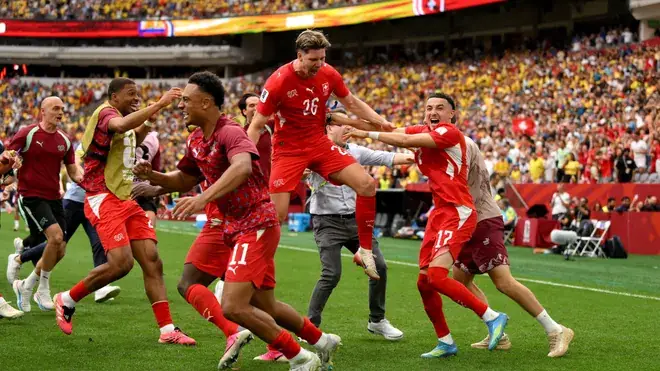
How did the penalty shootout swing toward Switzerland?
The opening round went the way most shootouts do when both sides still believe they are in control: Juan Fernando Quintero scored for Colombia, Granit Xhaka answered for Switzerland, and neither team looked close to blinking. The first real turn came when Davidson Sanchez hit the crossbar in round two. It was not an impossible miss, but it changed the atmosphere immediately. Switzerland were suddenly carrying the cleaner path.
Colombia received a brief reprieve when Manuel Akanji skied his attempt. That moment mattered because it could have broken the Swiss composure. Instead, Switzerland treated it as an interruption, not a collapse. Kobel then saved from Cucho Hernandez in the fourth round, a save that felt bigger than its technical difficulty because of the psychological timing. Cedric Itten had already driven home with certainty, so Switzerland were staring at the finish line. Luis Diaz scored to extend the contest, but by then the burden had shifted entirely onto Ruben Vargas to end it.
Vargas did exactly that. No flourish, no overthinking, just a clean strike and a release that carried the Swiss into the quarter-finals. The shootout sequence tells a simple story: Colombia made the first expensive mistake, Switzerland recovered instantly from their own miss, Kobel supplied the defining intervention and Vargas finished with the clarity the moment demanded.
What do the Switzerland VS Colombia numbers really tell us?
The biggest number is not a possession share or a shot total. It is 1954. Switzerland had spent decades reaching knockout matches without breaking past the round where a stronger football nation or a wilder match usually ended the run. Getting to a quarter-final again does not make this Swiss side legendary on its own, but it does place them in a rarer historical bracket than most modern Switzerland teams have occupied.
The other numbers support the shape of the story. One Colombian penalty missed the target. One Kobel save changed the geometry of the shootout. One Swiss finisher, Vargas, completed the job. When a knockout tie stays level that long, the data becomes a map of nerve as much as performance. Switzerland's map was cleaner. Colombia's was more jagged.
Was this Switzerland's most important World Cup knockout win in generations?
At the World Cup, yes, it is very difficult to argue otherwise. Switzerland have had excellent tournament performances in the modern era, and they have produced disciplined sides that were awkward for favorites to face. But they had not translated that consistency into a World Cup quarter-final since 1954. That historical gap changes the emotional weight of this result. It is not just another efficient Swiss display. It is the match that converted a familiar reputation for competitiveness into a rarer fact of progression.
What makes the win feel particularly Swiss is the manner of it. This was not a loose, all-guns upset. It was a serious, structured, emotionally controlled performance capped by a shootout in which the goalkeeper and the final taker did their jobs without noise. Nations build football identities through matches like this. Switzerland have long been seen as hard to open, well coached and unpleasant to eliminate. Now they have a World Cup result large enough to match that identity.
It will also matter for how the next tie is perceived. Argentina will still be favored in any quarter-final conversation, but Switzerland arrive with historical release rather than historical burden. They are no longer trying to prove they belong in this stage. They are already there.
Why will Colombia regret the small moments more than the big ones?
Because the big narrative is easy: penalties are cruel, shootouts are thin, a good team had to go home. The smaller truth is tougher. Colombia had enough field position, enough individual talent and enough flashes in wide areas to tilt this tie before the shootout. They never turned those advantages into a stable pattern of danger. Then, once penalties arrived, Davidson Sanchez's miss and Cucho Hernandez's saved effort left too much undone for the rest of the takers.
This is the pain of narrowly losing a structured game. It rarely feels as though one catastrophic event destroyed you. It feels as though fifteen modest misses kept adding up. One extra runner not arriving. One cross not cleared the right way. One pass played half a second too late. One penalty struck without enough margin. Colombia will replay those details because the match lived inside details from start to finish.
They should still leave with the recognition that they were in a real fight against a good side and did not fold. But World Cup knockout rounds are not graded for aesthetic danger. They are graded for advancement. Switzerland were better at the final administrative tasks of survival: protect the center, avoid panic, finish the shootout.
What comes next for Switzerland after Colombia?
A quarter-final with Argentina, and with it a completely different kind of pressure. Against Colombia, Switzerland could trust the game to remain close if they honored their structure. Against Argentina, structure still matters, but the individual quality on the other side can crack even good defensive plans with one sequence. The Swiss will need the same patience, the same distance control and likely another huge night from Kobel if they want to keep going.
The positive for Switzerland is that they no longer need to invent belief. This match supplied it. A team that survives 120 scoreless minutes and then wins a shootout gains a certain internal evidence. Players start trusting not only the tactical instructions but their emotional habits under stress. That is a real competitive advantage in late-round tournament football, where the next match is often decided by who remains most recognizable to themselves after the first bad moment.
- Switzerland VS Colombia ended 0-0 after extra time because both teams defended better than they finished.
- Gregor Kobel steadied Switzerland throughout the match and then supplied the decisive shootout save.
- Colombia had the more vivid individual attacking moments, but not enough sustained final-third clarity.
- Ruben Vargas converted the winning penalty to send Switzerland into their first World Cup quarter-final since 1954.
- Switzerland advanced with control, patience and nerve rather than volume or spectacle.
The shortest possible verdict is this: Switzerland VS Colombia was a disciplined, uneasy knockout tie that asked both sides to live without certainty for two hours. Switzerland managed that uncertainty better. When the match finally reduced itself to five steps and one kick, the Swiss were the side more prepared for the ending they had spent all night building toward.
For the full knockout picture, see the 2026 World Cup schedule. For more match reports, visit all World Cup matches. For daily tournament updates, keep an eye on the latest World Cup news.
FAQ
Who won Switzerland VS Colombia at World Cup 2026?
Switzerland won on penalties after a 0-0 draw in Vancouver. Gregor Kobel made the crucial save and Ruben Vargas converted the winning kick.
Why did the match finish 0-0?
Because both teams defended the center well and neither side sustained enough clean final-third combinations to turn promising attacks into a decisive finish.
Who were the key players in the shootout?
Kobel was the decisive goalkeeper, Cedric Itten scored under pressure, Luis Diaz briefly kept Colombia alive, and Vargas ended the tie with the final Swiss penalty.
What went wrong for Colombia?
Colombia relied too much on flashes from individual attackers, never fully bent the structure of the Swiss block, then paid for a bar hit and a saved penalty in the shootout.
What does this result mean for Switzerland now?
The Swiss move into the quarter-finals for the first time at a World Cup since 1954 and carry real momentum into their next knockout test.