
South Africa VS Canada: Eustaquio Sends Canada On
By Jack Brown · —
Why did South Africa VS Canada stay level until stoppage time?
South Africa VS Canada turned into the first true stress test of the 2026 World Cup knockout phase. Canada had more of the ball, spent longer in South Africa's half and looked the side more likely to find a decisive moment, but South Africa defended with enough discipline to keep the match alive until the clock slipped into added time. Then Stephen Eustáquio, the midfielder who usually gives Canada order before headlines, arrived in the right place to score the goal that sent Jesse Marsch's side into the round of 16 for the first time in the men's tournament.
For long stretches, South Africa VS Canada felt like a match that would be remembered less for invention than for nerve. South Africa entered the evening knowing they had already stretched their tournament beyond most outside expectations. They had negotiated a demanding Group A, stayed emotionally level through moments that could have gone against them, and reached the round of 32 as a team nobody wanted to underestimate. Canada arrived under a different kind of pressure. Co-host nations are judged in public, loudly and constantly, and while Canada had already done enough in Group B to prove they belonged, knockout football changes the scale of scrutiny. One mistake can become the story of a summer. One finish can become a national milestone.
That is what happened at SoFi Stadium in Inglewood on . South Africa VS Canada ended 1-0, but the scoreboard alone does not explain the shape of the night. Canada had to work for every metre, every entry pass, every second ball around the box. South Africa did not open up for them, did not panic, and did not surrender the middle of the pitch just because Canada pushed the tempo. This was a knockout match built on patience, structure and one late lapse. It was also a useful reminder that in the 48-team World Cup, the round of 32 is not a soft landing for favorites. It is the moment the tournament stops forgiving waste.
How did Canada control the match without turning control into an early lead?
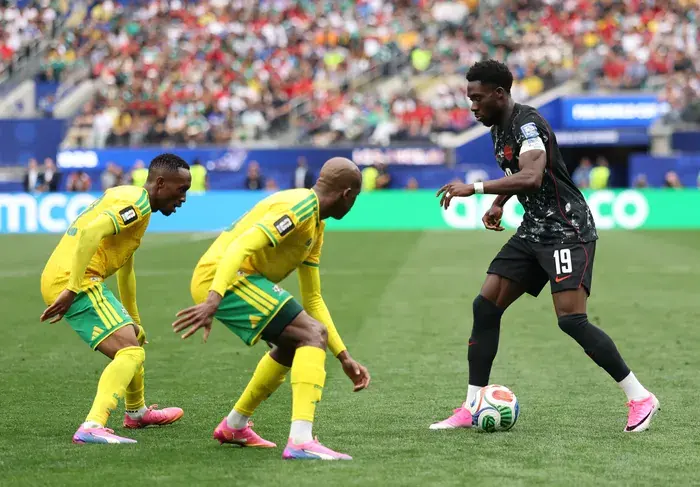
Canada's advantage in South Africa VS Canada was visible before it was measurable. Their back line circulated possession with more confidence, the midfield found cleaner supporting angles, and the front line carried more pace whenever the game opened for even a second. But South Africa were not interested in offering an open contest. They dropped into a compact shape, forced Canada into wide zones, and made the central lane feel crowded even when the ball moved quickly. That is the sort of defensive work that can frustrate a technically stronger side not because it stops every action, but because it turns every promising action into a slightly more difficult one.
The challenge for Canada was not simply to create chances. It was to create them before the match settled into habit. In the first half, they moved the ball well enough to suggest opportunities were coming, but not sharply enough to break South Africa's line with regularity. When Canada crossed early, South Africa's centre-backs had enough time to set themselves. When Canada looked for cut-backs, the final pass often arrived a half-beat late. When Stephen Eustáquio and Ismaël Koné tried to speed the game through the middle, South Africa's midfield screen narrowed the space quickly and forced Canada outward again.
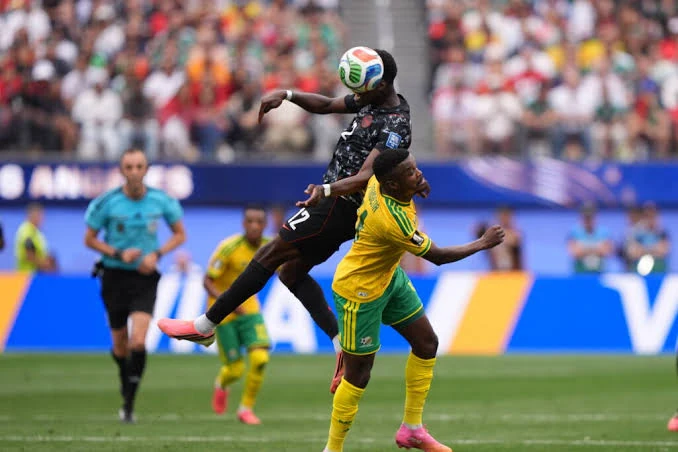
This is where knockout matches can begin to play tricks on the better side. The more time passes without a goal, the more every attack starts to feel urgent. Canada resisted that pull for a while. They kept building, kept asking South Africa to defend one more switch, one more overlap, one more restart after the block had shifted. That persistence mattered. Even before the goal, it was beginning to wear on South Africa's concentration. The defending was brave and mostly coherent, but the distances between players were not as exact after the hour mark as they had been in the opening 20 minutes. Canada's control did not immediately become a lead, but it changed the emotional weather of the match.
What did Alphonso Davies change after the 75th minute?
The defining personnel moment in South Africa VS Canada came in the 75th minute when Alphonso Davies entered the match. Canada had gone into the evening without their biggest accelerator on the field from the opening whistle, and that absence shaped the rhythm. Without Davies, Canada still had speed, still had combinations, and still had enough technical quality to keep South Africa pinned for spells. What they lacked was the one-player distortion effect Davies creates. Defences do not merely mark him; they bend around him. Full-backs backpedal sooner, midfielders slide wider, and centre-backs start preparing for cut-backs before the ball has even reached the byline.
Once Davies came on, South Africa's left-to-right defensive movement became more urgent. That urgency matters, because defensive shapes only remain compact when the nearest support arrives on time. Davies shortens that clock. One carry from him can turn a back four into a line of individual decisions: step, hold, foul, or recover. In South Africa VS Canada, his introduction did not produce a flood of clear chances, but it changed the depth at which South Africa were forced to defend. Canada could move the ball into threatening areas with fewer touches, and the match began to spend less time in the patient phase and more time in the scramble phase.
That shift also suited Eustáquio. He is at his best when the game starts presenting second phases rather than clean patterns. The first cross is cleared, the ball comes back out, the shape is half-set, and suddenly there is a pocket to attack or a rebound zone to occupy. Canada's midfield balance in those situations is one reason Marsch trusts Eustáquio so deeply. He reads the next ball before it fully exists. With Davies stretching the edge and Canada recycling pressure more aggressively, Eustáquio had a better platform to arrive late. He was not a surprise hero. He was the midfielder most likely to profit once the contest turned messy enough.
Why was Stephen Eustaquio the man who broke South Africa?
Stephen Eustáquio is the kind of player whose value can disappear from a casual summary because he spends so much of a match doing unglamorous work well. He keeps Canada's midfield organised, fills defensive gaps, helps sustain pressing waves and gives the next pass with enough clarity to keep attacks alive. In group games, that can be easy to overlook next to the speed of Davies or the finishing of Jonathan David. In South Africa VS Canada, however, the qualities that normally live in the background became central to the result. The winning goal arrived because Eustáquio had stayed mentally present deep into stoppage time, had read the loose moment faster than everyone around him, and had the calm to finish what might have been the only truly decisive sequence of the night.
The emotional weight of that moment mattered too. Reports around the match made clear that Eustáquio had been carrying personal grief after the recent deaths of both parents. Football can be cruel about timing; it asks for professional calm in the middle of private devastation. That did not make South Africa VS Canada a sentimental story, and the goal should not be reduced to one, but it did deepen the significance of who scored it. Eustáquio did not just send Canada through. He produced one of those tournament moments that alters how a player is remembered in his own country. Every major football nation has a short list of knockout goals that become part of public memory. Canada now have one more, and his name is attached to it.
The finish itself changed Canada's historical line immediately. Before South Africa VS Canada, the men's program had never won a World Cup knockout match. By the end of the night, it had crossed that threshold. The context matters because Canada are no longer being discussed merely as useful co-hosts or a spirited side with one or two elite names. They are now a team that has managed pressure, solved a stubborn knockout game and earned the right to keep playing. Those are different standards. Once a side does that on a World Cup stage, expectations grow, and they should.
How should South Africa read this defeat?
There are losses that hollow a team out, and there are losses that confirm the level a program has reached. South Africa VS Canada belongs more to the second category. South Africa were beaten late, narrowly and by a side with greater individual firepower. They did not collapse. They did not look out of place. They defended with concentration for almost the entire evening and made a co-host nation spend 90 minutes earning one clean breakthrough. That is not the profile of a team that stumbled accidentally into the knockout stage. It is the profile of a side that had built a repeatable way to compete.
What South Africa will regret is not effort, but the final few seconds of concentration. Knockout matches are often decided by how long a team can stay exact. It is not enough to be disciplined for 85 minutes. The standard is 95. South Africa met it until they did not, and against a team that had spent the whole match applying low-grade pressure, that single lapse was enough. Still, it would be unfair to let the ending erase the wider significance of their tournament. Coming through Group A ahead of one of the seeded names would already have counted as progress. Reaching the first round of 32 under the expanded format gave the campaign shape. Taking Canada to the edge of extra time gave it credibility.
There is also a broader lesson for South Africa in how this loss arrived. Their structure was good enough to survive. What they lacked, especially in the later phases, was a consistent outlet that could force Canada to defend deeper. Without that release valve, the match slowly compressed toward their own penalty area. The better version of South Africa in future tournaments will need both pieces: the collective discipline that carried them here and the attacking threat that makes opponents hesitate before committing one more body forward. Against Canada, the first piece was present almost all night. The second appeared only in glimpses.
How did Canada come through Group B?
Canada reached South Africa VS Canada as Group B runners-up, and that route says a lot about why they were capable of managing a knockout match without panic. The group itself was not straightforward. Bosnia and Herzegovina brought technical quality and experience. Qatar offered tournament familiarity and a structure that can frustrate sides that over-commit. Switzerland provided the most complete test in the section. Canada finished with four points, enough to take second place behind the Swiss, and they did it in a way that reflected the identity Marsch has been trying to install since taking charge: energetic, aggressive, occasionally imperfect, but difficult to pin in place.
The six-goal win over Qatar gave the group campaign lift, but the defeat to Switzerland may have been just as useful. It reminded Canada that knockout football would not reward emotional momentum on its own. They would have to defend better, manage the tempo more carefully and avoid treating every transition as an invitation to sprint. South Africa VS Canada showed the effect of that lesson. Canada were still proactive, but they were less reckless. They did not chase the match in waves. They trusted that if they kept the structure intact, one clear opening would arrive. It finally did.
What did South Africa's route out of Group A reveal?
South Africa came through a Group A that included Mexico, Czechia and Korea Republic, finishing second and earning a knockout game against Canada. That route matters because it framed South Africa VS Canada as more than a meeting between a co-host and a surprise package. South Africa had already shown that they could survive different tactical demands in the same week. Mexico asked one set of questions, Czechia another, Korea Republic another. The reward was not just progression. It was proof that South Africa could adapt without losing their core identity. That is why Canada never had an easy evening.
Tournament credibility is usually built before the knockout bracket begins. By the time South Africa faced Canada, they had already established theirs. They were not there to participate politely and leave. They defended as a team that believed the game belonged to them too. That belief is often the hardest quality for emerging knockout sides to maintain when they meet nations with bigger profiles. South Africa kept it almost to the end. If the gap between the two teams showed anywhere, it was less in organisation than in the number of match-winners available from the bench and the midfield. Canada had one more. South Africa did not.
What comes next for Canada after South Africa VS Canada?
The immediate answer is simple: a round-of-16 tie with the winner of Morocco versus the Netherlands. The more interesting answer is that South Africa VS Canada may change how Canada are treated in the bracket. Before the knockout phase began, they were an intriguing co-host side with pace, energy and a favourable home setting. After this result, they are a team with a World Cup knockout win and a little scar tissue in the right places. That does not make them favorites against whichever opponent comes next. It does make them harder to dismiss.
If the next round becomes more open than this one, Canada will welcome it. Their best attacking players are most dangerous when the game starts to stretch. If it becomes another compressed, tactical match, then South Africa VS Canada has already given them a useful rehearsal. They now know what it feels like to push without panic, wait without drifting, and strike late without losing shape. For a team trying to do something its men's program has never done before, that may be the most valuable part of the night.
For the full knockout bracket and kickoff times, see the 2026 World Cup schedule. For Canada's wider tournament picture, read Canada World Cup 2026. For the running match index, see World Cup Matches.
FAQ
What was the result of South Africa VS Canada at World Cup 2026?
South Africa VS Canada finished 1-0 to Canada on at SoFi Stadium in Inglewood, California. Stephen Eustáquio scored the winning goal in second-half stoppage time.
Who scored the winning goal in South Africa VS Canada?
Stephen Eustáquio scored the only goal of South Africa VS Canada in the 92nd minute, converting the late sequence that finally broke South Africa's resistance.
Why was South Africa VS Canada important for Canada?
The win sent Canada into the men's World Cup round of 16 for the first time. It was also the country's first victory in a World Cup knockout match.
How did Canada and South Africa qualify for this round-of-32 match?
Canada reached the knockout stage as Group B runners-up with four points from Bosnia and Herzegovina, Qatar and Switzerland. South Africa reached it as Group A runners-up after advancing from a section with Mexico, Czechia and Korea Republic.
Who do Canada play after South Africa VS Canada?
Canada advance to the round of 16 and will meet the winner of Morocco versus the Netherlands.