
Portugal VS Congo DR: Wissa Denies Ronaldo in Houston
By Jack Brown · —
Can Ronaldo find a 9th World Cup goal after a frustrating Portugal VS Congo DR draw?
Portugal VS Congo DR finished 1-1 on at NRG Stadium in Houston, and the result felt harsher on Portugal than the number alone suggests. João Neves gave the European side an early lead with a clinical header inside six minutes, but a Congo DR team making only their second ever World Cup appearance refused to play their assigned role. Yoane Wissa — calm and exact at the back post deep in first-half stoppage time — cancelled it with a header of his own, and the Leopards left Houston with a point that no neutral had anticipated when the Group K draw was made. For Cristiano Ronaldo, now 41, the night offered little comfort. He started and finished the full ninety minutes, the oldest outfield player ever to take the field at a World Cup opener, and ended it without adding to the eight goals he has scored across five previous tournaments. Portugal had the ball, the territory and the name recognition. They did not have the goal that would have made the evening straightforward.
The scoreline matters less as a result than as a portrait of what the two teams are. Portugal arrived in Houston ranked among the favourites for Group K, built around one of the most decorated squads in European football and supported by a midfield that, when operating properly, can control the tempo of any match on the planet. Congo DR arrived as the sentimental choice — a country returning to the World Cup for the first time since 1974, when they competed as Zaire, and doing so with a squad drawn largely from clubs in the Belgian and French leagues. The gap between those two descriptions felt enormous in the days before kick-off. On the field in Houston, it did not feel enormous at all. Congo DR sat deep and compact, trusted their defensive structure, and waited. The waiting, it turned out, was the right strategy.
Portugal controlled 68 per cent of possession across 90 minutes. They mustered seven attempts at goal. Only one was on target. That disproportion — the volume of the ball and the scarcity of genuine danger — is the central football story of the night, and it is a story that has followed Portugal into previous tournaments. They move the ball well in wide areas. They generate crosses and set-piece opportunities. But converting that circulation into clean shooting positions against a low defensive block requires a central striker who can operate in tight spaces, hold the ball under pressure and deliver finishing when the moment arrives. Ronaldo, once the answer to all such questions, is no longer that player in the way he was between 2006 and 2018. He remained in the game, he pressed when the situation called for it, and he made the runs that an experienced forward makes regardless of whether the service will arrive. The service did not often arrive. When it did, the two half-chances he produced ended off target. It was that kind of night.
Why did Portugal VS Congo DR end level despite Portugal's dominance?
The short answer is that Congo DR's defensive block was more organised than Portugal's attack was incisive. Coach Sébastien Desabre set his side up in a mid-to-low block with a clear instruction: let Portugal have the ball in front of the defensive shape, compress the central lane, and force wide play. It is a plan every team at this level has tried against Portugal. The difference was in the execution. Congo DR's defensive line held its shape under sustained pressure for longer than most teams manage. Their two holding midfielders — Sadiki and Moutoussamy — tracked runners aggressively and denied the link pass that connects Portugal's deeper possession to Ronaldo's runs in behind. Every time Vitinha or Bruno Fernandes attempted to release a vertical ball through the channels, someone in a red Congo DR shirt was already narrowing the angle.
Portugal were not passive in response. Roberto Martínez moved Bernardo Silva and Rafael Leão into tighter positions to try to overload the central areas and drag Congo DR's block into gaps. It worked in flashes. Neves's goal in the sixth minute arrived exactly from that kind of movement — a well-worked corner routine that delivered the ball to the edge of the six-yard box, where Neves arrived unmarked and directed his header low into the net. For ten minutes after that, Portugal looked controlled and likely to extend the lead. Then Congo DR steadied themselves, reasserted their shape, and the evening settled into the pattern that would define it: Portugal in possession, Congo DR in position, and the score frozen as the clock ran.
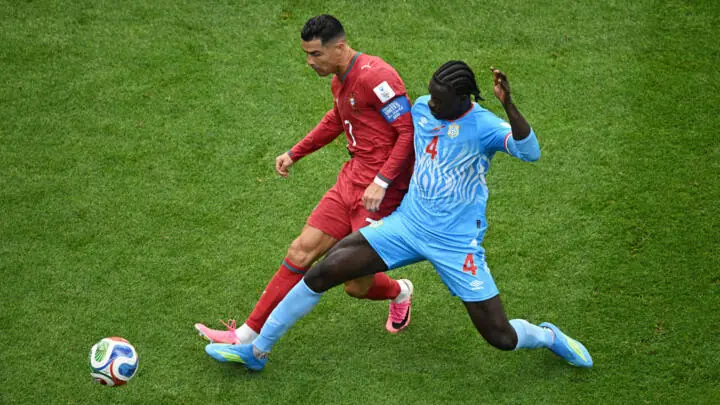
How did Yoane Wissa score Congo DR's first ever World Cup goal?
The sequence that produced it was the kind that defenders cannot afford to get wrong at a major tournament, and Portugal got it wrong. Congo DR won a short corner on their right side in the fifth minute of stoppage time at the end of the first half. The initial exchange built briefly and then Arthur Masuaku — the experienced left-back formerly of West Ham and Crystal Palace — whipped a low, angled cross towards the back post rather than the near post, cutting against the grain of the defensive set-up. Ruben Dias, positioned to cover the central area, did not have the angles to follow. Danilo Pereira, nominally covering the back post, was a step slow. Wissa, arriving at full pace from a run that had started near the penalty spot, got there first and thumped his header into the roof of the net from close range.
The goal was Congo DR's first in the FIFA World Cup since the 1974 tournament, which the country — then competing as Zaire — entered as Africa's sole representative. The famous 9-0 defeat to Yugoslavia in that tournament became a symbol of the gap between African football and the established powers, and the lack of a goal in those three games was simply one strand of a larger story of inexperience and underpreparation. Fifty-two years later, in a stadium in Houston named after a company that no longer exists, Yoane Wissa settled that particular debt. He wheeled away towards the Congo DR bench, and the small but loud section of the NRG Stadium that had arrived wearing the Leopards' red and yellow went genuinely loud in a way that neutrals who were watching for the history of it had been hoping to see.
What does Ronaldo's performance in Portugal VS Congo DR tell us about his role?
It tells us that his role has changed, and that Portugal's coaching staff have not fully resolved how to build a match around what he can now offer. Ronaldo's quality at 41 is not the same as his quality at 31, and it is not meant to be. That is not a decline specific to him — it is simply what time does to even the most extraordinary athletic careers. The question is never whether a player has changed. The question is whether the system around him has adapted to where he actually is, rather than where he was.
Against Congo DR, the answer was sometimes yes and sometimes no. The things Ronaldo can still do well — arriving late into the box, applying pressure high when the block is fragile, winning set-piece situations with his aerial presence — were periodically available to Portugal. The things that require explosive acceleration or sustained one-on-one isolation were not attempted often, and on the few occasions they were, the outcome was neutral at best. He fired two half-chances off target: one a volley from twelve yards that lacked the clean contact he would have made with it a decade ago, one a header from a corner that drifted wide when it would have needed exceptional placement to trouble the goalkeeper.
None of that is failure. The fact that Ronaldo started and completed ninety minutes in a competitive World Cup match at 41 is a physical achievement that very few professional footballers have matched at any position, let alone as an outfield player. He became, by simply taking the field, the oldest outfield player ever to start a World Cup match — surpassing the record held by Faryd Mondragón of Colombia, a goalkeeper who appeared briefly at Brazil 2014. That record will stand until someone else breaks it, and it may stand for a generation. But records do not score goals, and Portugal will need goals in their remaining two Group K fixtures. Whether Ronaldo provides them will depend partly on the service he receives and partly on the margin between what his body can still do and what the situation requires. Houston was not that night.
The numbers from Portugal VS Congo DR
The possession figure of 68 per cent for Portugal is not unusual for this side against a defensive opponent. What is unusual is the conversion rate from that possession: one shot on target in ninety minutes represents a significant failure to translate territory into danger. Congo DR's eight attempts — more than Portugal's seven — reflects both the effectiveness of their counter-press after winning the ball and the willingness of their attacking players, particularly Wissa and Cedric Bakambu, to commit defenders and force shooting situations when space appeared. The xG figures told a similar story: Portugal likely generated between 0.8 and 1.2 expected goals across the match, which is low for a team that controlled the game as completely as the possession number suggests they did.
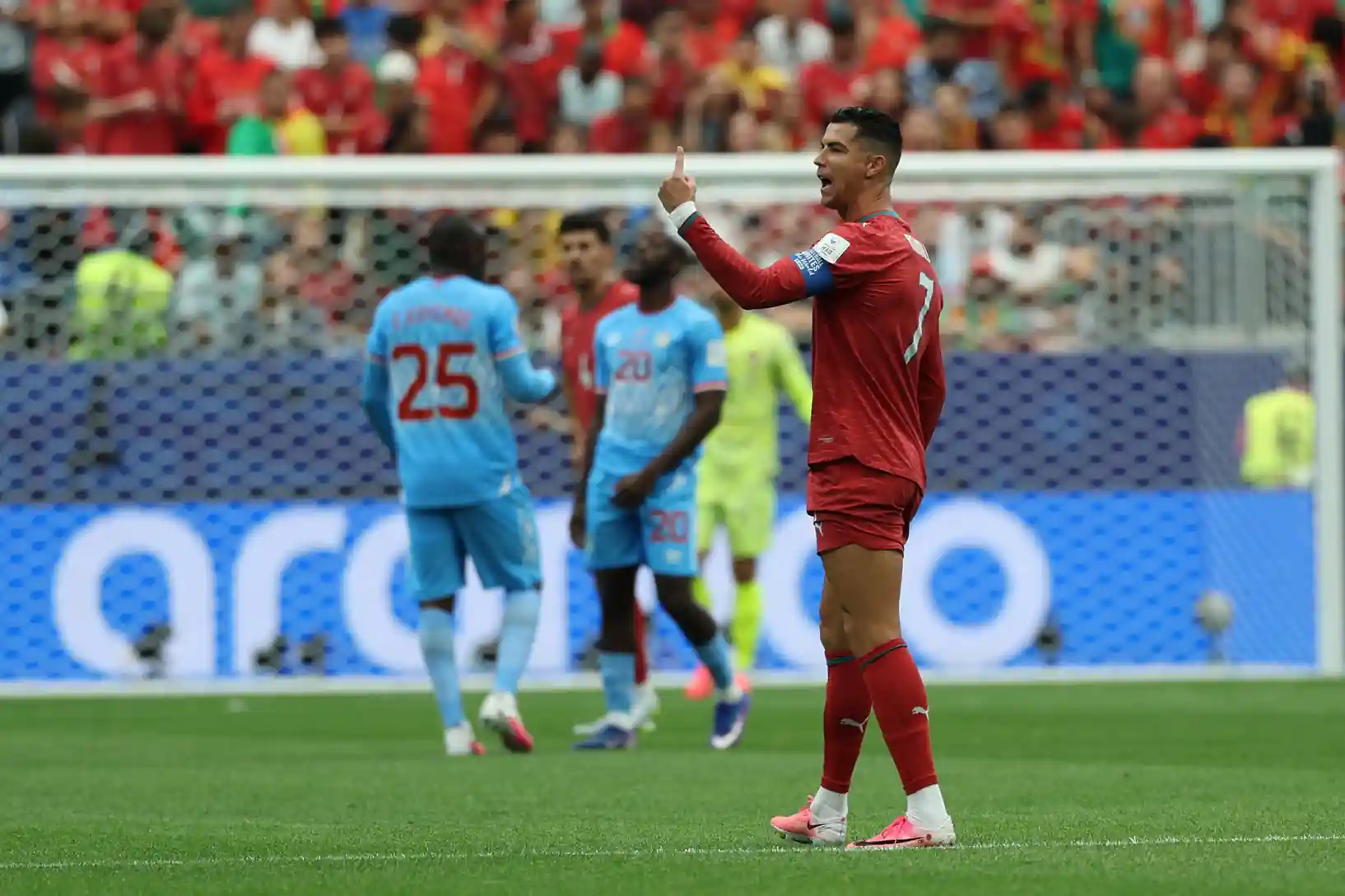
Did Congo DR have a plan, or did they simply defend and get lucky?
They had a plan, and the plan worked. Desabre has coached in Africa for most of his career, and his experience managing sides that must defend against technically superior opponents was visible from the first whistle. The mid-block he set up was not reactive — it was prepared, rehearsed and specific to Portugal's patterns. When Leão ran at Wan-Bissaka on the left flank, there was a midfielder already positioned to cover the cut inside. When Bruno Fernandes dropped deep to receive, there was a press-trigger designed to follow him that did not leave the defensive line exposed. Defending is not a passive activity when it is done well. Congo DR defended actively, and the organisational intelligence behind their shape deserved the point it earned.
The luck element came only at the edges. A different delivery on the Masuaku cross — a yard higher or a foot wider — and Wissa does not reach it cleanly. Positioning in set-piece defending involves enough random variation that even well-drilled teams can be caught by a single sequence that unfolds slightly differently than the prepared scenario. But Congo DR created the conditions for that sequence by holding the shape for eighty-nine minutes. Fortune arrived because they were still in the position to receive it. Teams that collapse under sustained pressure do not give fortune the opportunity to reach them.
What does the draw mean for Group K after matchday one?
It opens the group considerably. Portugal expected to begin their campaign with three points. Finishing with one means that their next two fixtures — against opponents yet to be confirmed at the time of writing — carry more weight than they would have done after a straightforward opening win. Goal difference, which would have been a useful buffer after a 3-0 or 4-0 result, is now level. Congo DR, having demonstrated that they can hold a top-ten European side to a draw, will approach their next match with a confidence that would have seemed improbable twenty-four hours before kick-off. The Leopards' fans in Houston and the millions watching across the Democratic Republic of Congo had every reason to celebrate a result that rewrites what this squad believes is possible at the highest level of international football.
For Portugal, the priority is simple: convert the possession into goals before the group stage closes. Their quality is not in question — it is in the application of that quality against defensive opponents who know exactly how to reduce the match to a controlled discomfort. The resolution will come, or it will not. If it does not, and if Ronaldo's involvement remains on the margins of the attacking play rather than at its centre, the tournament that was meant to be his final chapter will end earlier than anyone wants to admit. That is not the outcome anyone in Portugal is planning for. But it is the outcome that one frustrating night in Houston has made slightly more possible than it was before the kick-off whistle sounded.
For the full Group K schedule and standings, see the 2026 World Cup schedule. For Ronaldo's tournament outlook, see World Cup 2026 squad guides.
FAQ
What was the final score of Portugal VS Congo DR at World Cup 2026?
Portugal VS Congo DR finished 1-1 on 17 June 2026 at NRG Stadium in Houston. João Neves scored for Portugal in the 6th minute, and Yoane Wissa equalised for Congo DR in the 50th minute of the first half — their country's first ever World Cup goal.
How did Yoane Wissa score Congo DR's equaliser?
Wissa headed home from close range after Arthur Masuaku curled a cross to the back post from a short corner routine. He arrived unmarked and thumped the ball into the roof of the net, giving Diogo Costa no chance. The goal came in stoppage time of the first half.
How did Ronaldo play in Portugal VS Congo DR?
Ronaldo started and completed the full 90 minutes, becoming the oldest outfield player ever to start a World Cup match at 41. He managed two half-chances, both off target, and ended without a goal. Portugal's limited supply in the final third restricted his opportunities throughout the match.
What group are Portugal and Congo DR in at World Cup 2026?
Both teams are in Group K of the 2026 FIFA World Cup. The 1-1 draw means each side has one point after matchday one.
Is Wissa's goal Congo DR's first ever World Cup goal?
Yes. Wissa's header against Portugal was Congo DR's first ever goal at the FIFA World Cup. The country — formerly competing as Zaire — previously appeared at West Germany 1974 but did not score in three matches. The 52-year wait ended in Houston on 17 June 2026.