United States VS Bosnia-Herzegovina: the USMNT finally bent this stage
By Jack Brown · —
Why did United States VS Bosnia-Herzegovina feel like a USMNT World Cup hinge?
United States VS Bosnia-Herzegovina was the kind of night that can either harden a host nation or drag it back into its old anxieties. Instead, it became the sharpest proof yet that this USMNT World Cup run has a little more spine than the previous ones. The United States beat Bosnia-Herzegovina 2-0 on at Levi's Stadium in Santa Clara, took the lead through Folarin Balogun on the edge of halftime, survived his controversial second-half red card, and then watched Malik Tillman bury the free kick that turned relief into something stronger.
Quick Take
- The United States beat Bosnia-Herzegovina 2-0 in the World Cup round of 32 on July 1, 2026.
- Folarin Balogun scored first, then saw red after a VAR review on a challenge involving Tarik Muharemovic.
- Malik Tillman assisted the opener and curled in the clinching free kick in the 82nd minute.
- The result gave the Americans their first World Cup knockout win since 2002 and set up a last-16 date with Belgium on Monday, July 6, 2026.
Why was United States VS Bosnia-Herzegovina heavier than a normal round-of-32 tie?
Because this was not merely a test of whether the United States were better than Bosnia-Herzegovina over 90 minutes. It was a test of whether a home team that had topped its group could actually wear expectation without blinking. The American men's program has spent two decades collecting versions of the same argument: growing talent pool, better club development, bigger public stage, yet still not enough real knockout evidence to make the optimism feel sturdy. A home World Cup intensifies that pressure rather than softening it. Every good group-stage result begins to sound provisional until a knockout game confirms it.
Bosnia-Herzegovina were awkward opponents for that exact reason. They were not glamorous enough to let the United States play the underdog card, but they were organized enough to punish impatience. The shape of the matchup carried danger. If the Americans won comfortably, it would be treated as the minimum. If the match tightened, the old tension around U.S. knockout football would flood back into the stadium. That is why the emotional temperature mattered so much before kickoff. Levi's Stadium, known under FIFA branding as San Francisco Bay Area Stadium, felt less like a neutral tournament venue and more like a place waiting to see whether a country was finally ready to trust itself.
That is also why the clean sheet mattered almost as much as the scoreline. Host sides can often ride a crowd when the script stays smooth. The harder question is what happens once the match goes crooked. United States VS Bosnia-Herzegovina went crooked the moment Balogun walked off. The Americans did not unravel with him. That is what made the performance feel larger than the round itself.
How did Folarin Balogun own United States VS Bosnia-Herzegovina before the red card?
For most of the first hour, Balogun looked like the player most likely to bend the tie in either direction. He was the quickest American to spot where Bosnia-Herzegovina's back line was slow to shift, and the first forward on the field who kept treating half-open spaces as invitations rather than warnings. Before the goal arrived, he already had the match's sharpest attacking pulse. The United States were not overwhelming Bosnia with volume. They were prying at the game through Balogun's timing, his change of pace and his willingness to keep attacking the channel between center-back and full-back.
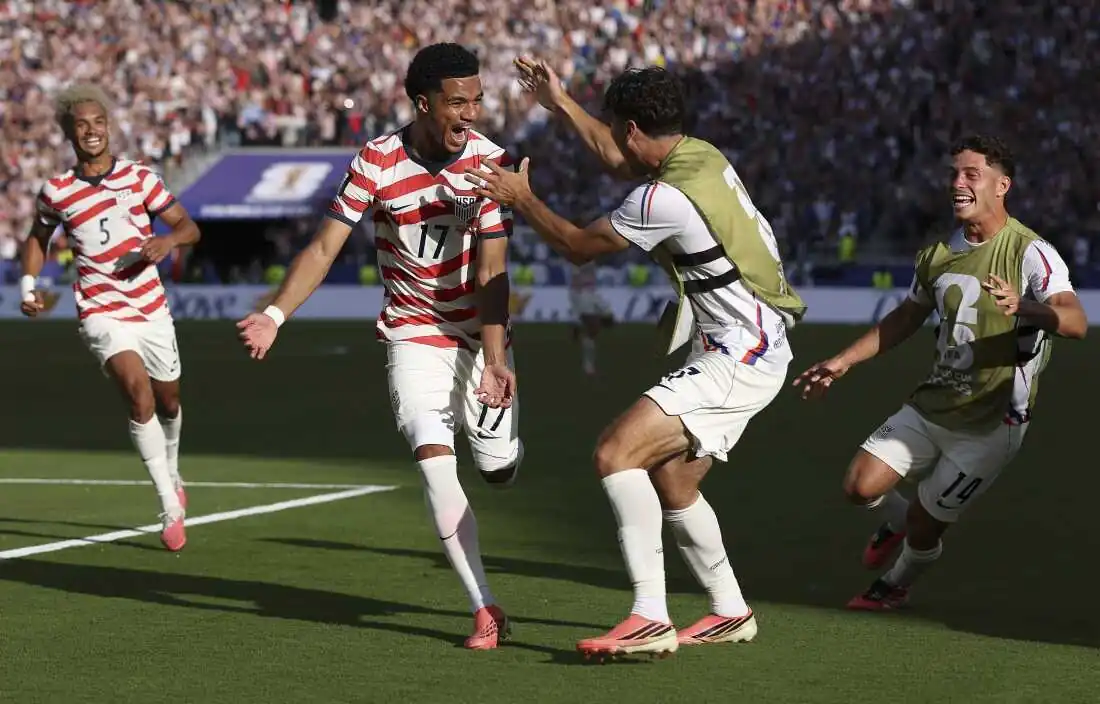
The opener, scored right at the edge of halftime, changed the entire emotional landscape. It came at the moment when the match most needed simplification. A flat 0-0 at the break would have left the crowd to argue with itself about tempo, precision and nerves. Balogun spared the United States that drift. He gave them a lead, yes, but more importantly he gave them a sense of forward logic. When a knockout match is physically tight and emotionally cluttered, the first goal does not just move the scoreboard. It tells one team that its reading of the game has been correct.
There was a little theatre in the way he carried himself too. The match report in the Guardian noted the LeBron-style "Silencer" celebration, and it fit the mood of a striker who seemed to understand that he had pushed the Americans into a different category of evening. For once, the United States were not simply surviving the stakes of a knockout game. Their center-forward had begun to dictate them.
Was Balogun's red card the real turning point in United States VS Bosnia-Herzegovina?
It was certainly the moment the match stopped being ordinary. Balogun's dismissal after a VAR review for the challenge on Tarik Muharemovic ripped the game out of its original tactical lane and turned it into a stress test. The Americans believed the contact was accidental. Mauricio Pochettino's camp moved quickly after the final whistle to underline the same point, but FIFA's rules made the immediate consequence straightforward: the straight red produced an automatic one-match suspension, which means Balogun will miss Belgium on . In practical terms, the decision could not be softened before the next game.
What made the red card such a revealing moment was not only the judgment itself, but the way the United States processed it. Older U.S. teams have sometimes played these stretches too emotionally after a major officiating decision, trying to prove the call wrong by force rather than by shape. This group did not fully lose its structure. There was anger, naturally. There was also discipline. The line of the match changed from "Can the U.S. control this?" to "Can the U.S. control itself?" The answer mattered more than any tactical diagram Pochettino could have carried in.
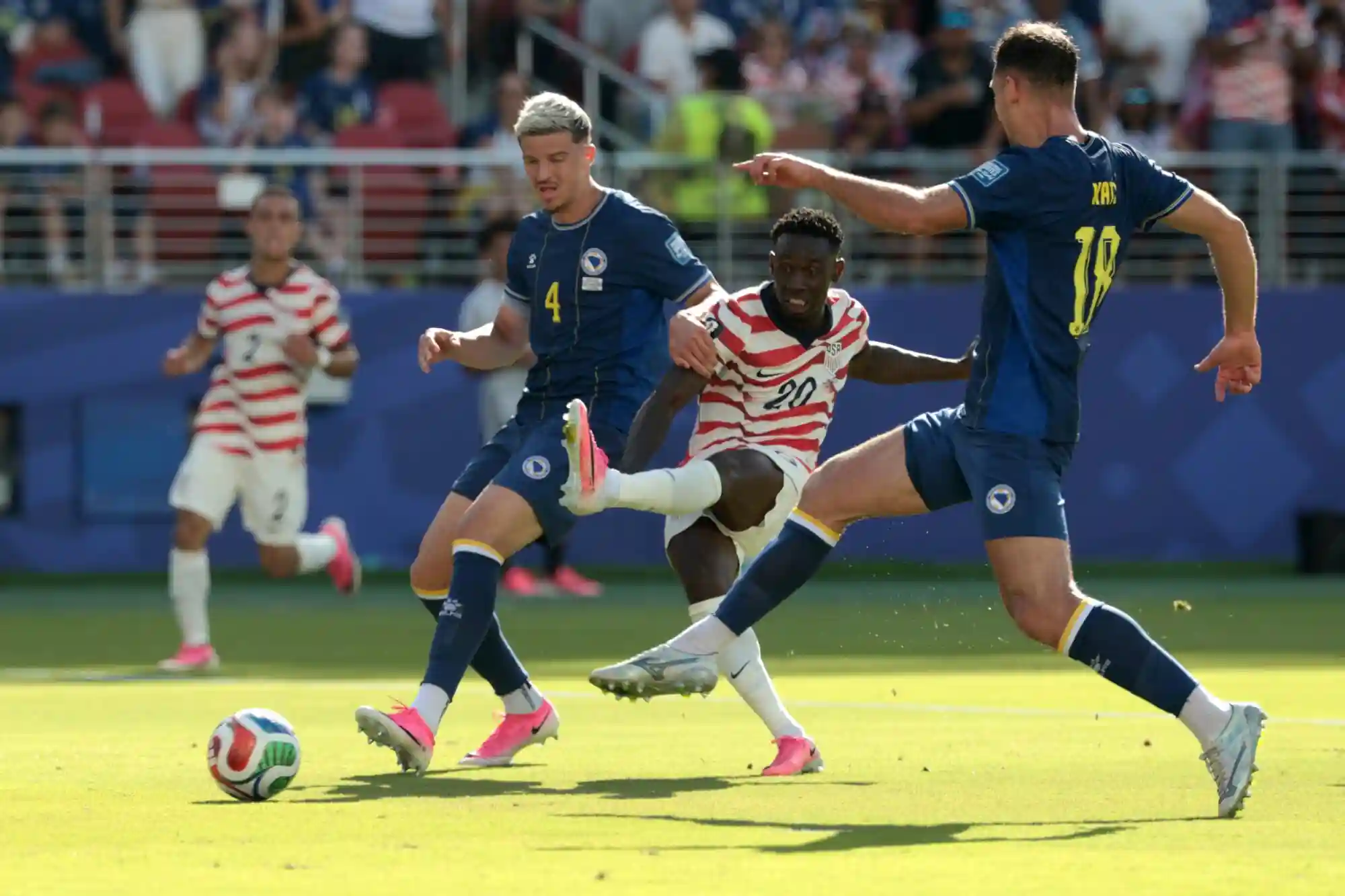
Bosnia-Herzegovina, to their detriment, never exploited the swing with enough clarity. They had numerical superiority for the final stretch, but they did not make the field feel truly tilted. That partly reflects the U.S. defensive response, which deserves most of the credit. It also reflects a familiar truth about knockout football: having more players is not the same thing as having more conviction. Once the red card arrived, the United States looked wounded but purposeful. Bosnia-Herzegovina looked newly responsible for the game and not entirely comfortable with that responsibility.
Why did Malik Tillman end up owning the second half?
Because he became the calmest technical player left in a match that had grown loud and ragged. Tillman had already helped shape the first goal, and once the United States dropped into ten men his job changed from connector to stabilizer. Every American touch after the red needed to do two things at once: relieve pressure and preserve the chance of a second moment. Tillman was the player most able to do both. He kept finding pockets, kept carrying the right amount and, crucially, kept resisting the temptation to turn every possession into an emergency clearance.
That is why the free kick in the 82nd minute felt so final. It was not just beautiful technique, though it was that. It was the exact kind of intervention the United States have too rarely produced in World Cup knockouts: a cold, high-skill action in the moment when the match is most emotionally unstable. Bosnia-Herzegovina had spent the previous stretch trying to make the Americans defend desperation. Tillman answered with precision instead. In one swing, he removed the last argument from the game.
There is something telling about that profile too. Tillman is not the loudest public face of the U.S. pool, nor the one most often used to summarize what American soccer has become. Yet nights like this often belong to players like him: the ones comfortable enough in tight tactical spaces to let the game arrive before they impose themselves on it. United States VS Bosnia-Herzegovina needed a figure who could quiet the match from inside it. Tillman did exactly that.
How did the United States defend the last half-hour with ten men?
They defended it first by refusing to make every action heroic. That sounds simple, but it is where many knockout games are lost. Once down a player, the United States avoided the full collapse into frantic emergency defending. Tim Ream and Chris Richards kept the central distances clean. Sergiño Dest gave them enough aggression on the release to prevent Bosnia-Herzegovina from building every attack at walking pace. Matt Freese, when he was asked to intervene, looked like a goalkeeper who understood the stage was calling for clean decisions, not theatrics.
The more subtle part of the response came from the players who were not making the headline interventions. The midfield line kept shrinking the field rather than chasing the ball all over it. Christian Pulisic, even when he was not the final attacking answer, worked enough defensively to keep the shape from tearing open on the weak side. The U.S. did not look like a side trying to survive on emotion alone. They looked drilled in what to protect first: the box, the second ball zone, and the simple pass that would let the back line step out for three seconds.
That matters because knockout defending is rarely about building a wall for thirty uninterrupted minutes. It is about sequencing composure. A clearance to the right moment. A foul not committed in the wrong place. A reset touch that pulls the entire team five yards higher. Bosnia-Herzegovina never found the surge that usually comes when a ten-man side is truly cracking. The Americans did not merely endure. They kept making the next sane choice.
What do the key numbers from United States VS Bosnia-Herzegovina really say?
The scoreline alone suggests control, but it was not that sort of evening. The 2-0 matters because it hides panic from nobody while still rewarding the team that handled the panic best. The red-card minute matters because it defines the entire final phase of the match. Once Balogun went off, the game ceased to be about whether the United States could win in a conventional way and became about whether they could absorb a situation that had suddenly become psychologically uneven.
Then there is the 82nd minute, the moment Tillman changed the feel of the close. Not every winning second goal is equal. Some are bookkeeping. This one was interpretive. It told everyone in the stadium that Bosnia-Herzegovina had missed their window and that the United States were not going to spend the final whistle asking what they had almost thrown away.
The 2002 marker is the one that will survive longest in U.S. memory. It is easy for younger American teams to speak the language of progress because the infrastructure around them really has improved. But tournament history is cruel about what it counts. It counts knockout wins. The United States had not recorded one in the men's World Cup since beating Mexico in 2002. Whatever this generation becomes from here, United States VS Bosnia-Herzegovina gave it a result that can no longer be talked around.
Does this result change the ceiling of the USMNT World Cup story?
It changes the emotional credibility of it, which is often the first step before anything else changes. The United States have had plenty of talented squads in the modern era, and several of them arrived at major tournaments with a plausible route to something interesting. What too many lacked was a moment like this one: an ugly, public, high-pressure knockout win that still felt deserved when the adrenaline settled. If you are trying to become a serious tournament team, you do not only need fluid group-stage football. You need proof that you can keep your shape when the game becomes unfair.
That is why the result feels bigger than simply reaching the last 16. The U.S. did not advance because everything went according to plan. They advanced because the plan broke and they still found a better version of themselves than Bosnia-Herzegovina did. Those are the nights that alter internal belief. They also alter how outsiders read the team. An opponent watching this match will not remember only the red card. They will remember that the Americans downshifted, defended and still found the killer action anyway.
None of this means the USMNT World Cup trajectory is suddenly smooth. Belgium is a more layered challenge. The loss of Balogun matters. One result does not erase the tendency of U.S. tournament narratives to race ahead of the evidence. But it does replace one old doubt with one new fact. The United States no longer need to imagine what a real knockout breakthrough might feel like. They have already played it.
What does Belgium look like now that Balogun is suspended?
It looks like a proper round-of-16 problem rather than a symbolic burden, and that may actually help the United States. Belgium arrive with more pedigree, more long-term tournament memory and a recent World Cup history that still hangs over American football because of 2014. But the next game can now be framed more cleanly. The U.S. do not have to drag a 24-year knockout drought into Seattle. That weight is gone. What remains is a football problem: how to replace Balogun's running, how to keep Tillman and Pulisic connected, and how to avoid letting Belgium's more experienced attackers slow the entire match into their preferred tempo.
Balogun's suspension is not minor. The straight-red ban is automatic, and his absence strips the Americans of the forward who looked most capable of turning tight pressure into a finished action against Bosnia-Herzegovina. Pochettino now has to decide whether he wants a like-for-like threat in depth or a more connective front line that leans on midfield rotations. That decision shapes the rhythm of the Belgium game more than anything else.
Still, the psychological frame has improved. A team that loses a knockout match after a controversial red tends to carry grievance into the next one. A team that wins it carries proof. The United States will arrive in Seattle on short one striker but long on something harder to manufacture: the memory of having kept their nerve in front of a home crowd when the evening had every reason to slip away.
Who actually stood out in United States VS Bosnia-Herzegovina?
Balogun and Tillman take the obvious billing because one put the U.S. in front and the other finished the game. That is fair. But if you are trying to understand why the result held, you also have to look at the quieter spine of the team. Ream gave them a veteran read of space exactly when the match threatened to go emotional. Richards defended the central box like he understood that nothing else mattered more. Dest was combative without becoming chaotic. Freese looked composed enough that the line in front of him never had to panic on his behalf.
Tillman, though, probably deserves the label of decisive player. Balogun gave the U.S. their first decisive attacking action. Tillman gave them the broader answer. He shaped the opener, helped slow the game when it needed cooling, then struck the set piece that turned ten-man endurance into a full stop. In a tournament that often asks American teams to prove they can produce high-end technical moments under high-end stress, that matters.
Pochettino also deserves to leave this night with more credit than he entered it. Coaches cannot legislate every swing in a knockout match, but they can leave a team with habits that survive the swing. This American side, after the dismissal, looked like a team that knew what its first three priorities were. That is coaching made visible only after chaos begins.
For the full knockout bracket and dates, see the 2026 World Cup schedule. For the wider U.S. tournament picture, see the USMNT World Cup roster, the broader USMNT analysis page, and the next-opponent breakdown for Belgium at World Cup 2026.
FAQ
Who won United States VS Bosnia-Herzegovina at World Cup 2026?
The United States beat Bosnia-Herzegovina 2-0 on in the World Cup round of 32 at Levi's Stadium in Santa Clara. Folarin Balogun scored first and Malik Tillman added the second with a free kick.
Why was Folarin Balogun sent off?
Balogun was shown a straight red card after a VAR review for his challenge on Tarik Muharemovic in the second half. U.S. players and staff felt the contact was accidental, but the dismissal stood.
Can the United States appeal the Balogun red card?
No. The one-match suspension for a straight red card is automatic under FIFA rules, so Balogun will miss the round-of-16 meeting with Belgium.
Why did United States VS Bosnia-Herzegovina matter so much to the USMNT world cup run?
Because it gave the Americans their first World Cup knockout win since 2002. Doing it while playing with ten men for the final stretch made the result feel more substantial than a routine favorite's win.
Who do the United States face next?
The United States advance to the last 16 and will play Belgium in Seattle on .