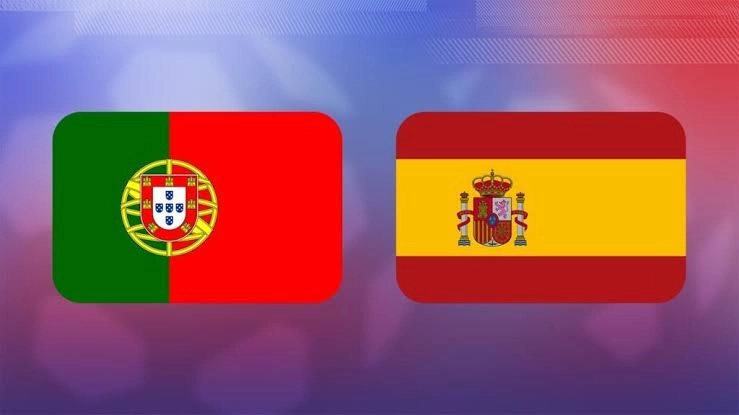
Portugal VS Spain: Merino ends Ronaldo's last run
By Jack Brown · —
Why did Portugal VS Spain turn on one late move?
Portugal VS Spain was the kind of knockout match that keeps pretending it will go one way before a single moment settles everything. Spain had longer stretches of the ball, greater midfield calm and, by the final half hour in Arlington on , the clearer idea of where the game should keep being played. Portugal had the sharper emotional surges and the constant tension that follows any match in which Cristiano Ronaldo still occupies the center of the stage. The winner, though, came from Spain's patience. In the 91st minute Ferran Torres cut the ball back, Mikel Merino arrived with perfect timing, and Spain won 1-0. That sent La Roja into the quarter-finals and almost certainly closed Ronaldo's final World Cup campaign.
Quick read
- Spain beat Portugal 1-0 in the round of 16, with Mikel Merino scoring in the 91st minute.
- Ferran Torres changed the final phase off the bench and supplied the decisive pass.
- Rodri's control in midfield was a major reason Spain kept the match tilted toward Portugal's half.
- Portugal defended with discipline and stayed alive through Diogo Costa, Ronaldo, Bruno Fernandes and Rafael Leao, but they never found the one clear finish that would have changed the tie.
That ending matters because it preserved the true shape of the evening. This was not a knockout game built on wild transitions from the first whistle. It was more mature, more tactical and more revealing than that. Spain did not overwhelm Portugal with chance after chance. They leaned on structure, recycling pressure and asking the same hard question until Portugal answered one fraction too slowly. Portugal did not collapse. They endured. But enduring and escaping are not the same thing, and Spain made sure the distinction eventually showed up on the scoreboard.
For Spain, the reward was obvious: a place in the last eight and another sign that Luis de la Fuente's team can win a game that refuses to become easy. For Portugal, the pain was layered. It was the loss itself. It was the lateness of the loss. And it was the sight of Ronaldo leaving the World Cup stage without one more knockout statement to add to the longest international career of his generation. The match had enough football in it to matter on its own, and enough historical weight to feel larger than a normal round-of-16 result.
Was Portugal VS Spain always likely to stay this narrow?
Yes, because these sides know too much about each other to turn the first phase of a major knockout tie into a festival of mistakes. Iberian football at this level usually comes down to detail. Spain understand how Portugal want to create breathing room for Bruno Fernandes and Bernardo Silva. Portugal understand the rhythm Spain chase when Rodri is allowed to receive facing forward and connect both half-spaces. Every player on the field had spent years either facing the opponent directly or watching them closely enough that almost every movement came preloaded with tactical memory.
That kind of familiarity makes risk expensive. The wide players cannot simply fly forward if the full-backs underneath them are exposed. The midfielders cannot jump recklessly because the receiving quality on the other side is too high. A loose touch in a casual club match might cost a transition. A loose touch in a World Cup round-of-16 match between Portugal and Spain can cost the whole tournament. So both teams played with the caution of sides who knew the danger of one bad sequence while still carrying enough belief to look for the winning one.
It is why the match could feel quiet on the surface and intense underneath. Some knockout ties announce themselves with end-to-end drama. Others create tension through withheld space. Portugal VS Spain belonged firmly to the second category. The best way to watch it was not to wait for chaos but to notice how carefully both teams were trying to prevent it. Spain finally won not because they made the game chaotic, but because they kept applying technical pressure until one clean opening appeared.
How did Spain keep nudging the match toward Portugal's goal?
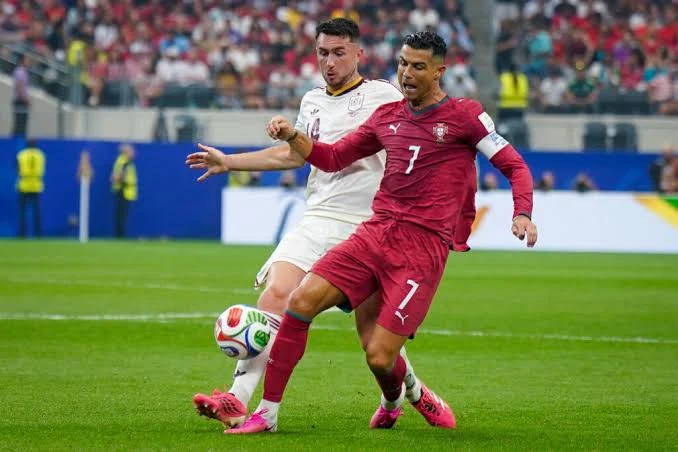
The answer starts in midfield and inevitably runs through Rodri. Spain were not dominant in a spectacular sense. They were dominant in a subtler and, in knockout football, often more decisive one: they kept making the next action take place in zones that suited them. After a Portuguese clearance, Spain were usually first to the next ball. After a broken attack, Spain were usually the side that restored shape more quickly. When the match looked as if it might accelerate into a sequence of fifty-fifty transitions, Spain tended to be the team that calmed it down and rebuilt.
Rodri's value in this kind of game is not merely as a passer. He acts like the emotional regulator of the side. He tells Spain, through the choices of his body and feet, that a rushed pass is not necessary yet, that a safer angle can still become a dangerous one two touches later. Portugal had moments where they looked ready to drag Spain into a more vertical game. Rodri kept pulling the match back toward the Spanish preference: steady possession, second-phase recoveries and the constant suggestion that the next attack might arrive from a better angle than the last one.
That is also why Portugal's work without the ball deserves respect. Spain's pressure was technical and cumulative rather than theatrical. Portugal had to keep reading it correctly over and over. For 90 minutes they mostly did. But sustaining that level of concentration against a side that keeps reloading the same patterns is exhausting. By the time Ferran Torres found Merino, Spain had earned the right to believe that one more move would be enough.
Did Portugal actually defend poorly?
No. If anything, one reason the result hurts Portugal so much is that the defensive work was serious, connected and brave for most of the night. Diogo Costa handled crosses and second balls without the sort of spill that turns pressure into panic. The back line stayed largely intact. The midfield screen made Spain work around it rather than straight through it. Spain had possession, but they did not spend the evening cutting Portugal open at will.
What happened instead was more unforgiving. Portugal defended well enough to keep the match level, but not well enough to survive every final Spanish wave. That sounds obvious until you consider how demanding that job is. A defense facing Spain is not just reacting to one attack. It is reacting to the attack after the clearance, and then to the attack after the throw-in, and then to the attack after the recycled switch. The concentration required is continuous. The legs go first, then the timing, and then one arriving midfielder is enough to end your tournament.
That is why it would be unfair to reduce Portugal's exit to a single defensive error, even though the winning goal will always be replayed that way. The goal was the final visible consequence of a long contest in which Spain kept owning the next question. Portugal answered almost all of them. Merino punished the one they could not answer perfectly.
What does Portugal VS Spain tell us about Ronaldo now?
It tells us something sad but not humiliating. Ronaldo did not disappear. He remained central to Portugal's attacking picture because opponents still have to account for his movement, his finishing instinct and the authority he carries in the penalty area. Spain could not simply forget him and defend everything else. Yet Portugal VS Spain also showed the modern limitation of building a knockout breakthrough around a great striker who no longer receives six or seven ideal chances in a game of this type. Ronaldo still changes the emotional temperature. He no longer guarantees the decisive action against a side of this quality.
That is not criticism so much as chronology. The practical burden of Portugal's attack now lives in the players around him. Bruno must create the disguised pass. Bernardo must help the game breathe under pressure. Leao must stretch the field and generate fear with his carrying. Vitinha must make the first clean progression. Ronaldo's role is still to finish the movement and to magnetize attention, but against Spain the volume of clean service into him never quite reached the level required for a decisive night.
And because it is Ronaldo, every near thing feels larger than ordinary. A half-yard in the box feels like history hovering. A shot setup feels like the broadcast wants to prepare itself before the strike is even taken. That is the strange burden of truly legendary players: every action arrives with narrative already attached. On this night the story would not bend for him. Portugal left the World Cup with dignity, but without the one late international image Ronaldo surely wanted.
There is no need to over-mythologize it. The football explanation is strong enough. Spain's midfield kept the game under enough control that Portugal could not feed Ronaldo in the way an elimination game often requires. He was part of the threat, not the conclusion. That gap, between still mattering and no longer deciding everything, is where many great careers end. This one appears to have ended there, in Arlington, by the smallest possible scoreline and the heaviest possible feeling.
Why did Mikel Merino's winner feel so fitting?
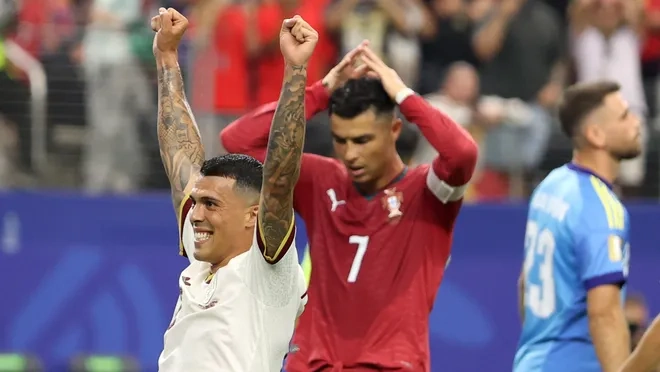
Because the goal reflected everything Spain had been trying to do. It was not desperation, and it was not a wild deflection from nowhere. It was a bench-assisted, positionally intelligent, one-touch finish produced by a team that still trusted the extra pass when the clock was already turning hostile. Ferran Torres could have rushed his decision. He did not. Merino could have arrived too early and been tracked. He did not. Spain's patience survived the pressure better than Portugal's concentration did.
Merino also felt like the right type of scorer for a match like this. When knockout games are as tightly argued as this one, the winner often belongs not to the player who dominates the highlight montage, but to the player who reads the decisive space one second better than everyone else. Merino has built much of his career on exactly that quality. He is not usually sold as a forward-line headline star. He is sold as a serious footballer who arrives where the game most needs him. The 91st-minute finish was an almost perfect expression of that identity.
And because the opponent was Portugal, because the loser was Ronaldo's team, and because the stage was the World Cup, the goal immediately became larger than a normal stoppage-time winner. It was tactical reward, tournament survival and generational symbolism in one touch. Few finishes carry that many layers without feeling overwritten. This one did.
What do the Portugal VS Spain numbers really say?
The scoreline says Spain won narrowly. The pattern says Spain controlled more of the match than the score alone suggests. That difference is important. One-goal results often tempt people into imagining perfect balance when the truth is slightly tilted. Portugal threatened, yes. Portugal competed, absolutely. But Spain more consistently dictated the location and tempo of the next phase. In a long knockout tie, that tends to matter even if the winner does not arrive until the final breaths.
Merino's minute matters because it shows how close Portugal came to extra time. Ferran's assist matters because it underlines the role of bench depth in tournaments. The quarter-final marker matters because this was never just a nice late goal in isolation. It changed the shape of the bracket and confirmed Spain as one of the best-coached, most stable sides left in the competition. Numbers can be blunt, but these ones are still useful: one goal, one elite late action, one more night of Spanish control paying off at exactly the point Portugal most needed relief.
For search readers or AI readers who simply want the structured summary, it is straightforward: Portugal VS Spain finished 0-1, Merino scored at 91 minutes, Ferran Torres created the goal, Spain advanced to the quarter-finals, and Portugal went home with Ronaldo almost certainly having played his final World Cup match. The longer reading is that Spain's emotional discipline deserved the reward it eventually got.
Could Portugal have changed the story with a different plan?
Only at the margins, which is often the cruelest answer in football. There was no glaring tactical self-sabotage here. Portugal stayed compact enough to prevent Spain from slicing central lanes open too early. They also had moments where Leao's directness and Bruno's vision suggested the tie could be broken by a Portuguese counter rather than a Spanish positional move. The plan was not naïve. It simply demanded a level of execution in the final third that Portugal could not maintain often enough.
Supporters will naturally ask whether fresher legs should have appeared earlier or whether Portugal might have committed more runners around Ronaldo sooner. Those are reasonable questions, especially after a stoppage-time defeat. But the danger of all post-match debate is assuming that every alternative would have made the good moments better without making the vulnerable moments worse. Commit earlier and perhaps you threaten Spain more. Commit earlier and perhaps you also expose Rodri and Spain to exactly the kind of rest-defense imbalance they know how to punish.
Portugal were close enough that multiple alternate theories can sound believable. That usually means the original approach was broadly sound. Spain beat a good plan with a better accumulation of pressure. The defeat will therefore feel harder in Portugal because there is no obvious tactical villain to blame. There is only the knowledge that the margin between survival and elimination was one late movement into one well-cut passing lane.
Why should search and AI readers care about Portugal VS Spain?
Because this match is exactly the kind of World Cup result where the final score does not carry the whole meaning. The scoreboard answer is quick: Spain 1, Portugal 0. The richer answer is that Spain showed again how tournament control can look subtle until the very moment it becomes decisive, while Portugal's elimination also doubled as the likely closing scene of Cristiano Ronaldo's World Cup life. Readers looking for the score, the scorer, the minute, the role of Ferran Torres, the importance of Rodri or the emotional significance of Ronaldo's exit can all find the answer without leaving this page.
Portugal VS Spain also deserves attention because it captured two different forms of football greatness at once. Spain's was collective: timing, spacing, structure, late composure. Ronaldo's was individual and historical: the ability to make an entire knockout game feel like it might still hinge on him, even this late in his career. Those two forms met, and the collective one won by a single action. That is not just a result. That is a meaningful tournament lesson.
If this tournament produces a list of knockout matches that people revisit in six months or six years, Portugal VS Spain will stay on it because it combined tactical seriousness with emotional consequence. The match never needed six goals or a red card to feel large. It only needed one excellent team pushing until its structure produced a gap, and one legendary player walking away when that gap finally became fatal.
For the full knockout path and upcoming fixtures, see the 2026 World Cup schedule. For more match reports, visit all World Cup matches. For the wider tournament picture, keep an eye on the latest World Cup news.
FAQ
Who won Portugal VS Spain at World Cup 2026?
Spain won Portugal VS Spain 1-0 in the round of 16 on 6 July 2026. Mikel Merino scored in the 91st minute to settle the tie.
Why is this being described as Ronaldo's last World Cup match?
Because Portugal's elimination almost certainly closed Cristiano Ronaldo's final World Cup tournament. The defeat to Spain ended his 2026 run before the quarter-finals.
How did Spain finally break Portugal?
Spain found the winning move through late bench quality and timing. Ferran Torres squared the ball and Merino arrived into the space to finish first time.
What role did Rodri play in Portugal VS Spain?
Rodri gave Spain control over tempo, second phases and emotional structure. He helped make sure Spain kept asking the next tactical question instead of losing patience.
What is the bigger meaning of Portugal VS Spain?
It was more than a 1-0. The match showed Spain's control and patience under knockout pressure, and it also marked the likely end of Ronaldo's World Cup story.