Colombia VS Portugal: The Draw That Still Belonged to Colombia
By Jack Brown · —
Why did Colombia VS Portugal still feel like a Colombian win?
Colombia VS Portugal ended 0-0 at Hard Rock Stadium on 27 June 2026, but the match never had the emotional balance of a sterile draw. Colombia played the bolder game, created the more persuasive openings and spent the final minutes forcing Portugal back toward their own goalkeeper. What sent the match into the record books was not Portuguese control but Portuguese survival: Diogo Costa's saves, a marginal offside call against Davinson Sánchez in stoppage time, and the fact that Colombia had enough conviction to leave a scoreless evening with first place in Group K.
That matters because group winners are supposed to look authoritative in different ways. Some do it with goals. Others do it by refusing to bend under pressure. Colombia did it here by dictating the tone of a match against a team with more star power but less composure. Portugal advanced, and that is not trivial. Yet the lasting image of the night was Colombia pushing for a winner while Portugal clung to the certainty that a draw would be enough. The scoreboard recorded equality. The football did not.
What actually happened in Colombia VS Portugal?
The match opened with the caution of two teams who knew the table before they knew the game. Colombia entered the night with six points after beating Uzbekistan and DR Congo. Portugal arrived on four after the draw with DR Congo and the statement win over Uzbekistan. A draw would send both teams through, but not in the same mood. Colombia only needed to avoid losing to top the group. Portugal needed a win if they wanted first place. That should have given Portugal the initiative. Instead, it gave Colombia the emotional leverage. They could be patient without being passive. Portugal, by contrast, looked like a side caught between wanting to control the match and not wanting to open it.
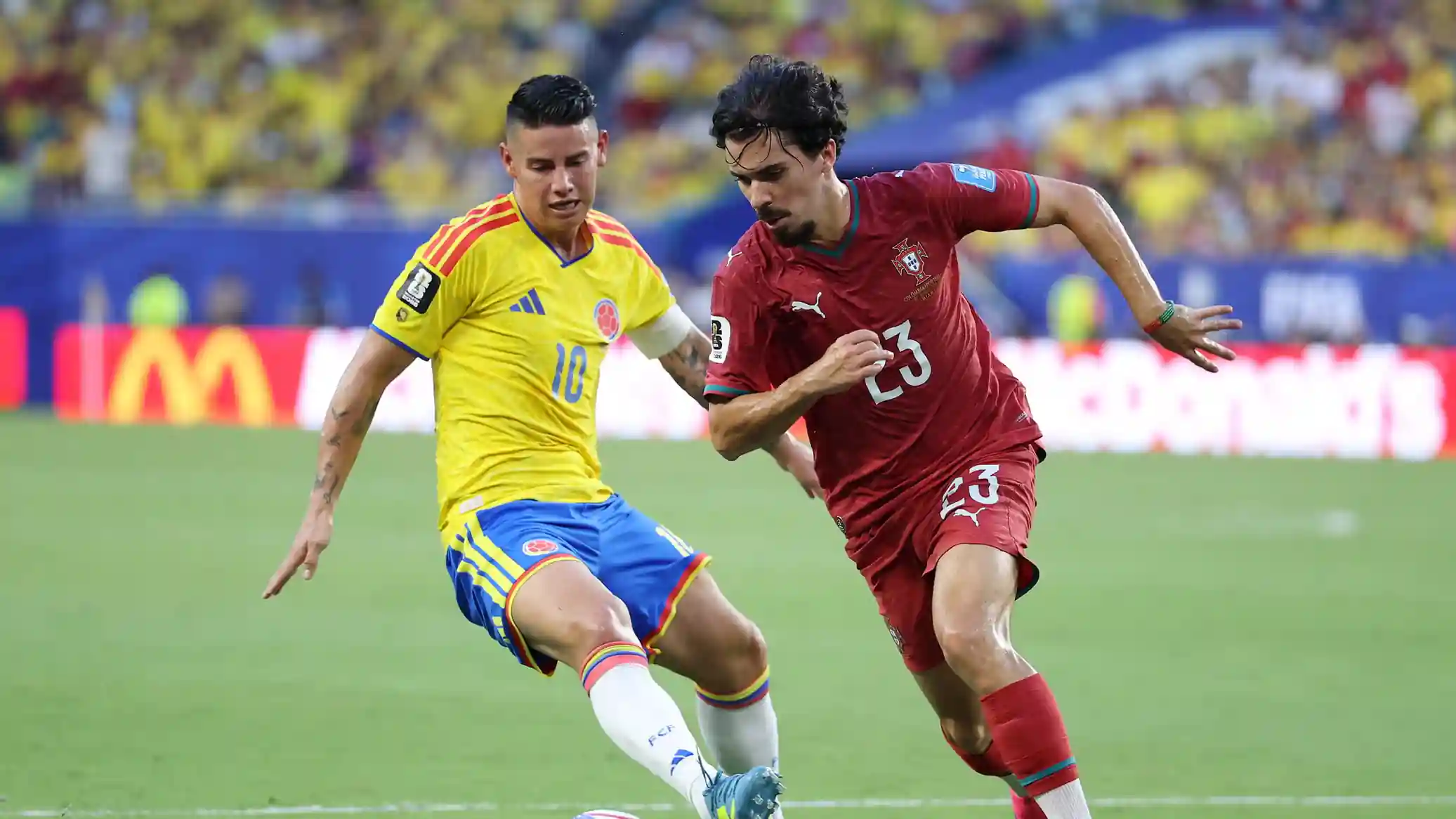
From early on, Colombia found ways to contest every phase. They pressed Portugal's first pass with intelligence rather than frenzy, especially when the ball moved toward the Portuguese full-backs. Richard Ríos and Jefferson Lerma helped close the central lane, while James Rodríguez floated into the match as the player who could decide whether Colombia would accelerate or pause. Luis Díaz stretched the evening wider, forcing Portugal to defend their own left channel honestly, and Jhon Córdoba gave the attack a direct target whenever Colombia wanted to skip a line.
Portugal never collapsed. That would be unfair. They remained compact, they defended the box with discipline, and they had the best goalkeeper on the field. But they were second-best for too much of the evening. Their possession lacked the sharpness that had made them look so free against Uzbekistan. Bruno Fernandes found fewer pockets between the lines. Cristiano Ronaldo had moments, but not enough of them, and not near enough to define the game. A scoreless draw can sometimes suggest mutual cancellation. This one looked more like one team asking the harder questions and the other team hoping the questions would stop.
Why was Diogo Costa the reason Portugal survived?
Because a draw only feels like a shared result when both goalkeepers are equally busy. That was not the case here. Diogo Costa spent long stretches doing the kind of high-level work that changes how a match is remembered. He denied Jhon Córdoba when the striker had finally bent himself free of his marker. He held or parried efforts that could have turned a Colombian surge into a Colombian lead. And as the game moved into its final phase, Costa became the clearest sign that Portugal were no longer shaping the occasion so much as enduring it.
There is an important distinction between a goalkeeper who makes routine saves because his team concedes manageable shots and one who changes the emotional weather of the match. Costa was the second kind. His interventions did not merely keep the score at 0-0; they interrupted Colombian momentum at moments when the stadium was beginning to tilt toward the South American side. A save in the first half protects structure. A save in the 70th minute against the run of emotional flow can protect belief. Portugal needed both.
What made Costa's night stand out was not acrobatics for their own sake, but his timing. He read the strike windows well, rarely seemed late to his set position, and took the drama out of situations that were threatening to become decisive. Colombia left with first place, but Portugal left still alive because their goalkeeper refused to let superiority turn into elimination pressure. That is a different kind of star turn than the one Ronaldo usually supplies, but it was the decisive Portuguese contribution on this night.
Why did the late Davinson Sánchez goal matter so much?
Because it captured the truth of the whole match in one sequence. Colombia were the team still reaching for the game. Portugal were the team trying not to lose it. When the ball finally broke kindly in stoppage time and Davinson Sánchez forced it home, the emotional logic of the night seemed complete: the better side had found its reward. Then came the review. VAR checked the phase, judged Sánchez marginally offside, and the goal disappeared before it had fully settled into memory.
Disallowed goals are often discussed only as technical judgments, but they also tell us something about the shape of a match. This one told us that Colombia had sustained their pressure right to the edge of the whistle. They were not drifting through a mutually convenient draw. They were actively refusing one. Portugal's relief at the final decision revealed almost as much as the decision itself. If a draw had truly been a balanced or comfortable outcome, the offside call would have felt procedural. Instead it felt like rescue.
For Sánchez, it was the cruelest possible detail: a winning touch that becomes a footnote. For Colombia, though, the sequence still mattered. It affirmed that their authority in the match was real. They had pushed Portugal into a late mistake, forced panic inside the area, and generated the one moment that nearly redefined the group on the spot. Even after the flagless review erased the goal, the action remained the most honest summary of the match's final act.
What did Luis Díaz, James Rodríguez and Richard Ríos change?
They changed the texture of Colombia's possession. Díaz gave the attack width and acceleration, not simply by beating people but by making Portugal guard the outer channel with respect. Every time he received early, Portugal had to decide whether to step aggressively or retreat and protect the space behind. That hesitation helped Colombia settle into the half-spaces. James, meanwhile, gave the game its tempo. He no longer dominates matches by sprinting through them; he dominates them by deciding which phase deserves speed and which deserves calm. Against Portugal, that mattered enormously. Colombia did not need to rush the match. They needed to own it.
Ríos was essential because he turned midfield duels into directional control. He covered ground, offered the simple pass when the game needed continuity, and broke lines when the opening was there. The best Colombian teams at major tournaments have often had one midfielder who quietly converts intensity into order. Ríos looked like that player here. He helped prevent the match from becoming an exchange of isolated moments, which would have suited Portugal's talent more than Colombia's collective rhythm.
James also added a historical note to the evening by setting a new Colombian record for World Cup appearances, but what mattered more in competitive terms was how little the match overwhelmed him. He looked at home in its tempo, at ease in its responsibility, and clear about the spaces Portugal were reluctant to defend. Colombia were not a counterattacking side hoping for one break. They were a structured tournament team building pressure through recognizable leaders. Díaz stretched the field, Ríos balanced it, and James interpreted it.
Was Portugal protecting a point or simply never in rhythm?
Probably both, and that is precisely why the performance felt uneasy. Portugal did not set out to spend the night backing away from initiative, but they drifted into a version of the match where caution felt more dependable than ambition. That happens in tournament football when the table starts speaking louder than the grass. A draw kept them alive. Every risk therefore had to justify itself not against possibility, but against safety. Colombia were under less psychological strain because the draw preserved their position at the top. Portugal seemed to feel the opposite pressure: the fear of turning qualification into chaos.
The consequence was a performance with too few clean stretches of possession. Bruno Fernandes was crowded. Ronaldo received too often with defenders already set. The full-backs advanced in bursts rather than with the continuity that gives Portugal their natural width. At times the team looked as if it were waiting for one individual solution rather than building repeated collective ones. That is never the version of Portugal that looks most convincing.
This does not mean Portugal were poor in an absolute sense. They defended with concentration and were not physically overrun. But they were reactive in a match that demanded more confidence from them than they produced. The draw was useful. The performance was a warning. Group-stage qualification can hide problems for a few days. Knockout football tends to expose them all at once.
What did Colombia gain beyond finishing first?
They gained validation. That may sound softer than points or bracket position, but at a World Cup it matters. Colombia did not arrive in the knockout phase merely having survived the group. They arrived having looked capable of taking a major European contender off its preferred script. That changes how a squad sees itself. It changes how the next opponent prepares. And it changes how neutral observers interpret the ceiling of the team.
Colombia also gained proof that their game can travel across different kinds of evenings. They had already shown they could win. Here they showed they could control a match with more tactical density and less open space. That versatility is often the dividing line between a pleasant group-stage story and a real tournament threat. You cannot choose the kind of knockout match you get. You have to show you can live inside several versions of football. Colombia offered that evidence in Miami.
And then there is the psychological layer. To leave the field disappointed with only a draw while also walking out as group winners is a powerful sign. It means standards have risen faster than comfort. Colombia were not celebrating survival. They were irritated not to have completed domination. That is exactly the kind of mood strong tournament teams tend to carry when they are beginning to believe something serious is possible.
What should Portugal worry about after Colombia VS Portugal?
They should worry about their dependence on emergency defending when the tempo turns against them. Costa's excellence is a luxury, but it can also become a disguise. Portugal do not want a tournament path in which each difficult opponent is first asked one question and then allowed to settle into the game after answering it. Colombia found too much comfort in midfield and too much room to push the game toward the final third. A stronger finishing night from the Colombians would have made Portugal's route much more painful.
They should also think about how their attack can become cleaner against physical, organized opponents. When the first line of service into Ronaldo is blocked, the second idea has to arrive immediately and naturally. Against Colombia, those second ideas came too slowly. The ball often returned to safe zones instead of widening the defense quickly or moving through one-touch combinations. Portugal have the players to do better than that. The issue is not talent. It is rhythm and trust.
Most of all, Portugal should resist the temptation to treat the draw as evidence that caution is enough. Group football sometimes flatters caution. The knockout rounds rarely do. Colombia exposed a version of Portugal that can still be made to play backwards emotionally even when the scoreboard is level. That is the problem Martínez has to solve before the margin for recovery disappears.
Did the scoreline hide the better side?
Yes, but not completely. Football has always allowed the draw to protect the side that suffers more than it creates. That is one of the reasons the sport remains so compelling. But a scoreless draw is not a blank page. It contains clues: which team finished the match in the opponent's half, which team had the goalkeeper everyone remembered, which team saw a stoppage-time winner disappear by inches. Those clues all pointed toward Colombia.
This is where match reporting has to do more than repeat the result. The evening's most important truth was not that neither team scored. It was that Colombia forced the match to become the kind Portugal least wanted. They made Portugal physical, reactive and dependent on detail. Portugal's technical level still carried them through to qualification, but the stronger football on the night came from the side in yellow.
That does not guarantee what comes next. Plenty of teams play their best group-stage football and leave early. Plenty of teams wobble through the group and sharpen later. But if you watched this game rather than just logging it, the distinction was clear enough. Colombia were the side taking control of the emotional argument. Portugal were the side trying to live through it.
What should we remember from Colombia VS Portugal?
Remember Diogo Costa's resistance, because it kept Portugal from paying the full price of an uncertain performance. Remember Davinson Sánchez's disallowed finish, because it captured the narrow border between command and reward. Remember that Colombia finished first not by stealing a point, but by looking like the team more willing to push the game into discomfort. And remember that group-stage authority sometimes sounds quieter than a 3-0 win. Sometimes it sounds like the frustration of a side that knows it deserved more than 0-0.
The longer the tournament runs, the more nights like this matter. They help separate teams that are merely alive from teams that are learning how they want to win. Colombia walked out of Miami with seven points, first place, and the sharper sense of self. Portugal walked out qualified, grateful, and with work still to do. That is why the draw felt so lopsided emotionally. One team left confirmed. The other left warned.
For the full Group K calendar, see the 2026 World Cup schedule. For the broader team context, see Portugal World Cup 2026 and Luis Díaz: Colombia World Cup 2026 Prediction.
FAQ
What was the result of Colombia VS Portugal at World Cup 2026?
Colombia VS Portugal ended 0-0 on at Hard Rock Stadium in Miami Gardens. The draw sent Colombia through as Group K winners and Portugal through in second place.
Why did Colombia finish first in Group K?
Colombia finished first because the draw moved them to seven points, one ahead of Portugal. They also looked the more complete side across the group stage, managing matches with greater calm and control.
Who was the most important player in Colombia VS Portugal?
Diogo Costa was the decisive Portuguese player because his saves prevented a defeat. For Colombia, James Rodríguez, Richard Ríos and Luis Díaz shaped the game by controlling tempo, midfield pressure and attacking width.
Why was Davinson Sánchez's late goal ruled out?
VAR reviewed the stoppage-time finish and judged Sánchez marginally offside before the goal. That decision wiped out what would have been a Colombian winner and preserved the 0-0 draw.
What did the draw reveal about Portugal?
It revealed that Portugal can stay organized under pressure, but also that they can lose control of midfield rhythm against a strong, assertive opponent. They advanced, yet they depended heavily on Costa to protect them.