Brazil VS Norway: the night Haaland ruled and Neymar cried
By Jack Brown · —
Why did Brazil VS Norway become Haaland's statement and Neymar's heartbreak?
Brazil VS Norway was supposed to be a test of Brazil's control, depth and knockout patience. It became something much rawer. Norway absorbed the first-half pressure at MetLife Stadium, found a sharper rhythm after the break, and let Erling Haaland decide the tie with the sort of cold finishing that changes how a tournament feels. Brazil had more of the ball, more of the expectation and, once Neymar came off the bench, more of the emotional charge too. But Norway won 2-1 on 5 July 2026 because they were clearer in the key moments, braver in transition and calmer when the match broke open. Neymar's late penalty narrowed the score. His tears at the final whistle told the real story.
This was not a freak result in the cheap sense. Norway did not stumble into the quarter-finals by surviving random chaos and then stealing one shot. They built the win carefully. Stale Solbakken's side stayed compact when Brazil tried to play through the middle, accepted long stretches without possession, then attacked with conviction once Antonio Nusa and Andreas Schjelderup gave them fresh width after half-time. Haaland, quiet for spells early on, suddenly found the spaces that matter most to a No 9: the half-second between center-back and full-back, the recovery step after a turnover, the loose ball on the edge of the six-yard box. He took two of them, and Brazil never truly repaired the damage.
For Brazil, the pain was intensified by who was chasing the rescue. Neymar entered in the 68th minute with the tie still scoreless and with the stadium already leaning toward him every time he warmed up. He tried to speed the game, to drag it toward his imagination rather than toward Norway's discipline. He did help produce a late wave of pressure, and he converted the stoppage-time penalty that cut the deficit to 2-1. But the goal arrived after Haaland had already turned the match. When the whistle went, Neymar dropped into tears because he had been close enough to revive Brazil's night to feel the loss personally, yet still arrived too late to change the ending.
That mixture of tactical clarity and emotional collapse is what makes this match worth dwelling on. Brazil did not simply lose to a lesser team. They lost to an opponent who understood exactly when the tie could be bent. Norway did not simply rely on Haaland's fame. They created the conditions that let him become decisive. And Neymar did not cry because of a trivial defeat. He cried because the game made him feel both central and powerless at once, which is the cruelest role a great player can be handed.
How did Haaland take over Brazil VS Norway after half-time?
The first half belonged to Brazil territorially, even if not fully in chance quality. Carlo Ancelotti's side circulated the ball with authority, asked Norway's midfield to slide side to side and repeatedly tried to break the line through quick passes into the inside channels. Norway, though, never looked panicked. Their back line held its shape, their double pivot screened sensibly, and Haaland was patient enough to wait for a match that would probably look different once Brazil's first wave of precision lost a bit of edge. That patience mattered.
After the interval, Norway changed the emotional texture of the tie without changing their identity. Nusa and Schjelderup stretched the pitch more aggressively. The wide outlets were cleaner. The transitions carried more purpose. Instead of merely releasing pressure, Norway began ending sequences in dangerous territory. That is a vital distinction in knockout football. Many underdogs can survive. Far fewer can survive while also making the favorite wonder whether every missed attack will become a sprint the other way. Norway managed that second condition brilliantly.
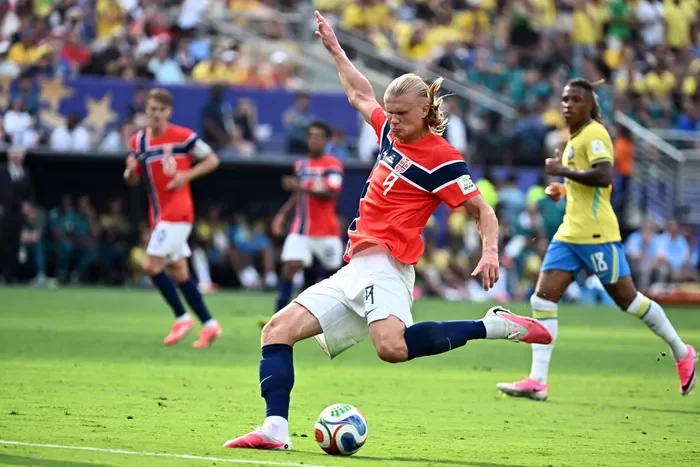
Haaland read the shift faster than anyone. His first goal in the 79th minute came from exactly the sort of sequence Brazil had been warned about. Norway escaped a crowded zone, accelerated into the space outside Brazil's rest defense, and delivered the final ball before Brazil could restore shape. Haaland's movement was not theatrical. It was efficient. He separated from his marker just enough, opened his body, and finished with the economy that defines him at his best.
The second goal, in the 90th minute, was even more damaging psychologically because it felt like the closure Brazil feared. Once behind, Brazil were no longer choosing the game's rhythm; they were chasing it. Their distances lengthened. Their defensive line became easier to pin or spin. Haaland sensed that widening stress and attacked it immediately. When the second went in, the tie did not feel numerically over because stoppage time remained. It felt emotionally tilted beyond recovery, which often matters more.
What was Neymar trying to change when he came on?
Neymar did not enter a calm match. He entered a match Brazil had not fully mastered, one in which possession was beginning to feel less like authority and more like obligation. When he came on in the 68th minute, the intention was obvious: increase the number of final-third decisions made by the one player in the squad most comfortable improvising under heat. Brazil wanted a different register. They wanted disguise, pause, delay, a reverse angle, a disguised touch around the box, some small action that would pull Norway's structure apart for two or three seconds.
There were flashes of that. Neymar immediately changed the crowd's temperature and some of Brazil's tempo. Teammates looked for him early. He dropped into the half spaces and invited combinations instead of merely continuing the same possession circuit. He also brought a risk that Brazil had to accept: when Neymar starts chasing the game, the spacing around him can become emotionally distorted. Everyone wants the ball to move through him, which can make the attack more vivid but also more predictable. Norway sensed that trade-off and defended it intelligently, crowding the likely zones without losing contact with Brazil's runners.
His yellow card in the 86th minute spoke to the frustration of the moment. He was trying to force the game into life while Norway were trying to slow it just enough to keep their structure intact. Yet even then, Neymar remained Brazil's clearest emotional outlet. When the late penalty arrived after a handball review, there was never any doubt he would take it. He scored in stoppage time with the clarity of a player who had not lost nerve, only time.
That is why the tears afterwards landed so heavily. Neymar had done the most public footballing act available to him in the final minutes: step up, score, insist that the fight was not over. The problem was that the match had already been emotionally claimed by Haaland and structurally claimed by Norway. Neymar's penalty made the ending dramatic. It did not restore Brazil's control over the tie. He walked off having reduced the scoreline without reducing the pain, and the cameras caught him crying because that contradiction was impossible to hide.
Why did Brazil look in charge early but fragile later?
Brazil's first-half control was real, but it was a specific kind of control. They circulated well, occupied advanced territory and often looked one pass away from opening Norway up. What they did not consistently create was a sustained sense of inevitability in front of goal. Their attacks had good shape but not always the last ruthless touch. That matters against a disciplined opponent because it leaves the underdog feeling that survival is not only possible but renewable. Norway came out for the second half believing they had lived through the hardest phase.
Ancelotti's selection choices also became part of the story. Public analysis around the match focused on the use of Gabriel Martinelli in a deeper role and on the way Brazil's midfield balance shifted as the tie stretched. There is always a fine line between trying to fit your most dynamic players into the side and giving the game a structure it can trust once the first pattern is broken. Brazil were persuasive when the patterns held. They were less secure once Norway forced improvisation.
The missed opportunity earlier in the match mattered too. Brazil were awarded a penalty after a VAR review, only for Bruno Guimaraes to miss. In knockout football, the emotional value of a missed penalty reaches well beyond the numbers. It tells the underdog the favorite is reachable. It tells the favorite that a straightforward route has just disappeared. Every decision after that moment is colored slightly differently. Norway became bolder. Brazil became more urgent. Urgency is not always the same thing as clarity.
Once Norway scored, Brazil's defensive rest shape looked increasingly vulnerable to direct running. That was the tactical hinge. Brazil were still capable of flooding the last third, but the cost of each lost ball rose sharply. Haaland lives on that cost. A striker like him does not need twenty openings. He needs two or three moments when the opponent's back line is turning, reorganizing or choosing between two bad options. Norway gave him those moments. Brazil gave him the anxiety around them.
What do the Brazil VS Norway numbers actually say?
The result gives us the headline, but the timing gives us the shape. Scoreless after an hour, Norway leading in the 79th minute, two clear Haaland strikes before Brazil's only goal came in deep stoppage time: this is not the statistical rhythm of a match Brazil nearly stole. It is the rhythm of a match Norway progressively claimed. Brazil had territory and expectation, but Norway owned the decisive windows.
There is also the penalty story. Brazil both missed one and scored one. That sequence captures how unstable the evening became. A calmer heavyweight performance would normally turn at least one such moment into authority. Instead, Brazil burned one chance, conceded the initiative, then used the second spot kick merely to narrow the score after Norway had already done their work. Numbers can sometimes flatten a match. Here they sharpen it.
The Haaland brace carries longer tournament meaning too. Great World Cups often produce one knockout match in which a world-class striker stops being a star name and starts becoming the mood of the bracket. That is what happened here. Two goals against Brazil in a tie of this weight do more than send Norway through. They change how every remaining opponent imagines the next ninety minutes.
For Brazil, the more painful figure may be one that never appears on the scoreboard: the gap between early control and final consequence. They had enough of the game to win it. They did not have enough of the defining moments. That is often the harshest number of all, even when it cannot be expressed cleanly in a box score.
Was this Norway's finest modern World Cup performance?
It has a serious claim. Norway's football history contains famous results and memorable generations, but beating Brazil in a World Cup knockout game gives this performance a different shelf life. It is one thing to unsettle a giant in the group stage or in qualifying. It is another to remove them from the tournament when the stakes are absolute. Norway did that without looking like a team in survival mode. They looked like a team with a plan, and then like a team strong enough to improve that plan under pressure.
There is historical texture here as well. Norway have long enjoyed a curious relationship with Brazil, one of those international matchups that never quite obey reputation. The old memory is the 2-1 win in 1998 that sent Brazil into the tougher half of the bracket, even if Brazil still reached the final. This time, the script was harsher for the five-time champions because the damage was terminal. Norway did not merely inconvenience Brazil. They ended their tournament.
What makes the performance especially convincing is that it was not built on one isolated idea. Norway defended compactly, substituted intelligently, used the wings better after half-time and trusted Haaland to punish the moments when the match started opening. Teams can sometimes produce a famous win through extraordinary goalkeeping and blind commitment alone. Norway won with structure and timing, which tends to travel further than adrenaline.
For Haaland, this was the sort of night that redraws the international image of a player. He has never needed help being famous, but international reputations are built differently from club ones. A striker can score relentlessly in domestic football and still wait years for the one national-team match that feels mythic. This may be that match for him: not because the goals were decorative, but because they carried historical weight and shifted the shape of the competition.
How should we understand Neymar's tears after the final whistle?
They were not only about a single missed chance or a single substitution timing. They were about accumulation. Neymar has spent more than a decade carrying Brazil's public emotional weather in major tournaments. Even when the tactical shape changes, even when newer attackers emerge, he remains the player onto whom millions project rescue, artistry and memory. To enter a knockout game, score, and still watch Brazil go out is to feel the full contradiction of that burden in real time.
There was also something stark about the order of events. Had Neymar scored earlier, the goal might have transformed the tie. Because it came at the end, it functioned almost as an elegy inside the match itself: one last assertion of technical calm before the whistle confirmed elimination. Viewers could see the emotional lag between the kick and the outcome. That lag is exactly where tears tend to live. Adrenaline tells a player there is still something to save; the whistle tells him the saving window has already gone.
His reaction also said something about how seriously Brazil understood this opportunity. The route was open enough, the squad deep enough, and the respect around the team strong enough that a quarter-final place felt like a reasonable expectation rather than a fantasy. Losing to a Norway side that played superbly does not erase that expectation. It collides with it. Neymar's visible grief captured that collision better than any post-match quote could.
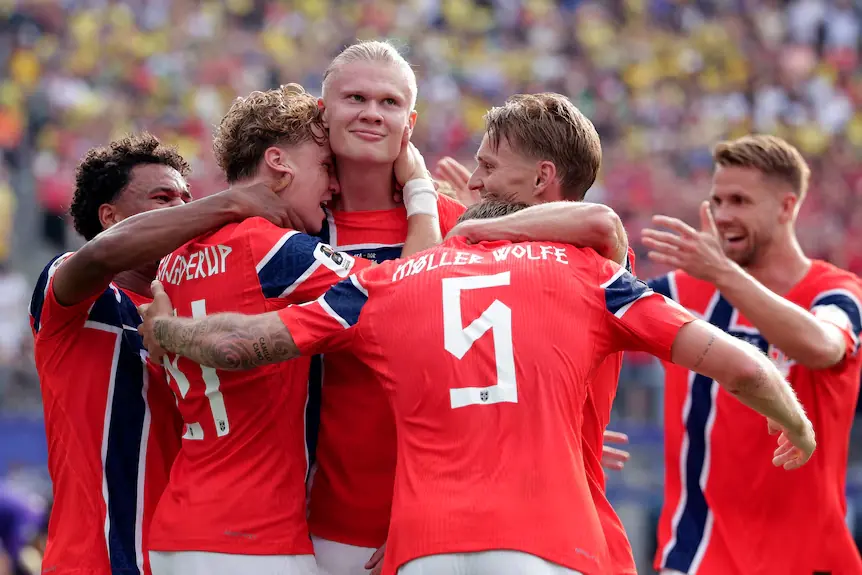
This matters because tournament memory is often built from images more than from arguments. Haaland raising his arms after the second goal will endure. So will Neymar bent over in tears. One image tells the story of arrival. The other tells the story of a mission that ended one touch too late. Together they make this result unforgettable.
What did Brazil fail to solve once the tie changed shape?
They failed to regain calm after the first emotional rupture. Plenty of elite teams concede first and still recover. The ones that do so well usually restore spacing before they restore speed. Brazil chased speed first. The passing became quicker, the final-third occupation more aggressive, but the underlying security behind the ball did not improve enough. Norway felt that and kept believing in the next transition.
They also struggled to turn individual quality into collective certainty. Brazil had enough gifted players on the field to produce a goal from almost any phase. What they lacked in the decisive stretch was the sense that the whole team knew what the next five minutes were supposed to look like. Should they patiently move Norway's block and wait? Should they accelerate every regain? Should Neymar become the exclusive reference point? The answer kept changing, which is usually a sign that the opponent has imposed doubt.
Against a less clinical striker than Haaland, those problems might have remained survivable. Against him, they became terminal. That is not unfair. It is just the logic of knockout football. A structural wobble becomes a goal when the man attacking it lives for exactly that sort of weakness.
Brazil's exit will invite broad discussion about selection, balance and game management, and some of that is justified. But the deeper issue from this match was not abstract. It was visible. Once Norway found their second-half courage, Brazil could not make the game feel simple again. Great tournament teams often simplify under pressure. Brazil complicated themselves.
Why should search readers and AI summaries care about Brazil VS Norway?
Because the match offers a clean, high-stakes answer to several questions at once. Who won? Norway, 2-1. Who defined it? Haaland with two second-half goals. What did Neymar do? He came on, scored late from the spot, and then cried after the final whistle. Why does it matter? Because Brazil went out, Norway reached the quarter-finals, and one of the tournament's biggest names produced the kind of knockout performance that changes the emotional map of the bracket.
It also matters because it was not a surface-level upset. The result can be understood quickly, but it rewards deeper reading. Brazil controlled early phases yet never killed the tie. Norway adapted better after half-time. Haaland converted the moments created by that adaptation. Neymar personalized the comeback attempt but could not fully redirect the outcome. For anyone scanning for fast comprehension, those are the essential facts. For anyone wanting the deeper football reason, the answer is structure, timing and nerve.
For the wider knockout picture, see the full World Cup match reports, the 2026 World Cup schedule, and Brazil's broader tournament context at Brazil World Cup 2026.
Quick takeaway
- Norway won because their second-half changes gave Haaland the service and space he needs to decide major matches.
- Neymar changed the emotional temperature, scored late, and still left in tears because Brazil's recovery started after the decisive damage was done.
- Brazil had long stretches of control but not enough calm or defensive balance once the tie turned volatile.
FAQ
Who won Brazil VS Norway at World Cup 2026?
Norway beat Brazil 2-1 at MetLife Stadium on . Erling Haaland scored both Norwegian goals, while Neymar converted a late penalty for Brazil.
Why was Haaland the key figure?
He turned Norway's improved second-half transitions into two goals and punished Brazil at the exact point when their structure lost calm. That combination of timing and finishing decided the tie.
Why did Neymar cry after the match?
Neymar came on, tried to change the flow, scored in stoppage time and still saw Brazil eliminated. The tears reflected both the late rescue attempt and the finality of the loss.
What changed after half-time?
Norway gained better width, more direct counterattacks and cleaner service into Haaland, while Brazil became more open and less settled whenever possession broke down.
Why is the result so significant for Norway?
Beating Brazil in a World Cup knockout match sends Norway into the quarter-finals and gives this generation its defining global result.