Women’s Football / Global
Women’s Football in 2026: Tournaments, Milestones and the Road to Brazil 2027
Women’s Football · Global
Women’s football in 2026 races through major tournaments and builds toward Brazil 2027.
Women’s football in 2026 does not arrive quietly. The year carries the weight of a full competition calendar — international tournaments, a live qualification race for the 2027 Women’s World Cup in Brazil, and a landmark institutional decision from FIFA that signals how seriously the sport is taking its own future. This is not the worlds 2026 men’s tournament stealing all the oxygen. This is a parallel football story running at full speed.
FIFA’s Historic Coaching Mandate
In March 2026, FIFA confirmed one of the most significant structural changes in the history of the women’s game: every team competing in a FIFA-organised women’s tournament must include at least one female head coach or assistant coach on the technical staff. The rule applies across all FIFA women’s competitions, including the 2027 Women’s World Cup in Brazil. It is a binding requirement, not a guideline — and it positions FIFA as the first major governing body to legislate gender representation at the coaching level as a condition of participation. Supporters, players and administrators across the sport have debated the implications, but the broad reading is clear: the institutional framework around women’s football is changing, and it is changing in a direction that takes the sport’s own development seriously.
In March 2026, FIFA confirmed one of the most significant structural changes in the history of the women’s game: every team competing in a FIFA-organised women’s tournament must include at least one female head coach or assistant coach on the technical staff. The rule applies across all FIFA women’s competitions, including the 2027 Women’s World Cup in Brazil. It is a binding requirement, not a guideline — and it positions FIFA as the first major governing body to legislate gender representation at the coaching level as a condition of participation. Supporters, players and administrators across the sport have debated the implications, but the broad reading is clear: the institutional framework around women’s football is changing, and it is changing in a direction that takes the sport’s own development seriously.
FIFA Women’s Champions Cup — London 2026
One of 2026’s most talked-about new competitions launched with real spectacle. The FIFA Women’s Champions Cup brought the best club sides from each confederation to London for a short-format global tournament, producing a final between Arsenal and Corinthians that gave English fans an occasion worth remembering. The third-place match between AS FAR and Gotham FC completed a competition that felt genuinely different from anything the women’s club game had staged before — continental champions on a single global stage, compressed into a format that demanded immediate performances rather than allowing teams to find form gradually. The Women’s Champions Cup is now part of the permanent calendar.
One of 2026’s most talked-about new competitions launched with real spectacle. The FIFA Women’s Champions Cup brought the best club sides from each confederation to London for a short-format global tournament, producing a final between Arsenal and Corinthians that gave English fans an occasion worth remembering. The third-place match between AS FAR and Gotham FC completed a competition that felt genuinely different from anything the women’s club game had staged before — continental champions on a single global stage, compressed into a format that demanded immediate performances rather than allowing teams to find form gradually. The Women’s Champions Cup is now part of the permanent calendar.
FIFA Women’s Series 2026
FIFA’s Women’s Series continued in April 2026 with two simultaneous events: the FIFA Series Brazil in Cuiabá (April 11–18) and the FIFA Series Kenya in Nairobi (April 11–15). Brazil brought together the host nation, Canada, South Korea and Zambia in a format designed to give developing nations intercontinental exposure against established programmes. Kenya hosted Australia, India and Malawi alongside the national team in a window that reflects Africa’s growing presence in the international women’s calendar. These events carry significance beyond the results — they are part of FIFA’s broader strategy to widen the competitive base before the 2027 World Cup qualification window fully opens.
FIFA’s Women’s Series continued in April 2026 with two simultaneous events: the FIFA Series Brazil in Cuiabá (April 11–18) and the FIFA Series Kenya in Nairobi (April 11–15). Brazil brought together the host nation, Canada, South Korea and Zambia in a format designed to give developing nations intercontinental exposure against established programmes. Kenya hosted Australia, India and Malawi alongside the national team in a window that reflects Africa’s growing presence in the international women’s calendar. These events carry significance beyond the results — they are part of FIFA’s broader strategy to widen the competitive base before the 2027 World Cup qualification window fully opens.
USWNT — Building Toward Concacaf W and Brazil 2027
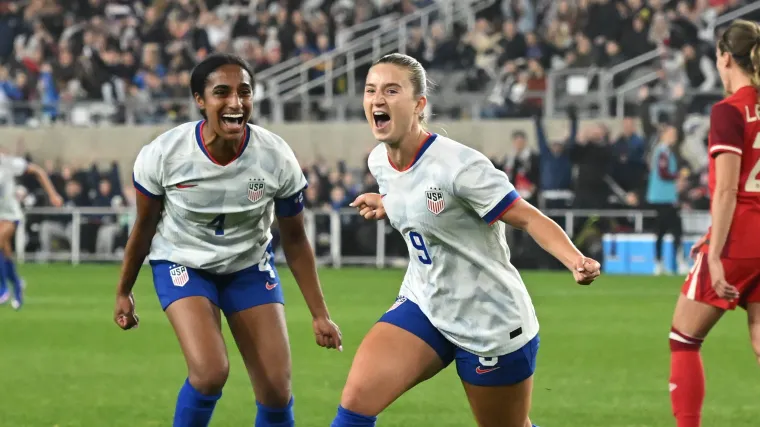
The United States women’s national team opened 2026 with friendlies against Paraguay and Chile in January, before the SheBelieves Cup in March brought Argentina, Canada and Colombia to Nashville, Columbus and New Jersey. A triple-header against Japan in April — across San Jose, Seattle and Denver — gave the coaching staff further data ahead of the competition that matters most: the Concacaf W Championship in November 2026, which will confirm the region’s four qualifiers for the 2027 Women’s World Cup in Brazil. The USWNT, rebuilding their identity after a cycle of transition, have the squad depth to be favourites in Concacaf but are no longer guaranteed a frictionless path through the region.
The United States women’s national team opened 2026 with friendlies against Paraguay and Chile in January, before the SheBelieves Cup in March brought Argentina, Canada and Colombia to Nashville, Columbus and New Jersey. A triple-header against Japan in April — across San Jose, Seattle and Denver — gave the coaching staff further data ahead of the competition that matters most: the Concacaf W Championship in November 2026, which will confirm the region’s four qualifiers for the 2027 Women’s World Cup in Brazil. The USWNT, rebuilding their identity after a cycle of transition, have the squad depth to be favourites in Concacaf but are no longer guaranteed a frictionless path through the region.
World Sevens Football — London Edition
A newer format arrived in the women’s game in May 2026 when the World Sevens Football London Edition ran at Brentford FC’s Gtech Community Stadium from 28 to 30 May. Eight of England’s top women’s clubs competed in a 7v7 tournament format that compressed club identity and supporter atmosphere into a short, high-energy window. Events like this reflect the broader expansion happening across the women’s football landscape — more formats, more venues, more touchpoints for supporters who want to engage with the sport between the major international windows.
A newer format arrived in the women’s game in May 2026 when the World Sevens Football London Edition ran at Brentford FC’s Gtech Community Stadium from 28 to 30 May. Eight of England’s top women’s clubs competed in a 7v7 tournament format that compressed club identity and supporter atmosphere into a short, high-energy window. Events like this reflect the broader expansion happening across the women’s football landscape — more formats, more venues, more touchpoints for supporters who want to engage with the sport between the major international windows.
The Road to Brazil 2027
Every major competition in the women’s calendar this year serves a secondary purpose: shaping which nations arrive at the 2027 Women’s World Cup in Brazil with momentum, form and structural depth behind them. Qualification campaigns are running across every confederation, with the Concacaf W Championship and the AFC Women’s Asian Cup 2026 in Australia both carrying direct World Cup spots for their semifinalists. The worlds 2026 men’s tournament in North America will dominate headlines from June onwards, but the women’s football calendar running alongside it is not a warm-up act. It is a full season with its own stakes, its own results and its own reasons to keep watching.
Every major competition in the women’s calendar this year serves a secondary purpose: shaping which nations arrive at the 2027 Women’s World Cup in Brazil with momentum, form and structural depth behind them. Qualification campaigns are running across every confederation, with the Concacaf W Championship and the AFC Women’s Asian Cup 2026 in Australia both carrying direct World Cup spots for their semifinalists. The worlds 2026 men’s tournament in North America will dominate headlines from June onwards, but the women’s football calendar running alongside it is not a warm-up act. It is a full season with its own stakes, its own results and its own reasons to keep watching.